1) This reminds me of junior high back in the Chicago suburbs when some classmates pretended my name was ‘too hard’ & relentlessly teased me as ‘Shoehead,’ ‘Shitvo,’ & ‘Shamu’ for almost 2 years until my social studies teacher Mr. C decided to absolutely GO OFF on them:
His face turned redder than his hair.
I actually felt bad for her she was so mortified.
!!
Then he said ‘If you don’t like these names, & I have many more for the rest of you, then learn to pronounce Shuvo’s name properly. I had better never hear another version of it ever again.’
I was shocked.
A few months later, at our junior high graduation, Mr C. retired.
He came to me & my parents to say ‘I just want you to know that I’d been waiting to tell off kids in this school for a long time.’
He shook my hand, patted my shoulder, & left.
I still try to be a good man, like Charlie Brown. And thanks, Mr. C. You were a good man, too. 🙏🏽
More from Education


OK I am going to be tackling this as surveillance/open source intel gathering exercise, because that is my background. I blew away 3 years of my life doing site acquisition/reconnaissance for a certain industry that shall remain unnamed and believe there is significant carryover.
This is NOT going to be zillow "here is how to google school districts and find walmart" we are not concerned with this malarkey, we are homeschooling and planting victory gardens and having gigantic happy families.
With that said, for my frog and frog-adjacent bros and sisters:
CHOICE SITES:
Zillow is obvious one, but there are many good sites like Billy Land, Classic Country Land, Landwatch, etc. and many of these specialize in owner financing (more on that later.) Do NOT treat these as authoritative sources - trust plat maps and parcel viewers.
TARGET IDENTIFICATION AND EVALUATION:
Okay, everyone knows how to google "raw land in x state" but there are other resources out there, including state Departments of Natural Resources, foreclosure auctions, etc. Finding the land you like is the easy part. Let's do a case study.
I'm going to target using an "off-grid but not" algorithm. This is a good piece in my book - middle of nowhere but still trekkable to civilization.
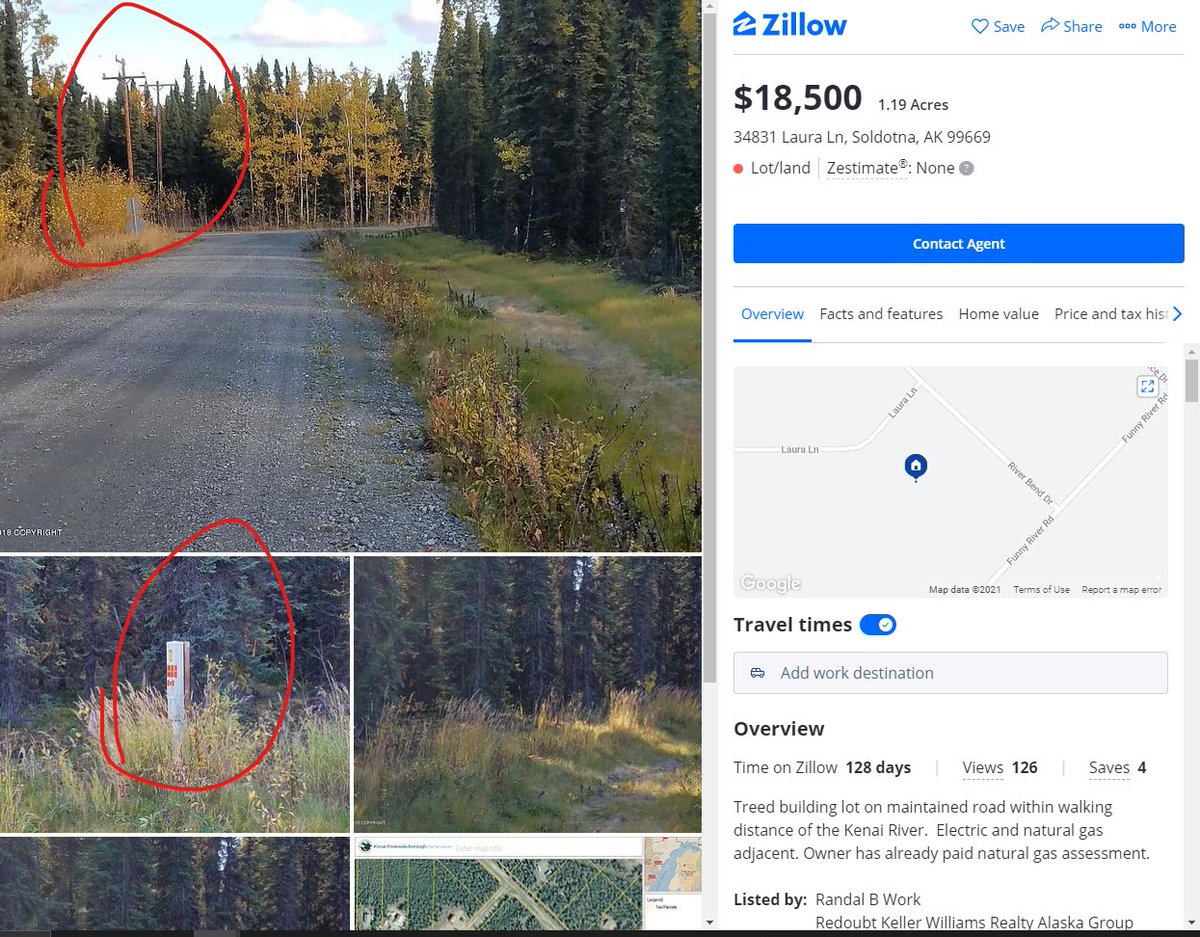
Note: visible power, power/fiber pedestal, utility corridor, nearby commercial enterprise(s), and utility pole shadows visible.
If I did thred on finding/acquiring decent raw land would that be something pepo are interested in
— Ovcharka (@ouroboros_outis) January 18, 2021
I think I know a bunch of weird tips/tricks for selection at this point that it might help u guys, lemme know
This is NOT going to be zillow "here is how to google school districts and find walmart" we are not concerned with this malarkey, we are homeschooling and planting victory gardens and having gigantic happy families.
With that said, for my frog and frog-adjacent bros and sisters:
CHOICE SITES:
Zillow is obvious one, but there are many good sites like Billy Land, Classic Country Land, Landwatch, etc. and many of these specialize in owner financing (more on that later.) Do NOT treat these as authoritative sources - trust plat maps and parcel viewers.
TARGET IDENTIFICATION AND EVALUATION:
Okay, everyone knows how to google "raw land in x state" but there are other resources out there, including state Departments of Natural Resources, foreclosure auctions, etc. Finding the land you like is the easy part. Let's do a case study.
I'm going to target using an "off-grid but not" algorithm. This is a good piece in my book - middle of nowhere but still trekkable to civilization.
Note: visible power, power/fiber pedestal, utility corridor, nearby commercial enterprise(s), and utility pole shadows visible.

Below is a list of awesome courses that dive into all different aspects of visual communication and storytelling.
Visual storytelling is a way for people to communicate their story using visuals and digital media such as video, graphics, and photography.
Visual Storytelling appeals to the emotions of the intended audience and it can humanize the business, giving the target market a way to relate to the business and their story.
1. The Art of Storytelling
2. Visual Thinking: Drawing Data to Communicate Ideas
https://t.co/YPiexr9RYJ
3. Find what fascinates you as you explore these visual storytelling
4. Awesome and affordable online art classes for artists of all skill levels! Take your art to the next level no matter where you are. https://t.co/k7xpp4sR4r
5. Digital Storytelling
6. Visual Storytelling | For Screenwriters & Novelists
https://t.co/FsZ7EFFVzo
7. Learn about storytelling with online courses and
Visual storytelling is a way for people to communicate their story using visuals and digital media such as video, graphics, and photography.
Visual Storytelling appeals to the emotions of the intended audience and it can humanize the business, giving the target market a way to relate to the business and their story.
1. The Art of Storytelling
2. Visual Thinking: Drawing Data to Communicate Ideas
https://t.co/YPiexr9RYJ
3. Find what fascinates you as you explore these visual storytelling
4. Awesome and affordable online art classes for artists of all skill levels! Take your art to the next level no matter where you are. https://t.co/k7xpp4sR4r
5. Digital Storytelling
6. Visual Storytelling | For Screenwriters & Novelists
https://t.co/FsZ7EFFVzo
7. Learn about storytelling with online courses and

When the university starts sending out teaching evaluation reminders, I tell all my classes about bias in teaching evals, with links to the evidence. Here's a version of the email I send, in case anyone else wants to poach from it.
1/16
When I say "anyone": needless to say, the people who are benefitting from the bias (like me) are the ones who should helping to correct it. Men in math, this is your job! Of course, it should also be dealt with at the institutional level, not just ad hoc.
OK, on to my email:
2/16
"You may have received automated reminders about course evals this fall. I encourage you to fill the evals out. I'd be particularly grateful for written feedback about what worked for you in the class, what was difficult, & how you ultimately spent your time for this class.
3/16
However, I don't feel comfortable just sending you an email saying: "please take the time to evaluate me". I do think student evaluations of teachers can be valuable: I have made changes to my teaching style as a direct result of comments from student teaching evaluations.
4/16
But teaching evaluations have a weakness: they are not an unbiased estimator of teaching quality. There is strong evidence that teaching evals tend to favour men over women, and that teaching evals tend to favour white instructors over non-white instructors.
5/16
1/16
When a teaching award is based solely on teaching evals and then only men get it. pic.twitter.com/szIBkCvTe9
— Dr. Marissa Kawehi (@MarissaKawehi) February 12, 2021
When I say "anyone": needless to say, the people who are benefitting from the bias (like me) are the ones who should helping to correct it. Men in math, this is your job! Of course, it should also be dealt with at the institutional level, not just ad hoc.
OK, on to my email:
2/16
"You may have received automated reminders about course evals this fall. I encourage you to fill the evals out. I'd be particularly grateful for written feedback about what worked for you in the class, what was difficult, & how you ultimately spent your time for this class.
3/16
However, I don't feel comfortable just sending you an email saying: "please take the time to evaluate me". I do think student evaluations of teachers can be valuable: I have made changes to my teaching style as a direct result of comments from student teaching evaluations.
4/16
But teaching evaluations have a weakness: they are not an unbiased estimator of teaching quality. There is strong evidence that teaching evals tend to favour men over women, and that teaching evals tend to favour white instructors over non-white instructors.
5/16