Today, barely 700,000 of the 3.8 million people live in those four cities.
1) Since 1970, the United States has increased its population by 64%.
Northeast Ohio, a 12-county region with more people than Connecticut, has lost 7% of its population over this same time period, shrinking from 4.1 million to 3.8 million people.
Today, barely 700,000 of the 3.8 million people live in those four cities.
Today, median household income in metro D.C. is 82% higher than in metro Cleveland.
If you look at this great analysis by @InnovateEconomy you will see that Ohio is one of the worst-performing states in terms of expanding poverty.
https://t.co/ZGoK2qqN1W
In 2008, Barack Obama won the 12-county Northeast Ohio region by nearly 400,000 votes.
In 2020, Joe Biden won this heavily-Democratic region by only 92,000 votes.
And I live here in urban Ohio. I've lived here for almost 5 decades. I can see what all of this looks like here on the ground.
It doesn't look pretty.
More from Economy





In this paper, we study vote choices of voters who are left-wing on economic issues and authoritarian/nationalist on cultural issues, especially immigration. For these voters, there is no often party combining positions in this way.
In the data from the Campaign Panel of the German Election Study 2017, many voters prefer higher social benefits and taxes and want to restrict immigration. @ches_data show that no party bundles issue positions in this way.
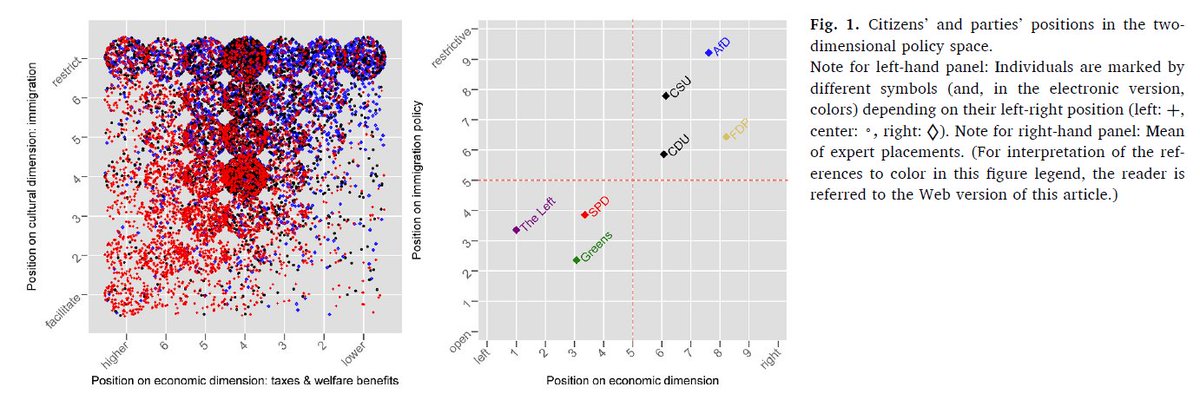
In the article, we show that many such “left-authoritarians” perceive the party they voted for to also hold a left-authoritarian position. Interestingly, this includes many AfD voters who report a perceived left-wing economic position of the party.
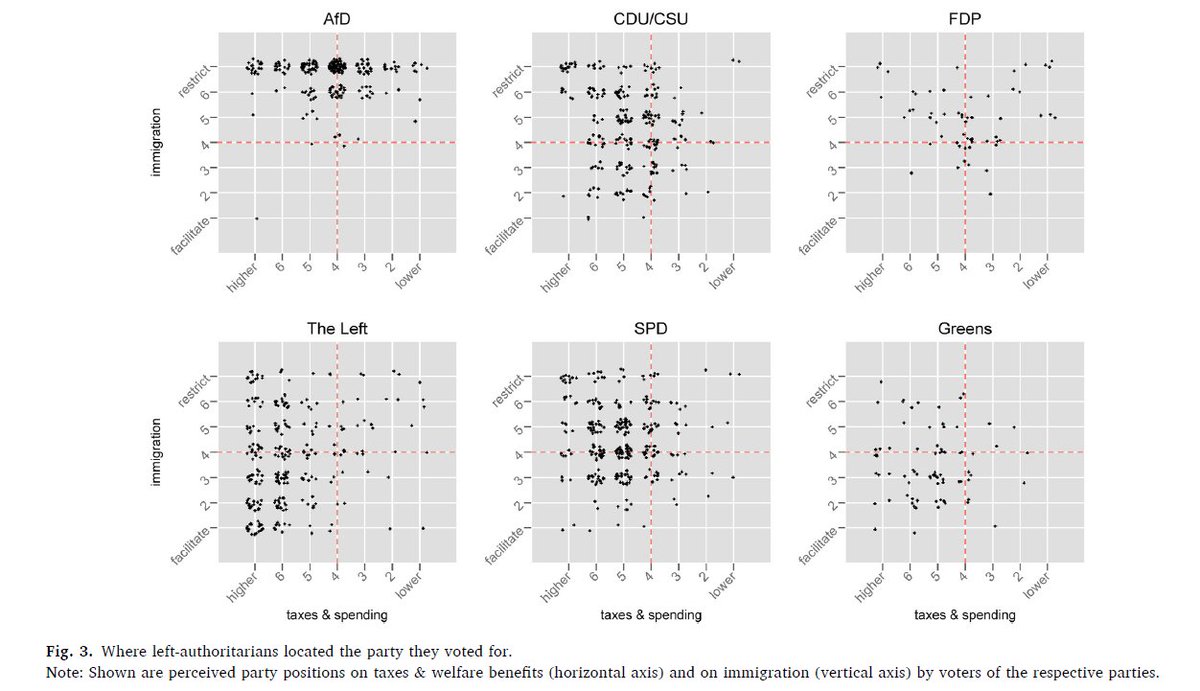
Our statistical models study the interplay between this (mis-)perceived congruence and issue importance, using an open-ended question on the most important political problem in Germany.
We find that (mis-)perceived congruence and issue importance interactively shape the left-authoritarian vote. Simply, perceived congruence matters more on an important issue—and issue salience matters most if voters accurately perceive incongruent party supply.
Vol 70 Apr | '#Vote choices of left-#authoritarians: Misperceived congruence and issue #salience' by @NilsSteiner and Sven Hillen is now available @ches_data @german_gles #Germany https://t.co/pmCoP5t7CL pic.twitter.com/Vl8rCahcZL
— Electoral Studies (@ElectoralStdies) January 30, 2021
In the data from the Campaign Panel of the German Election Study 2017, many voters prefer higher social benefits and taxes and want to restrict immigration. @ches_data show that no party bundles issue positions in this way.
In the article, we show that many such “left-authoritarians” perceive the party they voted for to also hold a left-authoritarian position. Interestingly, this includes many AfD voters who report a perceived left-wing economic position of the party.
Our statistical models study the interplay between this (mis-)perceived congruence and issue importance, using an open-ended question on the most important political problem in Germany.
We find that (mis-)perceived congruence and issue importance interactively shape the left-authoritarian vote. Simply, perceived congruence matters more on an important issue—and issue salience matters most if voters accurately perceive incongruent party supply.

You May Also Like

First thread of the year because I have time during MCO. As requested, a thread on the gods and spirits of Malay folk religion. Some are indigenous, some are of Indian origin, some have Islamic
Before I begin, it might be worth explaining the Malay conception of the spirit world. At its deepest level, Malay religious belief is animist. All living beings and even certain objects are said to have a soul. Natural phenomena are either controlled by or personified as spirits
Although these beings had to be respected, not all of them were powerful enough to be considered gods. Offerings would be made to the spirits that had greater influence on human life. Spells and incantations would invoke their
Two known examples of such elemental spirits that had god-like status are Raja Angin (king of the wind) and Mambang Tali Arus (spirit of river currents). There were undoubtedly many more which have been lost to time
Contact with ancient India brought the influence of Hinduism and Buddhism to SEA. What we now call Hinduism similarly developed in India out of native animism and the more formal Vedic tradition. This can be seen in the multitude of sacred animals and location-specific Hindu gods
i wonder if you can make a thread bout witchcraft in malaysia.. or list of our own local gods/deites..
— r a y a \U0001f319 (@lcvelylilith) February 20, 2020
Before I begin, it might be worth explaining the Malay conception of the spirit world. At its deepest level, Malay religious belief is animist. All living beings and even certain objects are said to have a soul. Natural phenomena are either controlled by or personified as spirits
Although these beings had to be respected, not all of them were powerful enough to be considered gods. Offerings would be made to the spirits that had greater influence on human life. Spells and incantations would invoke their
Animist ceremonies of a religious or magical nature were normally held for the purpose of divination or making a request. This would either be done at a keramat or at a shrine similar to the Thai spirit houses or Chinese roadside shrines pic.twitter.com/I1hliyi0x3
— \u2745\u1710\u170b\u1713\u170e (@uglyluhan) June 16, 2019
Two known examples of such elemental spirits that had god-like status are Raja Angin (king of the wind) and Mambang Tali Arus (spirit of river currents). There were undoubtedly many more which have been lost to time
Contact with ancient India brought the influence of Hinduism and Buddhism to SEA. What we now call Hinduism similarly developed in India out of native animism and the more formal Vedic tradition. This can be seen in the multitude of sacred animals and location-specific Hindu gods


A brief analysis and comparison of the CSS for Twitter's PWA vs Twitter's legacy desktop website. The difference is dramatic and I'll touch on some reasons why.
Legacy site *downloads* ~630 KB CSS per theme and writing direction.
6,769 rules
9,252 selectors
16.7k declarations
3,370 unique declarations
44 media queries
36 unique colors
50 unique background colors
46 unique font sizes
39 unique z-indices
https://t.co/qyl4Bt1i5x

PWA *incrementally generates* ~30 KB CSS that handles all themes and writing directions.
735 rules
740 selectors
757 declarations
730 unique declarations
0 media queries
11 unique colors
32 unique background colors
15 unique font sizes
7 unique z-indices
https://t.co/w7oNG5KUkJ

The legacy site's CSS is what happens when hundreds of people directly write CSS over many years. Specificity wars, redundancy, a house of cards that can't be fixed. The result is extremely inefficient and error-prone styling that punishes users and developers.
The PWA's CSS is generated on-demand by a JS framework that manages styles and outputs "atomic CSS". The framework can enforce strict constraints and perform optimisations, which is why the CSS is so much smaller and safer. Style conflicts and unbounded CSS growth are avoided.
Legacy site *downloads* ~630 KB CSS per theme and writing direction.
6,769 rules
9,252 selectors
16.7k declarations
3,370 unique declarations
44 media queries
36 unique colors
50 unique background colors
46 unique font sizes
39 unique z-indices
https://t.co/qyl4Bt1i5x
PWA *incrementally generates* ~30 KB CSS that handles all themes and writing directions.
735 rules
740 selectors
757 declarations
730 unique declarations
0 media queries
11 unique colors
32 unique background colors
15 unique font sizes
7 unique z-indices
https://t.co/w7oNG5KUkJ
The legacy site's CSS is what happens when hundreds of people directly write CSS over many years. Specificity wars, redundancy, a house of cards that can't be fixed. The result is extremely inefficient and error-prone styling that punishes users and developers.
The PWA's CSS is generated on-demand by a JS framework that manages styles and outputs "atomic CSS". The framework can enforce strict constraints and perform optimisations, which is why the CSS is so much smaller and safer. Style conflicts and unbounded CSS growth are avoided.