
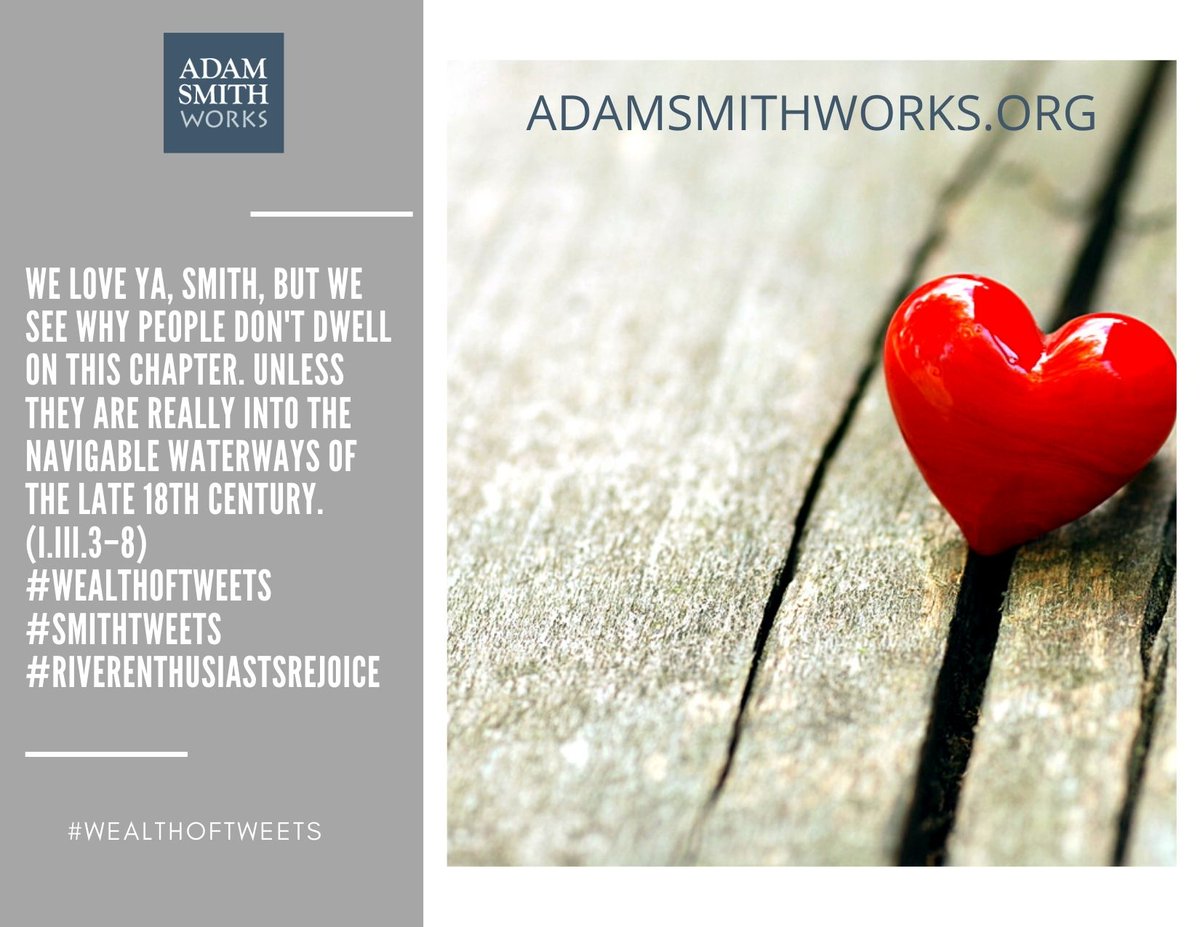
Today we come to the topic @EconTalker has called one of the more underemphasized lessons from #AdamSmith: That the Division of Labor is limited by the Extent of the Market. a.k.a Book 1 Chapter 3. #WealthOfTweets #SmithTweets

More from @AdamSmithWorks
OK. Chapter 7 of Book 4 of #WealthOfNations is tough going. It's long. It's serious. It's all about colonies.
We can take comfort, though, in knowing that the chapter #AdamSmith says is about colonies is, in fact, about colonies. (IV.vii) #WealthOfTweets #SmithTweets

Colonies were a vexed subject when #AdamSmith was writing, and they’re even more complicated now. So, before we even get to the tweeting, here’s a link to that thread on Smith and “savage nations.” (IV.vii) #WealthOfTweets
The reason for the ancient Greeks and Romans to settle colonies was straightforward: they didn’t have enough space for their growing populations. Their colonies were treated as “emancipated children”—connected but independent. (IV.vii.a.2) #WealthOfTweets #SmithTweets
(Both these things are in contrast to the European colonies, as we'll see.) (IV.vii.a.2) #WealthOfTweets #SmithTweets
Ancient Greeks and Romans needed more space because the land was owned by an increasingly small number of citizens and farming and nearly all trades and arts were performed by slaves. It was hard for a poor freeman to improve his life. (IV.vii.a.3) #WealthOfTweets #SmithTweets
We can take comfort, though, in knowing that the chapter #AdamSmith says is about colonies is, in fact, about colonies. (IV.vii) #WealthOfTweets #SmithTweets
Colonies were a vexed subject when #AdamSmith was writing, and they’re even more complicated now. So, before we even get to the tweeting, here’s a link to that thread on Smith and “savage nations.” (IV.vii) #WealthOfTweets
We have to pause now, because we have to have a whole new tweet thread on #AdamSmith and \u201csavage nations,\u201d because he\u2019s going to keep using this kind of phrase, so we need to talk about it. #WealthOfTweets #SmithTweets
— @AdamSmithWorks (@adamsmithworks) January 4, 2021
The reason for the ancient Greeks and Romans to settle colonies was straightforward: they didn’t have enough space for their growing populations. Their colonies were treated as “emancipated children”—connected but independent. (IV.vii.a.2) #WealthOfTweets #SmithTweets
(Both these things are in contrast to the European colonies, as we'll see.) (IV.vii.a.2) #WealthOfTweets #SmithTweets
Ancient Greeks and Romans needed more space because the land was owned by an increasingly small number of citizens and farming and nearly all trades and arts were performed by slaves. It was hard for a poor freeman to improve his life. (IV.vii.a.3) #WealthOfTweets #SmithTweets


More from Culture







You May Also Like




"I really want to break into Product Management"
make products.
"If only someone would tell me how I can get a startup to notice me."
Make Products.
"I guess it's impossible and I'll never break into the industry."
MAKE PRODUCTS.
Courtesy of @edbrisson's wonderful thread on breaking into comics – https://t.co/TgNblNSCBj – here is why the same applies to Product Management, too.
There is no better way of learning the craft of product, or proving your potential to employers, than just doing it.
You do not need anybody's permission. We don't have diplomas, nor doctorates. We can barely agree on a single standard of what a Product Manager is supposed to do.
But – there is at least one blindingly obvious industry consensus – a Product Manager makes Products.
And they don't need to be kept at the exact right temperature, given endless resource, or carefully protected in order to do this.
They find their own way.
make products.
"If only someone would tell me how I can get a startup to notice me."
Make Products.
"I guess it's impossible and I'll never break into the industry."
MAKE PRODUCTS.
Courtesy of @edbrisson's wonderful thread on breaking into comics – https://t.co/TgNblNSCBj – here is why the same applies to Product Management, too.
"I really want to break into comics"
— Ed Brisson (@edbrisson) December 4, 2018
make comics.
"If only someone would tell me how I can get an editor to notice me."
Make Comics.
"I guess it's impossible and I'll never break into the industry."
MAKE COMICS.
There is no better way of learning the craft of product, or proving your potential to employers, than just doing it.
You do not need anybody's permission. We don't have diplomas, nor doctorates. We can barely agree on a single standard of what a Product Manager is supposed to do.
But – there is at least one blindingly obvious industry consensus – a Product Manager makes Products.
And they don't need to be kept at the exact right temperature, given endless resource, or carefully protected in order to do this.
They find their own way.
