
Remember that volunteering or internship roles also count when you are writing your SOP.
WRITING A WINNING STATEMENT OF PURPOSE (SOP)
PART A
This VERY long thread will break down the process of writing an SOP using six questions that have worked for me in the several admissions and scholarships I have secured.
Get a drink and let us begin.
Remember that volunteering or internship roles also count when you are writing your SOP.
It is also very significant that you allow others (mentors, friends, professionals) to review your essays.
You can also use editing software or websites to assess your writing.
You will need to state clearly from the outset your academic qualification. Also, highlight your class of degree with any awards or recognition you received while undertaking your studies.
Also clearly state the outcome of your thesis. Were you able to publish it? Highlight this clearly.
Examples of skills you could have developed are research skills, facilitation skills, budgeting skills, critical thinking skills, use of statistical software etc.
For example, if you are writing an SOP for a master’s degree admission, state why you studied the course you did for your first degree.
Was it as a result of an incident that happened in your life? Tell the story emotively & critically.
Similarly, if you are applying for a PhD, highlight why you studied the course you did for your master’s degree. In doing this, you show the connection between 1 and 2.
It is important to demonstrate some level of experience in your field. In saying this, highlight the most relatable places you have worked, interned or volunteered.
This applies to both https://t.co/R9r5xUPrtS and PhD prospective applicants. While working in those positions, what skills did you develop?
This is an important component of the SOP. In this section, you will need to show that you are looking to address a gap or improve your knowledge in your field.
While you might have gained skills and competencies from your academic and professional journey (as highlighted in 1, 2 and 3)...,
Show that you have numerous skills, but you desire to learn more.
This is also a good place to strategically mention your limitation.
TO BE CONTD IN PART B.
cc: @Oludeewon @arawu_samuel @MICHAELSEGZY @ritapurity @olumuyiwaayo @Ijesha_canadian @dr_olubamiji @Okpala_IU @drhammed @particular6 @MichAdebayo
#AAPTalks
More from Culture





One of the authors of the Policy Exchange report on academic free speech thinks it is "ridiculous" to expect him to accurately portray an incident at Cardiff University in his study, both in the reporting and in a question put to a student sample.
Here is the incident Kaufmann incorporated into his study, as told by a Cardiff professor who was there. As you can see, the incident involved the university intervening to *uphold* free speech principles:
Here is the first mention of the Greer at Cardiff incident in Kaufmann's report. It refers to the "concrete case" of the "no-platforming of Germaine Greer". Any reasonable reader would assume that refers to an incident of no-platforming instead of its opposite.

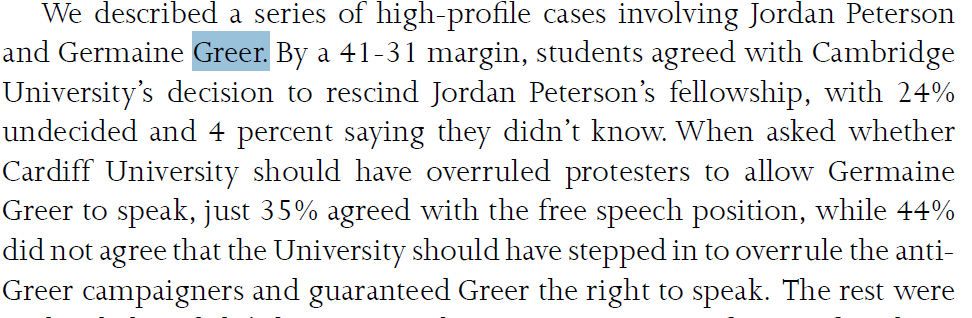
Here is the next mention of Greer in the report. The text asks whether the University "should have overruled protestors" and "stepped in...and guaranteed Greer the right to speak". Again the strong implication is that this did not happen and Greer was "no platformed".
The authors could easily have added a footnote at this point explaining what actually happened in Cardiff. They did not.
This is ridiculous. Students were asked for their views on this example and several others. The study findings and conclusions were about student responses not the substance of each case. Could\u2019ve used hypotheticals. The responses not the cases were the basis of the conclusions.
— Eric Kaufmann (@epkaufm) February 17, 2021
Here is the incident Kaufmann incorporated into his study, as told by a Cardiff professor who was there. As you can see, the incident involved the university intervening to *uphold* free speech principles:
The UK govt\u2019s paper on free speech in Unis (with implications for Wales) is getting a lot of attention.
— Richard Wyn Jones (@RWynJones) February 16, 2021
Worth noting then that an important part of the evidence-base on which it rests relates to (demonstrably false) claims about my own institution
1/https://t.co/buoGE7ocG7
Here is the first mention of the Greer at Cardiff incident in Kaufmann's report. It refers to the "concrete case" of the "no-platforming of Germaine Greer". Any reasonable reader would assume that refers to an incident of no-platforming instead of its opposite.
Here is the next mention of Greer in the report. The text asks whether the University "should have overruled protestors" and "stepped in...and guaranteed Greer the right to speak". Again the strong implication is that this did not happen and Greer was "no platformed".
The authors could easily have added a footnote at this point explaining what actually happened in Cardiff. They did not.
You May Also Like


1/ Some initial thoughts on personal moats:
Like company moats, your personal moat should be a competitive advantage that is not only durable—it should also compound over time.
Characteristics of a personal moat below:
2/ Like a company moat, you want to build career capital while you sleep.
As Andrew Chen noted:
3/ You don’t want to build a competitive advantage that is fleeting or that will get commoditized
Things that might get commoditized over time (some longer than
4/ Before the arrival of recorded music, what used to be scarce was the actual music itself — required an in-person artist.
After recorded music, the music itself became abundant and what became scarce was curation, distribution, and self space.
5/ Similarly, in careers, what used to be (more) scarce were things like ideas, money, and exclusive relationships.
In the internet economy, what has become scarce are things like specific knowledge, rare & valuable skills, and great reputations.
Like company moats, your personal moat should be a competitive advantage that is not only durable—it should also compound over time.
Characteristics of a personal moat below:
I'm increasingly interested in the idea of "personal moats" in the context of careers.
— Erik Torenberg (@eriktorenberg) November 22, 2018
Moats should be:
- Hard to learn and hard to do (but perhaps easier for you)
- Skills that are rare and valuable
- Legible
- Compounding over time
- Unique to your own talents & interests https://t.co/bB3k1YcH5b
2/ Like a company moat, you want to build career capital while you sleep.
As Andrew Chen noted:
People talk about \u201cpassive income\u201d a lot but not about \u201cpassive social capital\u201d or \u201cpassive networking\u201d or \u201cpassive knowledge gaining\u201d but that\u2019s what you can architect if you have a thing and it grows over time without intensive constant effort to sustain it
— Andrew Chen (@andrewchen) November 22, 2018
3/ You don’t want to build a competitive advantage that is fleeting or that will get commoditized
Things that might get commoditized over time (some longer than
Things that look like moats but likely aren\u2019t or may fade:
— Erik Torenberg (@eriktorenberg) November 22, 2018
- Proprietary networks
- Being something other than one of the best at any tournament style-game
- Many "awards"
- Twitter followers or general reach without "respect"
- Anything that depends on information asymmetry https://t.co/abjxesVIh9
4/ Before the arrival of recorded music, what used to be scarce was the actual music itself — required an in-person artist.
After recorded music, the music itself became abundant and what became scarce was curation, distribution, and self space.
5/ Similarly, in careers, what used to be (more) scarce were things like ideas, money, and exclusive relationships.
In the internet economy, what has become scarce are things like specific knowledge, rare & valuable skills, and great reputations.


