Today in pulp I look at the scandalous history of lady jeans!

Well there's a turn-up...

The denim jean and its predecessor the dungaree have a long history, and were traditionally seen as work wear for men.

But WWII changed all that...
As women headed for the factories and shipyards they found that a sturdy denim bib-n-brace, paired with a stout headscarf, was the way to go!
Coarse heavy 'jeens' were fine for riveting work, but 1940s women didn't take a shine to them as leisure wear. For one thing they were voluminous and shapeless.
Jeans were also seen as clothing for children. No adult wanted to be seen wearing kid's dungarees in public.

Or did they?
After WWII ended women's fashion initially reverted to type: mid-length in the skirt, long in the arm and with something fetching around the neck.

But one group of gals wasn't having any of it...
Bobby Soxers were teenage fans of pre-Rock 'n' Roll pop music - especially Frank Sinatra. They were also gang girls with a rigid look: ankle socks, sweaters, big shirts and rolled up blue jeans!
Soxers were the first proto-teens: cliquey, raucous and determined to stand out. Soon they would be joined by many others.
The moral panic over Rock 'n' Roll in the 1950s wasn't just about hot rods and rumbles - it also swept up the disquiet about independent teen girls that had been building since the Bobby Soxers.
And nothing said 'trouble' louder than a young girl in blue jeans and a yellow sweater. Soon the look became a shorthand for teen delinquency!
The 'dungaree set' were the girls you didn't let your daughter hang out with: they smoked, they drank, they ran with gangs, they made out with boys - a lot!

"Something must be done!" came the cry...
And jeans manufacturers cried it the loudest! Denim production had risen during the war and now they were looking for new markets to exploit. Could they make 'lady jeans' into a mainstay of a traditional woman's wardrobe?
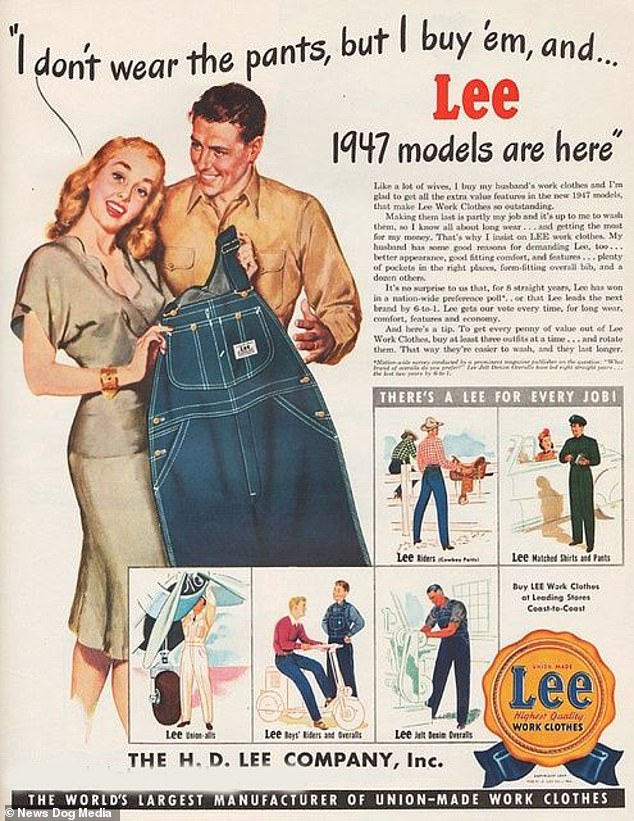
Starting in the mid-1950s manufacturers such as Lee, Levi and Wrangler began aggressively marketing 'western' jeans to women: playing up their cowboy heritage and playing down their hoodlum reputation.
All the tricks of marketing were used: they were renamed Ranch Pants...
...they were tailored to have a flattering silhouette...
...and they were heavily linked to wholesome living! The blue jean was changed from a symbol of rebellion to a statement of modern leisure and domesticity.
The popularity of jeans has waxed and waned over the years, but one thing is certain: they're no longer factory wear.

Ladies in Levi's - Twitter salutes you, however you choose to wear them!

More from Pulp Librarian

More from Culture

@bellingcat's attempt in their new book, published by
@BloomsburyBooks, to coverup the @OPCW #Douma controversy, promote US and UK gov. war narratives, and whitewash fraudulent conduct within the OPCW, is an exercise in deception through omission. @BloomsburyPub @Tim_Hayward_


1) 2000 words are devoted to the OPCW controversy regarding the alleged chemical weapon attack in #Douma, Syria in 2018 but critical material is omitted from the book. Reading it, one would never know the following:

2) That the controversy started when the original interim report, drafted and agreed by Douma inspection team members, was secretly modified by an unknown OPCW person who had manipulated the findings to suggest an attack had occurred. https://t.co/QtAAyH9WyX… @RobertF40396660


3) This act of attempted deception was only derailed because an inspector discovered the secret changes. The manipulations were reported by @ClarkeMicah
and can be readily observed in documents now available https://t.co/2BUNlD8ZUv….

4) @bellingcat's book also makes no mention of the @couragefoundation panel, attended by the @opcw's first Director General, Jose Bustani, at which an OPCW official detailed key procedural irregularities and scientific flaws with the Final Douma Report:

You May Also Like

I just finished Eric Adler's The Battle of the Classics, and wanted to say something about Joel Christiansen's review linked below. I am not sure what motivates the review (I speculate a bit below), but it gives a very misleading impression of the book. 1/x


The meat of the criticism is that the history Adler gives is insufficiently critical. Adler describes a few figures who had a great influence on how the modern US university was formed. It's certainly critical: it focuses on the social Darwinism of these figures. 2/x

Other insinuations and suggestions in the review seem wildly off the mark, distorted, or inappropriate-- for example, that the book is clickbaity (it is scholarly) or conservative (hardly) or connected to the events at the Capitol (give me a break). 3/x

The core question: in what sense is classics inherently racist? Classics is old. On Adler's account, it begins in ancient Rome and is revived in the Renaissance. Slavery (Christiansen's primary concern) is also very old. Let's say classics is an education for slaveowners. 4/x

It's worth remembering that literacy itself is elite throughout most of this history. Literacy is, then, also the education of slaveowners. We can honor oral and musical traditions without denying that literacy is, generally, good. 5/x
This is NONSENSE. The people who take photos with their books on instagram are known to be voracious readers who graciously take time to review books and recommend them to their followers. Part of their medium is to take elaborate, beautiful photos of books. Die mad, Guardian.


THEY DO READ THEM, YOU JUDGY, RACOON-PICKED TRASH BIN


If you come for Bookstagram, i will fight you.

In appreciation, here are some of my favourite bookstagrams of my books: (photos by lit_nerd37, mybookacademy, bookswrotemystory, and scorpio_books)