You might see an 'essay' going around today about 'the value of knowledge'. I'm not linking it, but I've taken out a few paragraphs that need to be reckoned with. 1/?
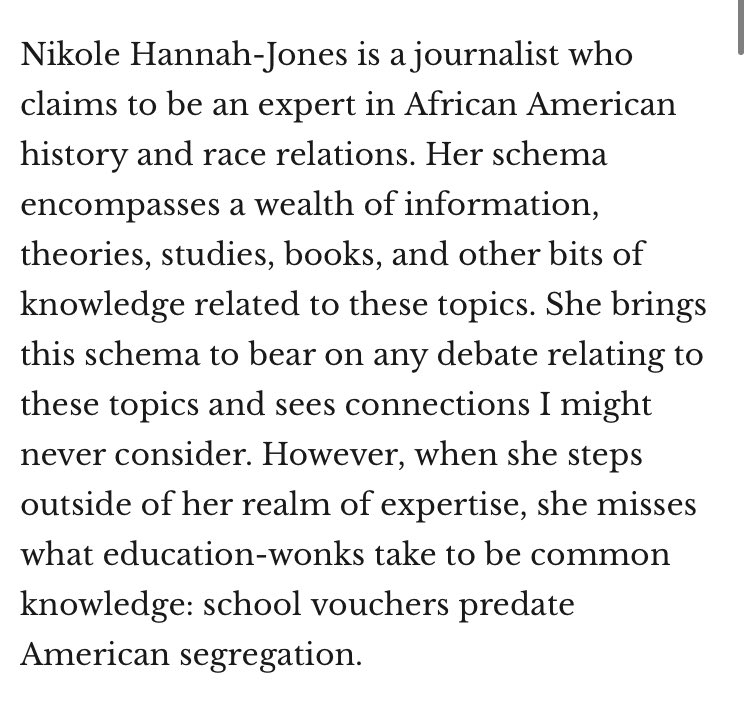
From the very first sentence, this person attacks Nikole Hannah Jones and the #1619Project in a typically conservative fashion, no doubt to get the conservative heads to go 'hear, hear!!'. He then says she 'claims' her expertise & essentially says to her 'stay in your lane'. 2/x
Ridiculous assertion aside, Considering this author is someone that routinely criticizes his education program for doing things like setting tasks of making 'BLM bracelets', but then heralds it in his bio, one must wonder how he reckons w/his own lack of expertise. 3/x
He then criticizes Gloria Ladson Billings, another Black woman for pointing out something that is literally true (have you not seen curricula that tell teachers to enact the slave trade? Or that propagate the thanksgiving myth?) 4/x
but does nothing to reckon with the the history of this country, the (failure) to teach Black children, the changes that DO need to be made in curriculum to ensure both rigor and windows and mirrors. 5/x
Next, he also criticizes Ibram Kendi, and look I'll be honest I've got some qualms with the ideas myself. However the idea of which knowledge we choose to center, whose knowledge we uphold as the standard stick IS a relevant question & not something to be sidelined 6/x
I wrestle with this question every day of my life as a Black woman and teacher of Black children from whom too many opportunities have been withheld, and reconcile what they need to understand about how the systems of the US works but also what it means to envision freedom 7/x
But, of course, this author teaches in a private school so those issues of 'white supremacy' don't really matter in that context right?

Also- WTAF do you mean about curriculum that is devoid of meaningful content? 8/x
Are you actually implying that a diverse and rigorous curriculum that allows children to both understand how they fit into the larger world AND teaches them about the larger is... wrong? Read Sims Bishop and get back to me. 9/x
Later in this essay he uncritically embraces ED Hirsch. the ideas of knowledge centered curriculum are what I agree with, but if you read 'Why Knowledge Matters' you see that even Hirsch himself said you don't have to use Core Knoweldge™️, but just make your own sequence 10/x
SO IF YOU MAKE YOUR OWN CORE KNOWLEDGE SEQUENCE YOU WILL AUTOMATICALLY Be DECIDING WHICH KNOWLEDGE TO CENTER AND YOU WILL WANT TO MAKE SURE IT IS ACCURATE AND REPRESENTATIVE OF DIVERSE PERSPECTIVES AND OPINIONS. TIME. SPACE. GENDER. RACE. COUNTRY OF ORIGIN 11/x
There are too many people talking and yapping their mouths off with half truths and understandings, ahistorical knowing, and theories that show how little they actually know or have thought or read about these issues that plague our system. 12/x
YALL. DONT. READ. 13/x
Finally, while in no way am I a 'progressive' educator—I've always been on about my issues w/YA lit in the study of English, I'm pro-systematic/explicit phonics etc— but make no mistake: I am not, and refuse to be put, in the same camp with the likes of this absolute shit. 13/end
Post Tweet: the essay is anti-intellectual bullshit that sees nothing except it's own narrow lens, and, despite being quite long, shows a lack of grappling deeply with the issues at hand.
For anyone wondering: 'absolute shit' didn't refer to the author as a person. Just the ideas.

More from Culture

I just finished Eric Adler's The Battle of the Classics, and wanted to say something about Joel Christiansen's review linked below. I am not sure what motivates the review (I speculate a bit below), but it gives a very misleading impression of the book. 1/x


The meat of the criticism is that the history Adler gives is insufficiently critical. Adler describes a few figures who had a great influence on how the modern US university was formed. It's certainly critical: it focuses on the social Darwinism of these figures. 2/x

Other insinuations and suggestions in the review seem wildly off the mark, distorted, or inappropriate-- for example, that the book is clickbaity (it is scholarly) or conservative (hardly) or connected to the events at the Capitol (give me a break). 3/x

The core question: in what sense is classics inherently racist? Classics is old. On Adler's account, it begins in ancient Rome and is revived in the Renaissance. Slavery (Christiansen's primary concern) is also very old. Let's say classics is an education for slaveowners. 4/x

It's worth remembering that literacy itself is elite throughout most of this history. Literacy is, then, also the education of slaveowners. We can honor oral and musical traditions without denying that literacy is, generally, good. 5/x
OK. Chapter 7 of Book 4 of #WealthOfNations is tough going. It's long. It's serious. It's all about colonies.

We can take comfort, though, in knowing that the chapter #AdamSmith says is about colonies is, in fact, about colonies. (IV.vii) #WealthOfTweets #SmithTweets


Colonies were a vexed subject when #AdamSmith was writing, and they’re even more complicated now. So, before we even get to the tweeting, here’s a link to that thread on Smith and “savage nations.” (IV.vii) #WealthOfTweets


The reason for the ancient Greeks and Romans to settle colonies was straightforward: they didn’t have enough space for their growing populations. Their colonies were treated as “emancipated children”—connected but independent. (IV.vii.a.2) #WealthOfTweets #SmithTweets

(Both these things are in contrast to the European colonies, as we'll see.) (IV.vii.a.2) #WealthOfTweets #SmithTweets

Ancient Greeks and Romans needed more space because the land was owned by an increasingly small number of citizens and farming and nearly all trades and arts were performed by slaves. It was hard for a poor freeman to improve his life. (IV.vii.a.3) #WealthOfTweets #SmithTweets

You May Also Like

IMPORTANCE, ADVANTAGES AND CHARACTERISTICS OF BHAGWAT PURAN

It was Ved Vyas who edited the eighteen thousand shlokas of Bhagwat. This book destroys all your sins. It has twelve parts which are like kalpvraksh.

In the first skandh, the importance of Vedvyas


and characters of Pandavas are described by the dialogues between Suutji and Shaunakji. Then there is the story of Parikshit.
Next there is a Brahm Narad dialogue describing the avtaar of Bhagwan. Then the characteristics of Puraan are mentioned.

It also discusses the evolution of universe.(
https://t.co/2aK1AZSC79 )

Next is the portrayal of Vidur and his dialogue with Maitreyji. Then there is a mention of Creation of universe by Brahma and the preachings of Sankhya by Kapil Muni.


In the next section we find the portrayal of Sati, Dhruv, Pruthu, and the story of ancient King, Bahirshi.
In the next section we find the character of King Priyavrat and his sons, different types of loks in this universe, and description of Narak. ( https://t.co/gmDTkLktKS )


In the sixth part we find the portrayal of Ajaamil ( https://t.co/LdVSSNspa2 ), Daksh and the birth of Marudgans( https://t.co/tecNidVckj )

In the seventh section we find the story of Prahlad and the description of Varnashram dharma. This section is based on karma vaasna.