Transparency and full public participation is needed for sound policy making on complex topics like this. However, with a shortened 15d window (holiday included) vs standard 60d, we are not getting a genuine opportunity to participate.
On Dec 18th, FinCEN announced a proposed rule that will require collection of personal information for transactions of >$3,000 sent to self-hosted wallets.
https://t.co/h1GT64oOqo
We are very concerned about this proposal @OKCoin.
Key takeaways below:
Transparency and full public participation is needed for sound policy making on complex topics like this. However, with a shortened 15d window (holiday included) vs standard 60d, we are not getting a genuine opportunity to participate.
No evidence indicates that illicit crypto activity has risen disproportionally to threaten national security that warrants such a rush.
This is revolutionary in human history and will greatly promote financial inclusion and freedom. It would also lead to innovations and paradigm shifts that we cannot imagine today.
It is also very nascent that needs very careful and thoughtful policy-making.
Good guys will have increased burden of compliance, less access to the system, and potential risk of data leakage.
Bad guys can off-ramp in other jurisdictions, which weakens law enforcement.
The former being decentralized in nature (and by design), and therefore does not have a centralized, secure messaging network like SWIFT for Travel Rule compliance by banks.
It would force crypto exchanges to store and hand over customer information automatically, every time, while today law enforcement has to subpoena to get such information
But when we are building a more sovereign financial world where trust is built into code and enabled through smart contracts, people are entitled to their financial privacy when using self-hosted wallets
https://t.co/RDxcWZLWFB
We hope that sound policy-making can finally prevail.
A hallmark feature of digital assets, like #BTC, is the ability to conduct transactions w/out an intermediary. This promotes financial inclusion and freedom. A rule adopted at this juncture would be a solution in search of a problem. More pressing BSA-related issues exist. (7/8)
— Cynthia Lummis (@CynthiaMLummis) December 18, 2020
More from Crypto

A primer on how to use @coingecko for your crypto data/research/trading needs.
Share it with a friend who needs it!
1/ Getting started with crypto and want to check prices/projects? https://t.co/LFnk4vukxj has info on just about every crypto you'll need :)
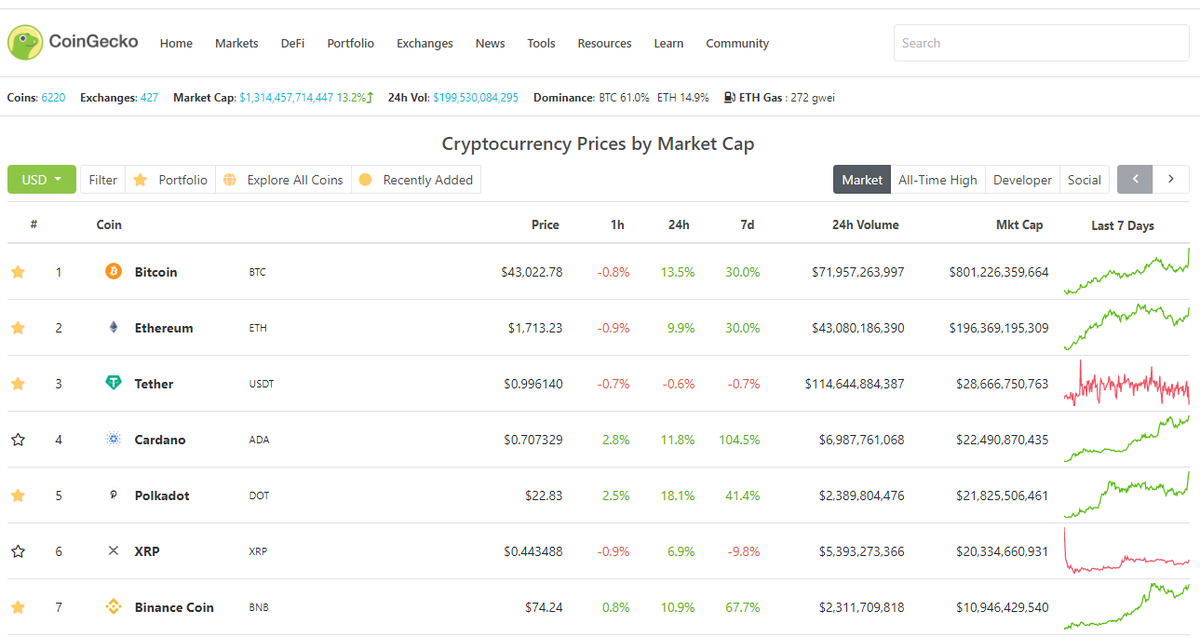
2/ Search over 6000+ cryptocurrencies available on the market. You can see what's trending in the space as well.
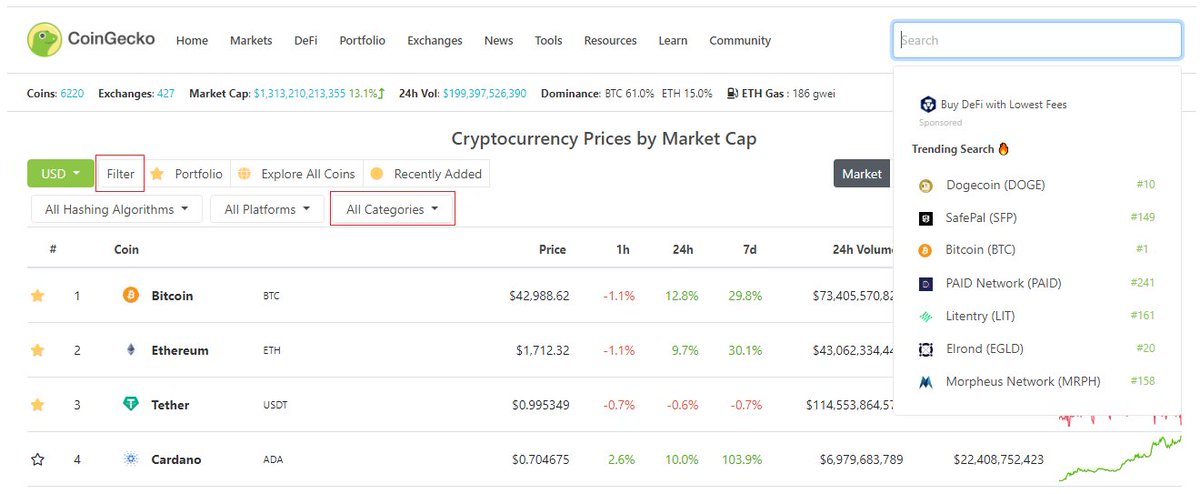
Researching by categories? Filter (left side) -> Select categories -> DeFi, DOT ecosystem, Exchange-based tokens, NFTs - anything!
3/ Lets say you're looking at #Bitcoin https://t.co/g205lj03pG
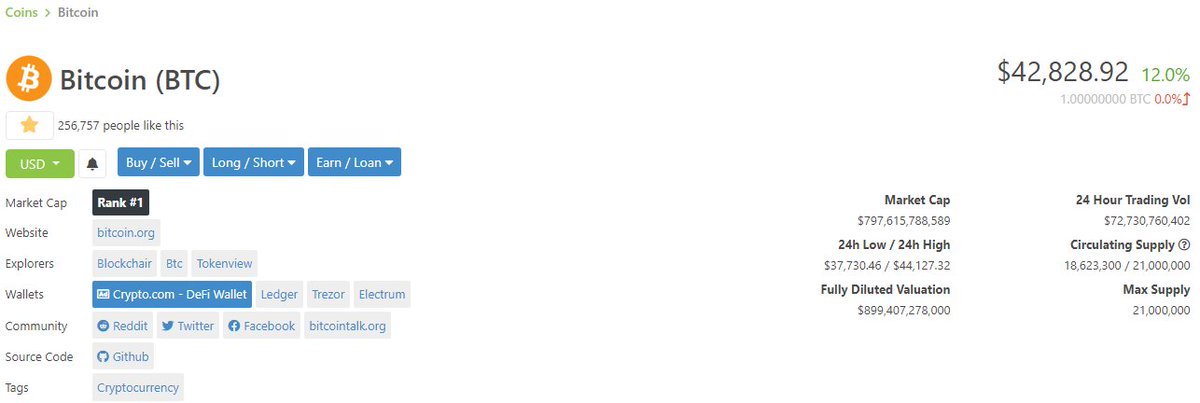
At a glance you get:
- Price
- Mkt Capitalization (valuation)
- Circulating/Total supply
- 24h trading volume
- Links to websites, social media, block explorers
- Calculator
Next - check valuation?
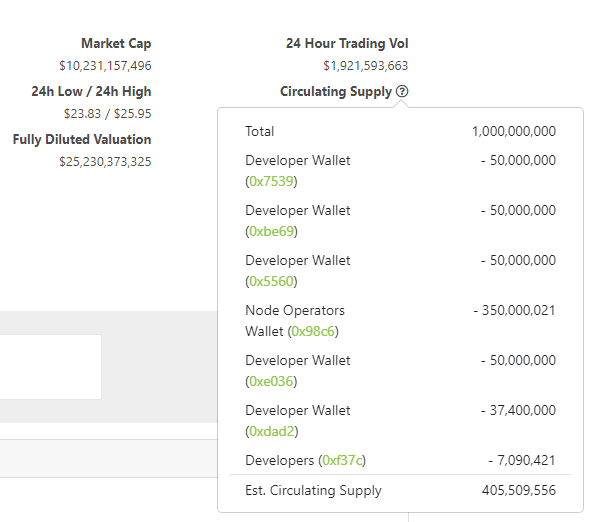
4/ Market cap is used to rank coins, and we'll show you how its calculated - Hover over Circulating Supply (?) for breakdown.
Note: used @chainlink as example here - https://t.co/Jc46fe79Ag
While MC is important also consider product fit, narrative, team, community etc.
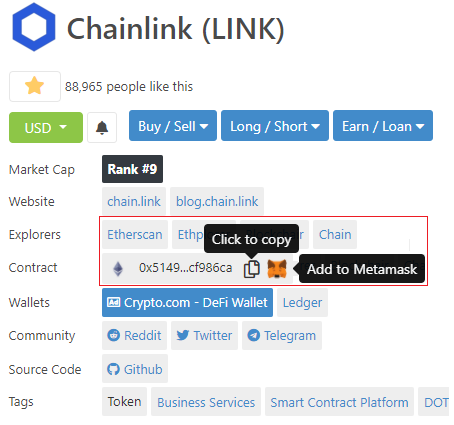
5/ If you're trading on AMMs like @Uniswap or @SushiSwap, you can copy the contract address directly to your clipboard.
Using @metamask_io? Add the token directly so it shows as one of the "Assets" that you own in the wallet.
See: https://t.co/94XihMf5oz
Share it with a friend who needs it!
1/ Getting started with crypto and want to check prices/projects? https://t.co/LFnk4vukxj has info on just about every crypto you'll need :)
2/ Search over 6000+ cryptocurrencies available on the market. You can see what's trending in the space as well.
Researching by categories? Filter (left side) -> Select categories -> DeFi, DOT ecosystem, Exchange-based tokens, NFTs - anything!
3/ Lets say you're looking at #Bitcoin https://t.co/g205lj03pG
At a glance you get:
- Price
- Mkt Capitalization (valuation)
- Circulating/Total supply
- 24h trading volume
- Links to websites, social media, block explorers
- Calculator
Next - check valuation?
4/ Market cap is used to rank coins, and we'll show you how its calculated - Hover over Circulating Supply (?) for breakdown.
Note: used @chainlink as example here - https://t.co/Jc46fe79Ag
While MC is important also consider product fit, narrative, team, community etc.
5/ If you're trading on AMMs like @Uniswap or @SushiSwap, you can copy the contract address directly to your clipboard.
Using @metamask_io? Add the token directly so it shows as one of the "Assets" that you own in the wallet.
See: https://t.co/94XihMf5oz
Introducing an effortless way to add tokens to your @metamask_io wallet \U0001f4e5
— CoinGecko (@coingecko) February 8, 2021
Skip the hassle of copying/pasting contract addresses to your wallet. Add an asset and it'll appear in your wallet with just a click - tap the \U0001f98a and try it out for yourself! pic.twitter.com/u26BA29ubs



1/ [December Bitcoin yield update]
Over the last year and a half, I’ve earned ~1.2BTC with various yield generating services to earn an average of 5% on 30 BTC.
Here’s my journey and how to guide👇
2/ Here are the ways you can earn yield:
Lending (Easiest/most popular)
Yield: 3-6%
- Ledn: https://t.co/4x0YATuQ0v
- BlockFi: https://t.co/90Xtg2cNka
Covered calls (Harder)
Yield: 1-80%
- Deribit: https://t.co/2iQVkXlylP
- LedgerX:
3/ Earning a yield enables you to stack more sats (what I’m doing), or reduce the temptation to sell your coin through earning an income.
The yield you earn comes with RISK!
Below is my current allocation for Dec (will update MoM)
(yellow = changes)
https://t.co/PZwVYs8lFT
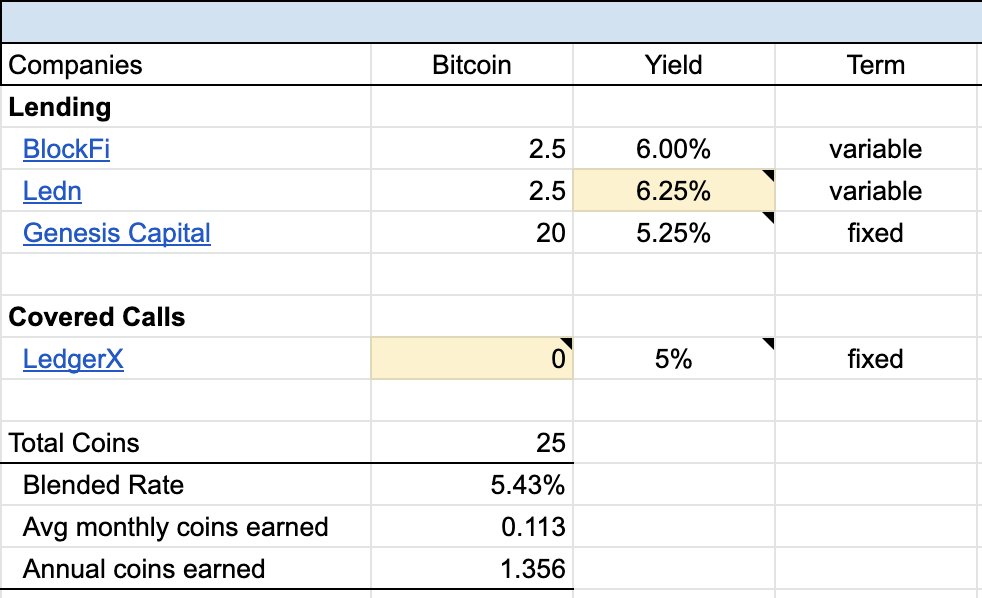
4a/ [Nov > Dec Changelog]
- Covered calls: approx. 4 BTC was in $40k 12/28/20 contracts. Those closed without them being exercised (a good outcome for me). However, I was nervous about my January 1/28 $50k contract so I decided to close out my position at a small loss.
4b/ [Nov > Dec Changelog]
- In process of reallocating the 5 BTC (probably will be a lending platform).
- I incorrectly had my Ledn rate at 6.5%, it's 6.25%
Over the last year and a half, I’ve earned ~1.2BTC with various yield generating services to earn an average of 5% on 30 BTC.
Here’s my journey and how to guide👇
2/ Here are the ways you can earn yield:
Lending (Easiest/most popular)
Yield: 3-6%
- Ledn: https://t.co/4x0YATuQ0v
- BlockFi: https://t.co/90Xtg2cNka
Covered calls (Harder)
Yield: 1-80%
- Deribit: https://t.co/2iQVkXlylP
- LedgerX:
3/ Earning a yield enables you to stack more sats (what I’m doing), or reduce the temptation to sell your coin through earning an income.
The yield you earn comes with RISK!
Below is my current allocation for Dec (will update MoM)
(yellow = changes)
https://t.co/PZwVYs8lFT
4a/ [Nov > Dec Changelog]
- Covered calls: approx. 4 BTC was in $40k 12/28/20 contracts. Those closed without them being exercised (a good outcome for me). However, I was nervous about my January 1/28 $50k contract so I decided to close out my position at a small loss.
4b/ [Nov > Dec Changelog]
- In process of reallocating the 5 BTC (probably will be a lending platform).
- I incorrectly had my Ledn rate at 6.5%, it's 6.25%