A Proof-Of-Work algorithm requires miners to do a certain amount of work that is compute-intensive to gain access to a service or the right to do something. This algorithm, by design, also requires that the work done shall not ...
"Blockchain technology is energy-intensive..." => No, it doesn't have to be.
Let's look at Proof-Of-Stake, an alternative to the energy-intensive Proof-Of-Work algorithm.
🧵🔽
A Proof-Of-Work algorithm requires miners to do a certain amount of work that is compute-intensive to gain access to a service or the right to do something. This algorithm, by design, also requires that the work done shall not ...
https://t.co/VGzmmbMisE
Proof-Of-Work is the name of a cryptographic algorithm that is used for some blockchains when new blocks are to be appended to the chain.
— Oliver Jumpertz (@oliverjumpertz) April 3, 2021
Let's take a higher-level look at how this one works, shall we?
\U0001f9f5\U0001f53d
Proof-Of-Stake is another algorithm, designed to create distributed consensus on a blockchain while being less energy-intensive and more scalable than Proof-Of-Work.
While having the same goal as Proof-Of-Work, distributed consensus, the process is completely different.
A Blockchain that uses Proof-Of-Stake chooses a node to create and append the next block randomly. This process of appending a new block to the chain is usually called "forging" and not "mining".
Whenever a node is chosen to forge a new block, the stake's age is reset to zero to distribute forging among all nodes ...
There are many other factors that can be taken into account and they are usually as individual as the blockchain using Proof-Of-Stake. Taking a look at the specific blockchain's whitepaper usually helps you to decide whether the chain is legit ...
When chosen, a forging node checks whether all transactions for the next block are valid. It then signs the block and appends it to the chain.
Well, we are at the end of this thread, and I hope you now understand Proof-Of-Stake, the alternative to the energy-intensive Proof-Of-Work a little better.
More from Crypto


Lots of people are sleeping on one the biggest things @quant_network is currently involved in-ODAP (Open Digital Asset Protocol).
So what is exactly #ODAP and why this makes $QNT one of the most significant and, regarding #crypto mcap, undervalued projects?
Time for a THREAD⬇️

1/ODAP is the protocol for communication between gateways, primarily with an enterprise focus.
So banks, central banks etc. would run a gateway in Overledger Network and ODAP would be the protocol for gateways to communicate with each other in a secure and trustless manner. $QNT
2/ #ODAP Interfaces are the open source connectors that will connect a gateway to #blockchains and any existing network / API. That is based on the standards from work done at ISO TC 307 which 57 countries are working towards.
$QNT CEO Gilbert Verdian is the founder of TC307.

3/We know from the submitted drafts via #IETF (the Internet Engineering Task Force) $QNT is working on #ODAP with:
✅@MIT
✅@intel
but, there’s more to the story as we found out from Gilbert that US Government, Juniper, payment and telecom companies are also there.

4/So how it all started with #ODAP?
Let’s go back to $QNT CEO Gilbert Verdian’s interview with Santiago Velez on #RealVision (October 14th) and try to put all the pieces of the puzzle together.
I’ll forward his words ⬇️
So what is exactly #ODAP and why this makes $QNT one of the most significant and, regarding #crypto mcap, undervalued projects?
Time for a THREAD⬇️
1/ODAP is the protocol for communication between gateways, primarily with an enterprise focus.
So banks, central banks etc. would run a gateway in Overledger Network and ODAP would be the protocol for gateways to communicate with each other in a secure and trustless manner. $QNT
Attending @ietf 109 to discuss our ODAP proposal with @MIT today. We\u2019re in the secdispatch session. They even have a virtual conference centre. #IETF109 https://t.co/2i9d5JxtR0 pic.twitter.com/osv2LCEUGx
— Gilbert Verdian (@gverdian) November 16, 2020
2/ #ODAP Interfaces are the open source connectors that will connect a gateway to #blockchains and any existing network / API. That is based on the standards from work done at ISO TC 307 which 57 countries are working towards.
$QNT CEO Gilbert Verdian is the founder of TC307.
3/We know from the submitted drafts via #IETF (the Internet Engineering Task Force) $QNT is working on #ODAP with:
✅@MIT
✅@intel
but, there’s more to the story as we found out from Gilbert that US Government, Juniper, payment and telecom companies are also there.
4/So how it all started with #ODAP?
Let’s go back to $QNT CEO Gilbert Verdian’s interview with Santiago Velez on #RealVision (October 14th) and try to put all the pieces of the puzzle together.
I’ll forward his words ⬇️
The #Blockchain Revolution and Economic Changes
— Real Vision (@RealVision) October 28, 2020
What kind of world does @gverdian envision? How will @quant_network change the existing structure to benefit us all?
Real Vision journalists examine @gverdian & @Santiag78758327 latest interview.https://t.co/dfDAjDFbF3


A primer on how to use @coingecko for your crypto data/research/trading needs.
Share it with a friend who needs it!
1/ Getting started with crypto and want to check prices/projects? https://t.co/LFnk4vukxj has info on just about every crypto you'll need :)
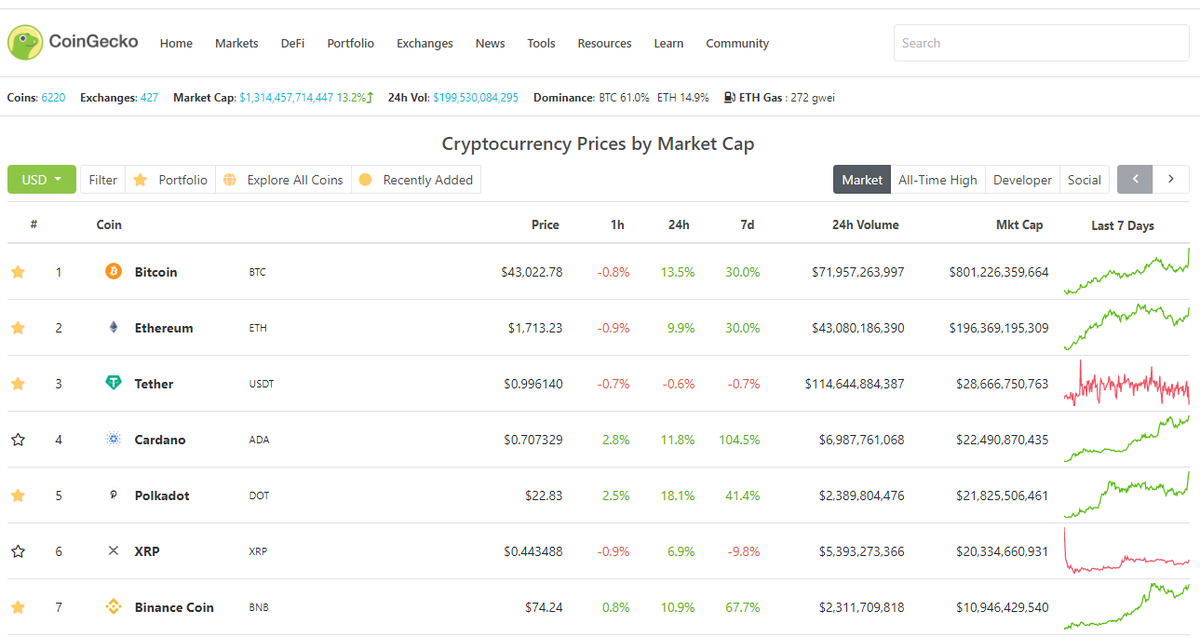
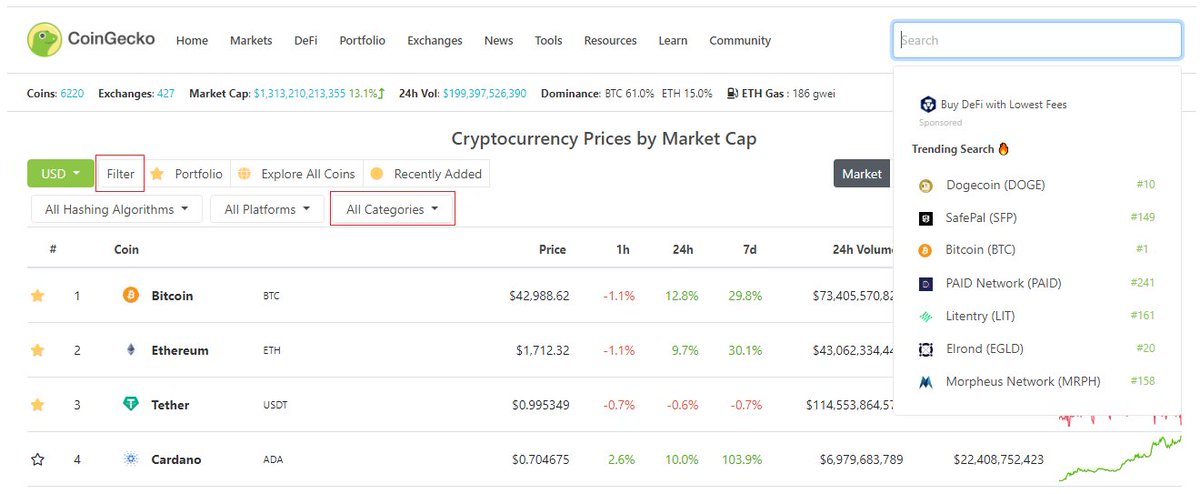
2/ Search over 6000+ cryptocurrencies available on the market. You can see what's trending in the space as well.
Researching by categories? Filter (left side) -> Select categories -> DeFi, DOT ecosystem, Exchange-based tokens, NFTs - anything!
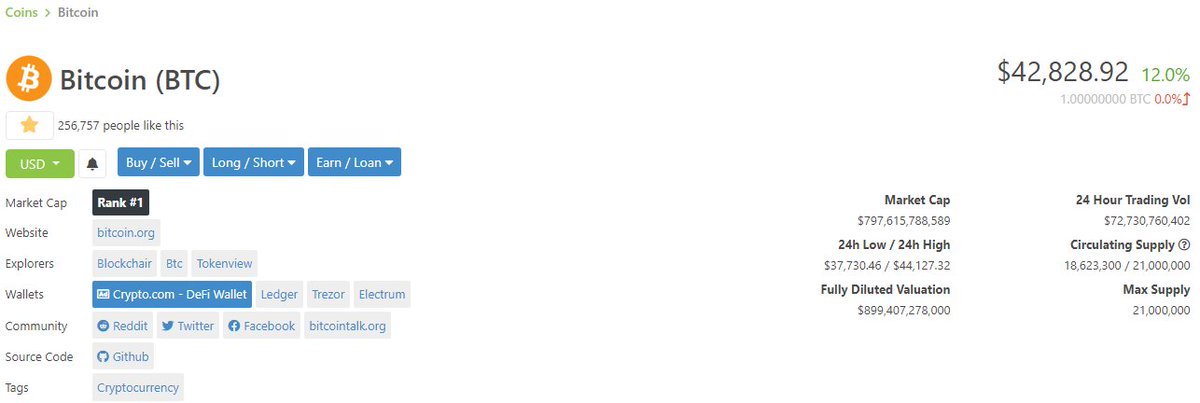
3/ Lets say you're looking at #Bitcoin https://t.co/g205lj03pG
At a glance you get:
- Price
- Mkt Capitalization (valuation)
- Circulating/Total supply
- 24h trading volume
- Links to websites, social media, block explorers
- Calculator
Next - check valuation?
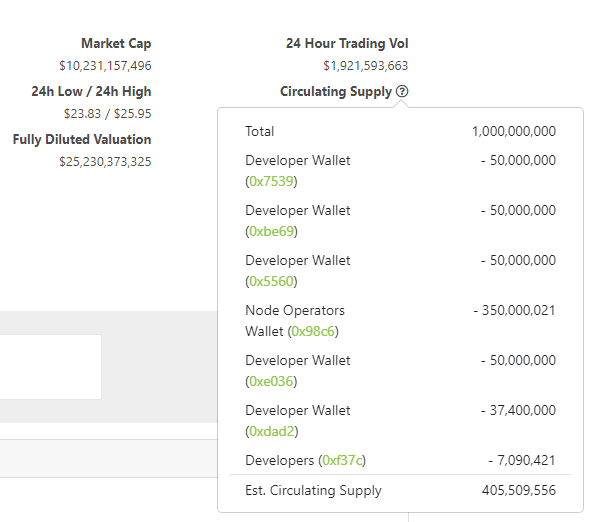
4/ Market cap is used to rank coins, and we'll show you how its calculated - Hover over Circulating Supply (?) for breakdown.
Note: used @chainlink as example here - https://t.co/Jc46fe79Ag
While MC is important also consider product fit, narrative, team, community etc.
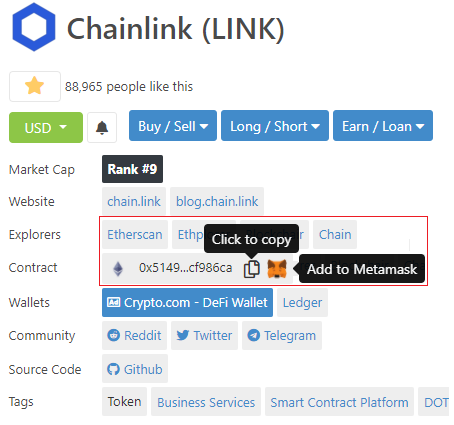
5/ If you're trading on AMMs like @Uniswap or @SushiSwap, you can copy the contract address directly to your clipboard.
Using @metamask_io? Add the token directly so it shows as one of the "Assets" that you own in the wallet.
See: https://t.co/94XihMf5oz
Share it with a friend who needs it!
1/ Getting started with crypto and want to check prices/projects? https://t.co/LFnk4vukxj has info on just about every crypto you'll need :)
2/ Search over 6000+ cryptocurrencies available on the market. You can see what's trending in the space as well.
Researching by categories? Filter (left side) -> Select categories -> DeFi, DOT ecosystem, Exchange-based tokens, NFTs - anything!
3/ Lets say you're looking at #Bitcoin https://t.co/g205lj03pG
At a glance you get:
- Price
- Mkt Capitalization (valuation)
- Circulating/Total supply
- 24h trading volume
- Links to websites, social media, block explorers
- Calculator
Next - check valuation?
4/ Market cap is used to rank coins, and we'll show you how its calculated - Hover over Circulating Supply (?) for breakdown.
Note: used @chainlink as example here - https://t.co/Jc46fe79Ag
While MC is important also consider product fit, narrative, team, community etc.
5/ If you're trading on AMMs like @Uniswap or @SushiSwap, you can copy the contract address directly to your clipboard.
Using @metamask_io? Add the token directly so it shows as one of the "Assets" that you own in the wallet.
See: https://t.co/94XihMf5oz
Introducing an effortless way to add tokens to your @metamask_io wallet \U0001f4e5
— CoinGecko (@coingecko) February 8, 2021
Skip the hassle of copying/pasting contract addresses to your wallet. Add an asset and it'll appear in your wallet with just a click - tap the \U0001f98a and try it out for yourself! pic.twitter.com/u26BA29ubs