Fascinating new paper by @AndrewDessler and colleagues arguing committed warming might be higher than expected given historical pattern effects. Its combining a lot of different concepts together, so lets spend some time disentangling them https://t.co/ILi5z515Qy

A thread: 1/19
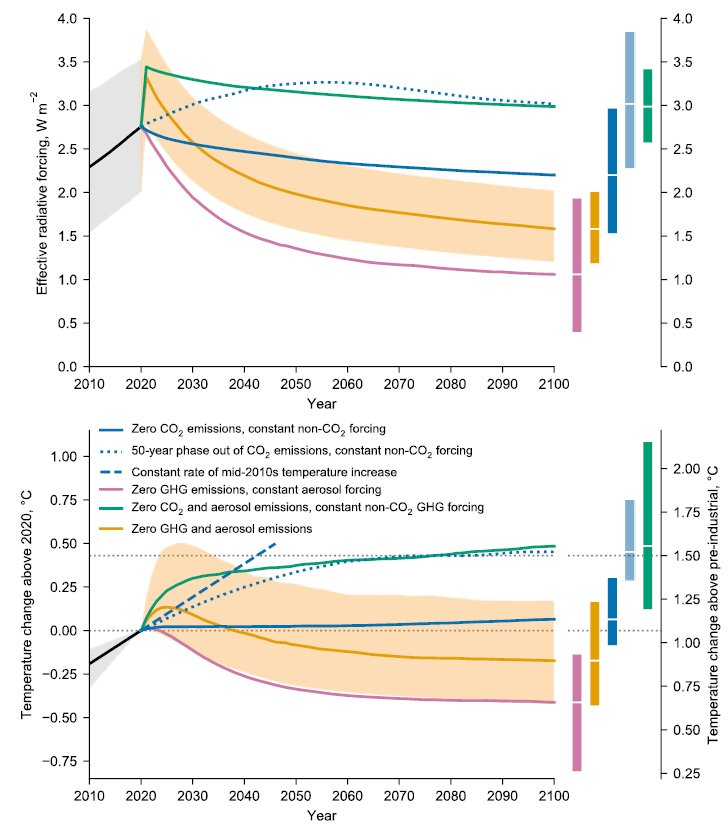
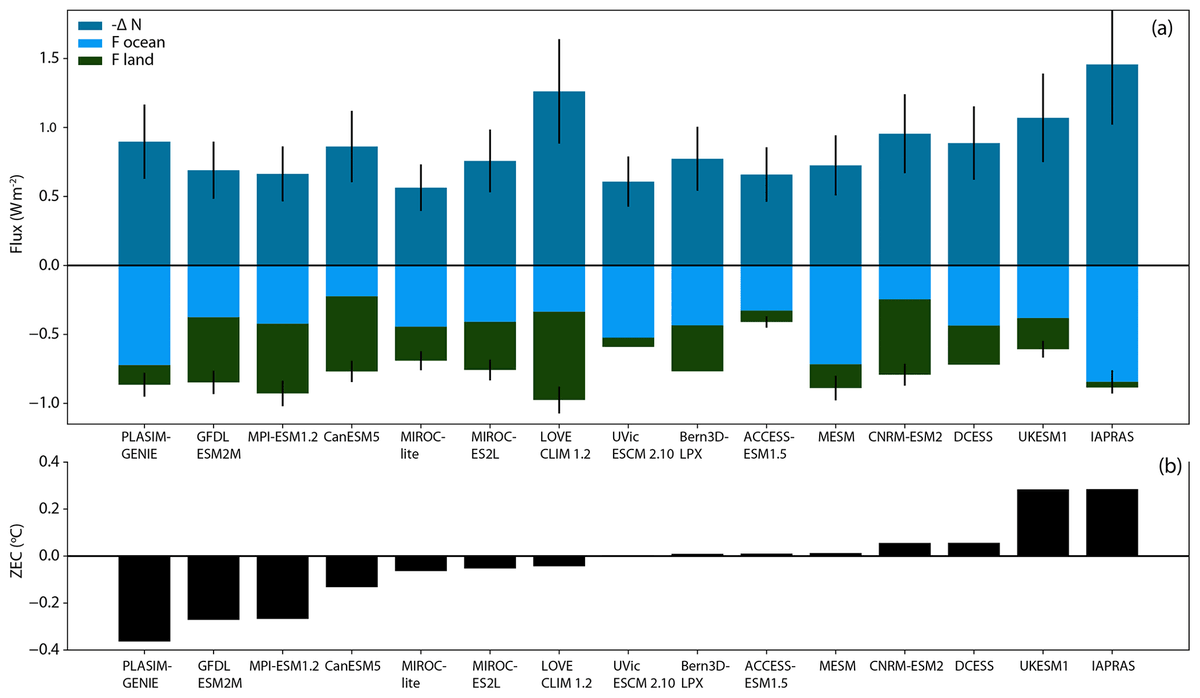
The paper's headline number is that we previously thought the world was committed to 1.3C warming, but that number is actually over 2C (> 1.5C by 2100). This is quite a different message than we get from Earth System Models, which suggest committed warming is only ~1.2C. 2/19
This would imply that the 1.5C by 2100 target is effectively impossible, and that long-term warming of >2C would be very difficult to avoid. However, the devil is in the details, and the picture is not quite as dire as it would seem at first glance. 3/19
When we talk about "committed warming" folks are generally talking about one of two scenarios: either constant CO2 and other GHG concentrations (and forcings), or getting all emissions (or just CO2 emissions) down to zero immediately. 4/19
In the first method – constant concentrations – we find that the world warms up another 0.5C or so, as the oceans continue to take up heat as more energy is being trapped by greenhouse gases than is being emitted back to space. Much of this additional warming happens by 2100 5/19
In the second method – zero emissions – atmospheric concentrations of CO2 start to fall, as the ocean and land continue taking up some of the CO2 that humans have previously emitted. 6/19
(short-lived greenhouse gases like methane are also quickly removed from the atmosphere, but so are short-lived aerosols that tend to cool the planet. To a first order approximation these cancel eachother out, though there are some temporal differences). 7/19
Falling atmospheric CO2 causes enough cooling to balance out the warming "in the pipeline" due to slow ocean heat uptake, and global temperatures remain relatively flat after net-zero emissions are reached. 8/19
This flat-temperatures-at-zero-emissions finding is quite robust, first appearing in Matthews and Caldeira in 2008, highlighted in the IPCC SR15, and more recently being found in 18 different Earth System Models in the CMIP6 ZECMIP: https://t.co/DjRn4f9MiC 9/19
What Dessler and colleagues look at in the new paper is the constant concentration scenario rather than the zero emission scenario, so its hard to directly compare the two. 10/19
Furthermore, their two numbers (1.3C vs 2C+ committed warming) conflate two different factors: higher climate sensitivity and changing warming patterns over time. 11/19
Modern climate models expect more then 1.3C warming at equilibrium in a constant concentration scenario. Rather, at 2.2 w/m^2 constant forcing they would expect around 1.7C warming (assuming a 3C ECS). 12/19
The 1.3C number in the paper is based on an observational-derived ECS of ~2C per doubling CO2, while the > 2C number is based on a revised ECS estimate of ~3.5C plus warming due to pattern effects. 13/19
Pattern effects themselves are a bit complicated. In short, climate models expect both the Western and Eastern Pacific Ocean to have similar rates of long-term warming. However, in the real world the Western Pacific is warming a lot faster than the Eastern. 14/19
Warming in the western Pacific tends to generate a lot more low-altitude clouds that reflect light back to space and cool the surface, while warming in the Eastern Pacific does not. This warming pattern is likely due to natural variability and may not persist in the future. 15/19
If the warming pattern in the Pacific changes to be more similar to that in climate models, Dessler and colleagues argue that it would result in between ~0.3 and ~0.6 w/m^2 additional radiative forcing (or 0.2C to 0.5C more warming, assuming 3C ECS). 16/19
So, in essence, Dessler and colleagues results would suggest that the world could warm 0.2C to 0.5C more under our best estimate of ECS even in a zero emissions scenario due to pattern effect changes. 17/19
However, not all of this warming would happen by 2100 (indeed, we really don't know when the Pacific warming pattern might shift!). The impact on meeting Paris Agreement goals would be smaller, though exactly how much depends on when the warming pattern changes. 18/19
I don't think this paper fundamentally changes our understanding of committed warming, and pattern effects are still an area of active research. But it should make us a bit cautious about being too confident in predictions of zero warming after emissions reach net-zero. 19/19

More from Climate change
It was a dark and stormy night...

(I’ve always wanted to tweet that) But seriously, there was a tropical storm when a group of people gathered in the woods.

If they were white, we’d call them “founding fathers” but they were slaves who were about to change the world

A thread


Voudou priestess Cecile Fatiman danced with a knife. Then she split a pig and everyone drank the pig’s blood from a wooden bowl while enslaved priest Cutty Boukman prayed:

“The god who created the earth; who created the sun that gives us light. The god who holds up the ocean;

who makes the thunder roar. Our god who has ears to hear. You who are hidden in the clouds, who watch us from where you are. You see all that the white has made us suffer. The white man’s god asks him to commit crimes. But the god within us wants to do good...

It’s He who will direct our arms and bring us the victory. It’s He who will assist us. We all should throw away the image of the white men’s god who is so pitiless. Listen to the voice for liberty that speaks in all our hearts.”

Then , the meeting adjourned & everyone went home.

A week later, on Aug. 21 1791, it began.

In one week, 1800 plantations on the Island of St. Domingue would be burned to the ground and 1,000 white enslavers would be dead.

The shit had finally hit the fan.
I don't have time to make this detailed, but here's a little thread about the world's first major politically-charged blackout that was blamed on renewables, in South Australia, in 2016............

On September 28, 2016, an unprecedented tropical storm progressed rapidly across South Australia. Truly - this thing was unusual. The sky folded in on itself. It tore towns to bits.


Australia's @climatecouncil pointed out that the storm was so unusual at least partly due to the influence of climate change, and that this is due to get worse.

https://t.co/76ekkfJpR8


I'm going to use brief snippets from my book to fill this out! The storm's primary impact on the grid was the destruction of several major transmission lines. When I say destruction - I mean they snapped like twigs.


Here's what happened in the following seconds:

- A voltage spike from the line falls
- Wind turbines automatically shut off due to software settings that trigger shutdown during a spike
- The interconnector to Vic tried to compensate, failed and died
- All of SA blacked out
FYI - The Storm approaches - take a look...

At the moment, POTUS is sitting on a stack of Trump cards that he's just waiting to unleash...a royal flush!

@John_F_Kennnedy @Pamelal33566076 @GeorgePapa19 @whitebunny @atvguy @stormis_us


He has court cases that will go to the Supreme Court and thanks to the Texas case, he's now aware how to file them properly... under article 3 not 2...

so the SCOTUS will be forced to listen.....He now has the DNI report. Barr stepped down and can now be a witness.....he did his job. Durham is special counsel and can prosecute, in any state....

He’s letting civil, criminal, and federal courts fail to handle the situation properly.....so he can use military tribunals. He has ALL the data from the NSA, the Kraken supercomputer, the Alice supercomputer and likely many more computers, unknown to us....

He has the dueling electors from 7 state legislatures. He has VP Pence, as the final arbiter of which ballots to accept.. the NDAA, the national emergency, the 14th amendment, the 2018 executive order, the 2017 very first EO, the Patriot Act, the FISA warrants,

You May Also Like