—TAKEAWAY LESSONS FROM PANDEMIC 2020-21: A THREAD—
Below, a few basic lessons I have drawn, as a political philosopher and informed citizen who has made it my business to closely follow political, social, economic, clinical, & epidemiological aspects of the pandemic:
https://t.co/bzsdKI3kae
More from Category c19

The genesis of a pandemic.
The #Corona crisis began with a panopticon of absurd events, improbable coincidences and outright lies.
Time for a review of the impossibilities.
A thread 🧵
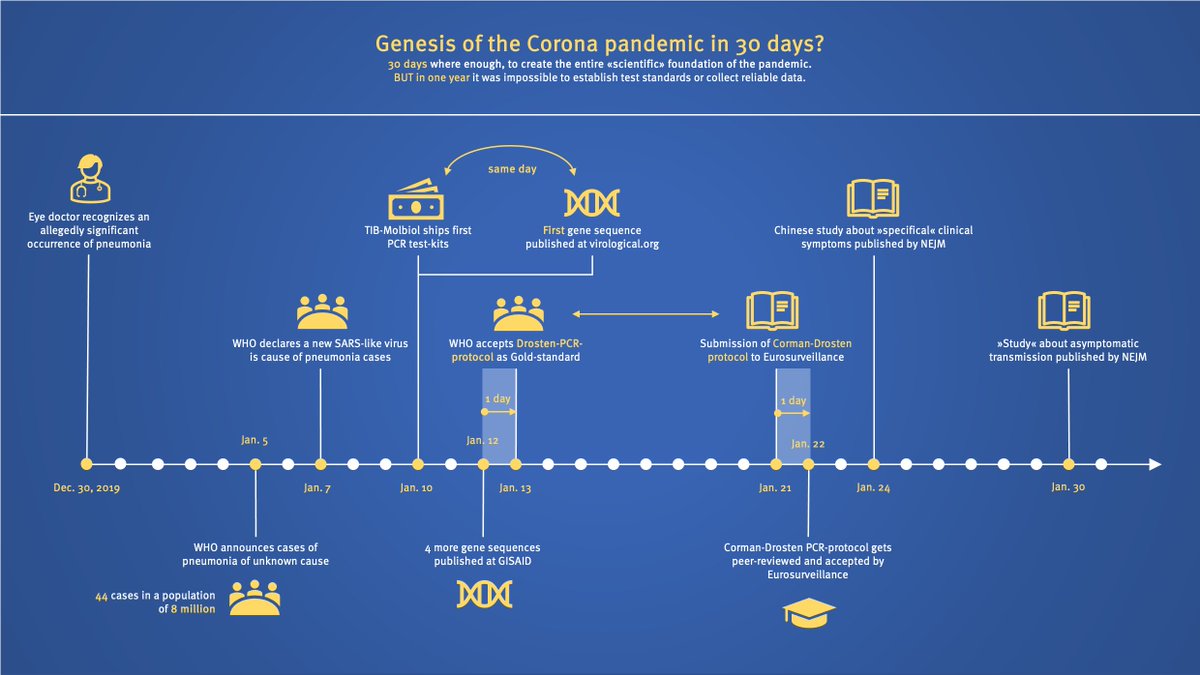
1/ At the end of December 2019, Wenliang, an eye doctor from Wuhan, noticed an allegedly unusual incidence of pneumonia. It remains a mystery what is unusual about 44 patients in a city with over 8 million citizens during winter.
2/ On Jan. 5, WHO informs for the first time about a pneumonia of unknown cause, which it can clarify by 7 January. The virus is believed to be a close relative of SARS. A fish market allegedly is the origin. The #Zoonosis legend, unproven until today, is born.

3/ On Jan. 10, the first gene sequence of the virus today called #SARS-CoV2 appears at https://t.co/tqxKgyykBr, and on Jan. 12, 4 more sequences are published by @edwardcholmes in the GISAID (Global Initiative on Sharing All Influenza Data)
4/ As early as January 13, just a single day later, WHO accepts Mr. #Drosten|s PCR testing protocol as gold
The #Corona crisis began with a panopticon of absurd events, improbable coincidences and outright lies.
Time for a review of the impossibilities.
A thread 🧵
1/ At the end of December 2019, Wenliang, an eye doctor from Wuhan, noticed an allegedly unusual incidence of pneumonia. It remains a mystery what is unusual about 44 patients in a city with over 8 million citizens during winter.
2/ On Jan. 5, WHO informs for the first time about a pneumonia of unknown cause, which it can clarify by 7 January. The virus is believed to be a close relative of SARS. A fish market allegedly is the origin. The #Zoonosis legend, unproven until today, is born.
3/ On Jan. 10, the first gene sequence of the virus today called #SARS-CoV2 appears at https://t.co/tqxKgyykBr, and on Jan. 12, 4 more sequences are published by @edwardcholmes in the GISAID (Global Initiative on Sharing All Influenza Data)
4/ As early as January 13, just a single day later, WHO accepts Mr. #Drosten|s PCR testing protocol as gold


1/12
RT-PCR corona (test) scam
Symptomatic people are tested for one and only one respiratory virus. This means that other acute respiratory infections are reclassified as
2/12
It is tested exquisitely with a hypersensitive non-specific RT-PCR test / Ct >35 (>30 is nonsense, >35 is madness), without considering Ct and clinical context. This means that more acute respiratory infections are reclassified as
3/12
The Drosten RT-PCR test is fabricated in a way that each country and laboratory perform it differently at too high Ct and that the high rate of false positives increases massively due to cross-reaction with other (corona) viruses in the "flu
4/12
Even asymptomatic, previously called healthy, people are tested (en masse) in this way, although there is no epidemiologically relevant asymptomatic transmission. This means that even healthy people are declared as COVID
5/12
Deaths within 28 days after a positive RT-PCR test from whatever cause are designated as deaths WITH COVID. This means that other causes of death are reclassified as
RT-PCR corona (test) scam
Symptomatic people are tested for one and only one respiratory virus. This means that other acute respiratory infections are reclassified as
4/10
— Dr. Thomas Binder, MD (@Thomas_Binder) October 22, 2020
...indication, first of all that testing for a (single) respiratory virus is done outside of surveillance systems or need for specific therapy, but even so the lack of consideration of Ct, symptoms and clinical findings when interpreting its result. https://t.co/gHH6kwRdZG
2/12
It is tested exquisitely with a hypersensitive non-specific RT-PCR test / Ct >35 (>30 is nonsense, >35 is madness), without considering Ct and clinical context. This means that more acute respiratory infections are reclassified as
6/10
— Dr. Thomas Binder, MD (@Thomas_Binder) October 22, 2020
The neither validated nor standardised hypersensitive RT-PCR test / Ct 35-45 for SARS-CoV-2 is abused to mislabel (also) other diseases, especially influenza, as COVID-19.https://t.co/AkFIfTCTkS
3/12
The Drosten RT-PCR test is fabricated in a way that each country and laboratory perform it differently at too high Ct and that the high rate of false positives increases massively due to cross-reaction with other (corona) viruses in the "flu
External peer review of the RTPCR test to detect SARS-CoV-2 reveals 10 major scientific flaws at the molecular and methodological level: consequences for false positive results.https://t.co/mbNY8bdw1p pic.twitter.com/OQBD4grMth
— Dr. Thomas Binder, MD (@Thomas_Binder) November 29, 2020
4/12
Even asymptomatic, previously called healthy, people are tested (en masse) in this way, although there is no epidemiologically relevant asymptomatic transmission. This means that even healthy people are declared as COVID
Thread web\u2b06\ufe0f\u2b07\ufe0f
— Dr. Thomas Binder, MD (@Thomas_Binder) December 16, 2020
The fabrication of the "asymptomatic (super) spreader" is the coronation of the total nons(ci)ense in the belief system of #CoronasWitnesses.
Asymptomatic transmission 0.7%; 95% CI 0%-4.9% - could well be 0%!https://t.co/VeZTzxXfvT
5/12
Deaths within 28 days after a positive RT-PCR test from whatever cause are designated as deaths WITH COVID. This means that other causes of death are reclassified as
8/8
— Dr. Thomas Binder, MD (@Thomas_Binder) March 24, 2020
By the way, who the f*** created this obviously (almost) worldwide definition of #CoronaDeath?
This is not only medical malpractice, this is utterly insane!https://t.co/FFsTx4L2mw

1) THERE IS A VERY REAL, CREDIBLE AND SIGNIFICANT DANGER THAT mRNA SPIKE PROTEIN THERAPIES WILL INDUCE PRION OR PRION-LIKE DISEASE
A paper from 2016 shows that prion and prion-like proteins can also spread and propagate from cell to cell through macropinocytosis. It is also
2) noted that the Spike Protein of SARS-CoV-2 can enter cells through macropinocytosis, without the presence of the entire virion. Given the recent Tweet to me by @endocdoc, where he recently saw a patient develop Creutzfeld-Jakob after COVID-19, the extant paper showing CJD
3) CJD after COVID-19 infection and the recent death of the head of Astra-Zeneca research from CJD should be concerning to all. Especially if he gave himself the AZ therapy during Stage 1 or Stage 2 trials. This would give a possible timeframe for onset.
Again, all Spike Protein
4) mRNA and DNA should be paused until long term animal studies can be
5)
https://t.co/PWOgyPoG5d
A paper from 2016 shows that prion and prion-like proteins can also spread and propagate from cell to cell through macropinocytosis. It is also
2) noted that the Spike Protein of SARS-CoV-2 can enter cells through macropinocytosis, without the presence of the entire virion. Given the recent Tweet to me by @endocdoc, where he recently saw a patient develop Creutzfeld-Jakob after COVID-19, the extant paper showing CJD
3) CJD after COVID-19 infection and the recent death of the head of Astra-Zeneca research from CJD should be concerning to all. Especially if he gave himself the AZ therapy during Stage 1 or Stage 2 trials. This would give a possible timeframe for onset.
Again, all Spike Protein
4) mRNA and DNA should be paused until long term animal studies can be
5)
https://t.co/PWOgyPoG5d