"The summer's protests forced businesses to denounce systemic racism and pledge to address pressing equity issues."

>Protests forced businesses

Correct me if I'm wrong, but they're saying violence works?

"Initiatives that would have taken companies years to craft now launching at a lightning pace as executives move to embed diversity & inclusion into their core business strategy. Equity and belonging will likely remain front of mind."

Faced with crisis, these are the solutions.
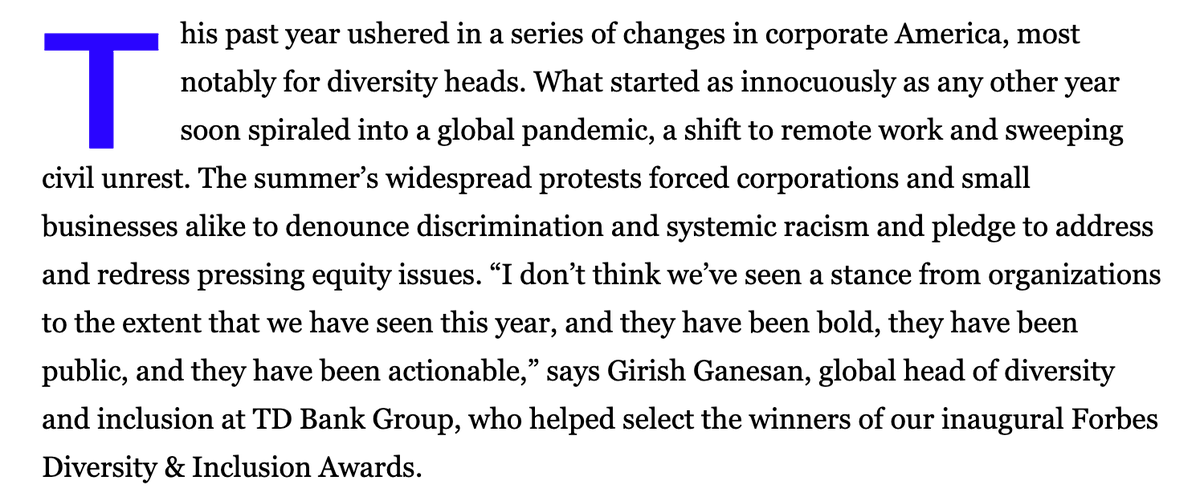
I interrupt this thread for physiognomy check on author (left) and quoted h*mosubcon (right).

Fellas, I must admit I would bleach left; WYB?

Different solution for right, naturally.
The 2% Solution, eh...
On top: carrot

On bottom: stick
Get ready to diversity your executive team with this new position: Chief Black Person.

This ties directly into the @FamedCelebrity post I RT'd this morning (which you should all read).
Gemal Harris had a barrier-breaking win by getting 1% of the DNC primary vote and being selected for the Veep slot on a ticket that is attempting to steal the presidency via fraud.

Huge win, truly #BlackGirlMagic. Person of the year!
I think I've already lost more followers for saying IWB this ebony queen than any other post... Listen up, I may be racist, but I sure as hell ain't gay!

https://t.co/s21vIOVpU8
The argument against was best made by ME, and certainly confuses the matter... if all Africans are male, bleaching her is in fact gay. Quite the conundrum.

https://t.co/QpLrzU8V47
The official title of this position is actually HNIC.

https://t.co/czzFzuGZWY

More from Business

You May Also Like

1/ Some initial thoughts on personal moats:

Like company moats, your personal moat should be a competitive advantage that is not only durable—it should also compound over time.

Characteristics of a personal moat below:


2/ Like a company moat, you want to build career capital while you sleep.

As Andrew Chen noted:


3/ You don’t want to build a competitive advantage that is fleeting or that will get commoditized

Things that might get commoditized over time (some longer than


4/ Before the arrival of recorded music, what used to be scarce was the actual music itself — required an in-person artist.

After recorded music, the music itself became abundant and what became scarce was curation, distribution, and self space.

5/ Similarly, in careers, what used to be (more) scarce were things like ideas, money, and exclusive relationships.

In the internet economy, what has become scarce are things like specific knowledge, rare & valuable skills, and great reputations.
"I lied about my basic beliefs in order to keep a prestigious job. Now that it will be zero-cost to me, I have a few things to say."


We know that elite institutions like the one Flier was in (partial) charge of rely on irrelevant status markers like private school education, whiteness, legacy, and ability to charm an old white guy at an interview.

Harvard's discriminatory policies are becoming increasingly well known, across the political spectrum (see, e.g., the recent lawsuit on discrimination against East Asian applications.)

It's refreshing to hear a senior administrator admits to personally opposing policies that attempt to remedy these basic flaws. These are flaws that harm his institution's ability to do cutting-edge research and to serve the public.

Harvard is being eclipsed by institutions that have different ideas about how to run a 21st Century institution. Stanford, for one; the UC system; the "public Ivys".