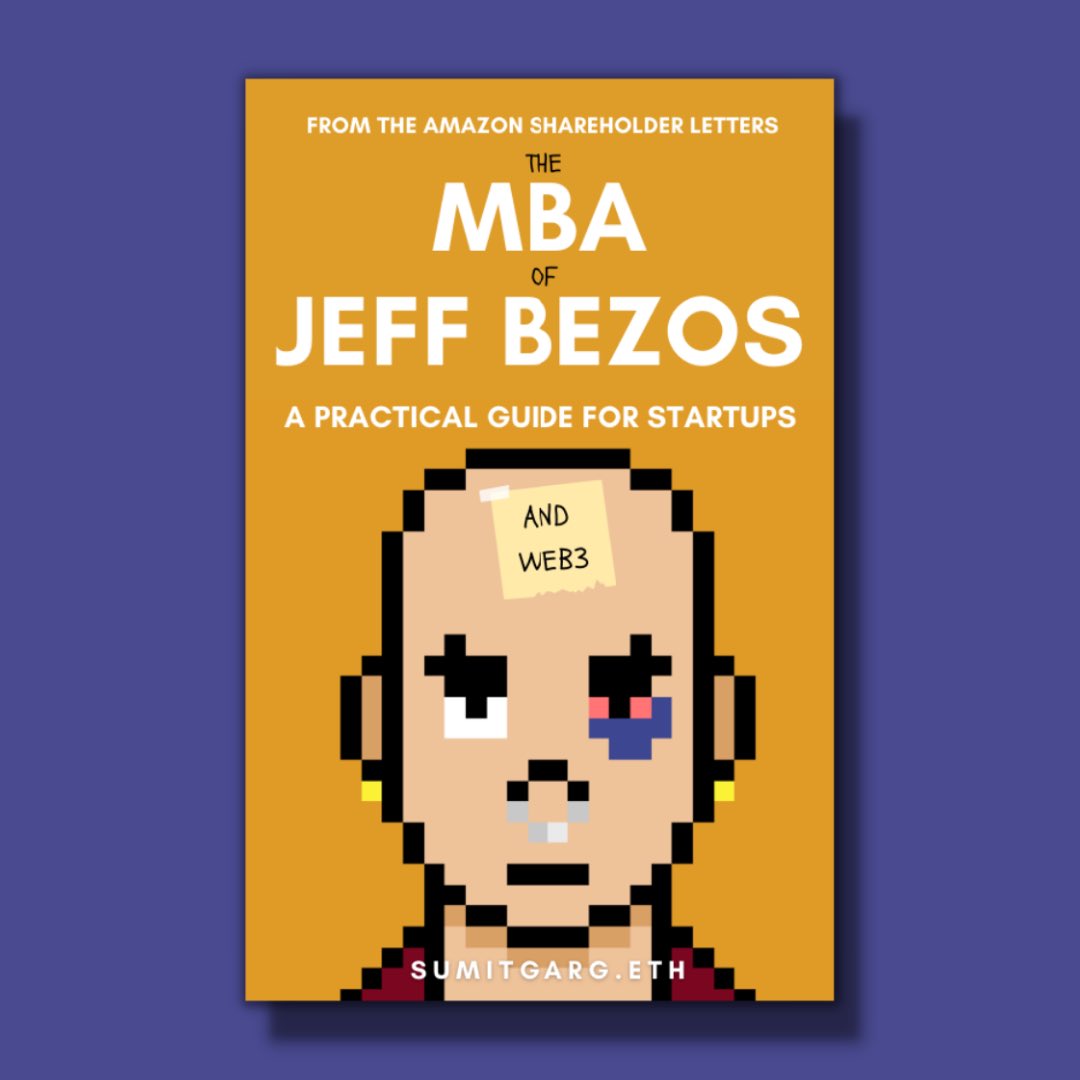
I just read all of Jeff Bezos's 23 letters to Amazon shareholders. And here's a thread with just one key-takeaway from each of these letters.
So if you're an artist or an entrepreneur looking to get some insight into the mind of this genius, read this right now.

1. Will you admire this person?
2. Will they raise the average level of effectiveness of the group?
3. Along what dimension might this person be a superstar?
We aren’t 10% smarter when the share goes 10% up, nor 10% dumber when it goes down. We want to be weighed, & we're always working to build a heavier company.
So then, when you fix it, you’re not just fixing it for one customer. You’re fixing it for every customer.
Owners are different from tenants: many investors are effectively short-term tenants, turning their portfolios so quickly that they are really just renting the stocks that they temporarily “own.”
Amazon has a cash generative operating cycle because it turns its inventory quickly, collecting payments from customers way before payments are due to suppliers.
1. Made with data, where it's easy to tell right from wrong.
2. Based on judgement, risky.
If you want to play it safe, limit yourself to number 1, but remember it would also limit innovation and long-term value creation.
✓ it generates expected ROI
✓ can grow to a scale
✓ the opportunity is currently underserved
✓ you've the capabilities that are needed to bring strong customer-facing differentiation to the marketplace
The mercenaries try to flip their stock. The missionaries love their product/service, and their customers, and are trying to build a great service.
Pradoxically, it’s usually the missionaries who make more money.
On the other hand, long-term thinking
• levers existing abilities,
• supports the failure and iteration required for invention,
• and frees us to pioneer in unexplored spaces.
The latest and the grestest technologies aren't always sufficient to solve all problems, so it's important to advance research and invent new approaches.
So the most radical & transformative of inventions are often those that empower others to unleash their creativity—to pursue their dreams.
Rather than waiting for external pressures, the brand is internally-driven to improve services before it has to, and to invent, before it has to.
While the headline says “Please Don’t Take This Offer.” It's meant to make them rethink their priorities. An employee staying somewhere they don’t want to be isn’t healthy for the employee or the company.
Check for these 4 attributes:
1. customers love it,
2. can grow to very large size,
3. has strong returns on capital,
4. is durable in time—with the potential to endure for decades.
Outsized returns come from betting against conventional wisdom, which is usually right. Given a 10% chance of a 100X payoff, you should take that bet every time. But you’re still going to be wrong nine times out of ten.
Day 2 is stasis. Followed by irrelevance, and decline, and, eventually, death.
Here's how to fend off Day 2:
• customer obsession
• a skeptical view of (overusing) proxies
• adoption of powerful trends
• high-velocity decision making
1. You have to be able to recognize what good looks like in a particular domain.
2. You must have realistic expectations for how hard it should be (how much work it will take) to achieve that result – the scope.
More from Sumit Grrg
These 10 threads will teach you more than reading 100 books
Five billionaires share their top lessons on startups, life and entrepreneurship (1/10)
10 competitive advantages that will trump talent (2/10)
Some harsh truths you probably don’t want to hear (3/10)
10 significant lies you’re told about the world (4/10)
Five billionaires share their top lessons on startups, life and entrepreneurship (1/10)
I interviewed 5 billionaires this week
— GREG ISENBERG (@gregisenberg) January 23, 2021
I asked them to share their lessons learned on startups, life and entrepreneurship:
Here's what they told me:
10 competitive advantages that will trump talent (2/10)
To outperform, you need serious competitive advantages.
— Sahil Bloom (@SahilBloom) March 20, 2021
But contrary to what you have been told, most of them don't require talent.
10 competitive advantages that you can start developing today:
Some harsh truths you probably don’t want to hear (3/10)
I\u2019ve gotten a lot of bad advice in my career and I see even more of it here on Twitter.
— Nick Huber (@sweatystartup) January 3, 2021
Time for a stiff drink and some truth you probably dont want to hear.
\U0001f447\U0001f447
10 significant lies you’re told about the world (4/10)
THREAD: 10 significant lies you're told about the world.
— Julian Shapiro (@Julian) January 9, 2021
On startups, writing, and your career:
More from Business


Introducing "The Balloon Effect"
Many businesses & creators have experienced a similar pattern of success.
From @MrBeastYT and @MorningBrew to @oatly and @Rovio.
Let's break down what "The Balloon Effect" is and examples of it in real life.
Keep reading 👇

1/ What is "The Balloon Effect"?
It is a particular pattern of growth.
It is not Instagram's growth trajectory.
It is not https://t.co/5axsTUKek6's growth trajectory.
"The Balloon Effect" is defined by several years of hard work & grit complemented by slow, linear growth.
2/ And then one day, one month, or one quarter...everything changes.
A business hits a tipping point and its trajectory shifts entirely.
Gradual growth turns to exponential growth & your brand and your size explode.
Like a step function.
3/ Now, you're probably wondering.
Why is it called "The Balloon Effect"?
Because filling/popping a water balloon follows the exact pattern I just described (and so many businesses experience).
Long unsexy slog 👉 Exponential tipping point.
4/ Initially, you turn on the faucet & water takes up space in the empty balloon.
Through effort you open the faucet, yet the results are unexciting.
But it's what must be done for water (or growth) to happen at all.
It's not sexy, but it's necessary.
Many businesses & creators have experienced a similar pattern of success.
From @MrBeastYT and @MorningBrew to @oatly and @Rovio.
Let's break down what "The Balloon Effect" is and examples of it in real life.
Keep reading 👇
1/ What is "The Balloon Effect"?
It is a particular pattern of growth.
It is not Instagram's growth trajectory.
It is not https://t.co/5axsTUKek6's growth trajectory.
"The Balloon Effect" is defined by several years of hard work & grit complemented by slow, linear growth.
2/ And then one day, one month, or one quarter...everything changes.
A business hits a tipping point and its trajectory shifts entirely.
Gradual growth turns to exponential growth & your brand and your size explode.
Like a step function.
3/ Now, you're probably wondering.
Why is it called "The Balloon Effect"?
Because filling/popping a water balloon follows the exact pattern I just described (and so many businesses experience).
Long unsexy slog 👉 Exponential tipping point.
4/ Initially, you turn on the faucet & water takes up space in the empty balloon.
Through effort you open the faucet, yet the results are unexciting.
But it's what must be done for water (or growth) to happen at all.
It's not sexy, but it's necessary.