Title VIII: Energy is the key section (page 156 onwards)
▶️ Standard stuff on commitment to competition, unbundling and customer choice
▶️ UK Capacity Market no longer needs to try to integrate overseas Capacity providers & vice versa
(Article ENER.6, Clause 3, page. 160)
2/
▶️ Existing "exemptions" for selected interconnectors will continue to apply.
This means that these interconnectors can continue to sell capacity rights ahead of time, rather than all through close to real-time markets.
(Article ENER.11, page 162)
3/
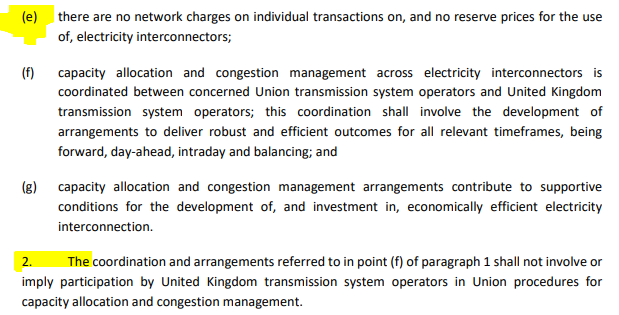
▶️ No network charges on individual interconnector transactions (as now)
▶️ But, UK cannot participate in EU procedures for capacity allocation and congestion management (more on this later)
(Article ENER.13, page 163)
4/
Gas trading: looks like the UK stays in the existing PRISMA gas trading platform.
Not my specialist area, but is this because PRISMA isn't an EU institution (unlike electricity market coupling)?
https://t.co/5GQJtZDpTa (Article ENER. 15, page 164)
5/
▶️ Network development: Parties to cooperate, including on interconnectors, but not much detail.
▶️ Security of Supply: Parties to cooperate, again not much detail. Can't see any references to a solidarity principle.
(Articles ENER. 16 and ENER. 17, page 165)
6/
Cooperation between TSOs & Regulators:
- UK TSOs (i.e. National Grid) to cooperate with EU TSOs through cooperation with ENTSO-E and ENTSOG but not membership
- UK regulator (@Ofgem) to cooperate with EU regulators through ACER. Again, no UK membership
(Articles ENER.19+20)
7/
New cooperation forum between UK and EU on offshore renewable energy.
Looks like UK no longer a member of North Seas Energy Cooperation, so a new forum is needed.
(Article ENER 23, page 169-170).
See summary of our report on Future of North Sea :
https://t.co/Qgh8b2p0yZ 8/
Final provisions, incl. termination (!)
Title on Energy ceases on 30 June 2026. Although can be extended to 31 March 2027 & again to 31 March 2028.
Seems linked to general termination provisions of the deal, including a reference to 🐟🐟 (Article FISH.17)
(ENER 33, p.172)
9/
Onto Annexes. Only Annex ENER-4 is interesting. Covers day-ahead market coupling over interconnectors.
Market coupling ceases on 1 Jan 2021. Will be replaced by April'22 with "Multi-region loose volume coupling"
New term for many
https://t.co/oSVDDiWFw9 Annex ENER-4 p.784
10/
If I understand it correctly, new system will produce net flows on the interconnectors, rather than prices.
Creates a risk that interconnectors flow the "wrong way" (i.e. from high prices to low prices).
Algorithm is separate to EU day-ahead market coupling (EUPHEMIA)
11/
Timeline to develop new system:
▶️ By April 2021: CBA and outline technical proposals
▶️ By November 2021: Technical proposals
▶️ By April 2022: System starts operating
p.785
12/
Other provisions in the deal:
▶️ New Specialised Committee on Energy to discuss/implement some bits of the energy title and annexes (page 12)
▶️ Commitment to carbon pricing in the section on "level playing field"
[Title XI, Article 7.3, page 202]
13/
Overall:
▶️ Lots of sensible provisions, much to gain for both sides
▶️ Market coupling will be weaker, even with new system (Apr 2022)
▶️ Welcome focus on North Sea
▶️ Need to understand more on termination provisions
See more in our recent paper:
https://t.co/KEXNIWvAHJ 14/14