दोन वर्षांपूर्वी जेव्हा मी ‘लीन इन’ हे पुस्तक वाचले होते तेव्हा मला कधीच वाटले नव्हते की ह्या पुस्तकाचा माझ्यावर कायमचा परिणाम होईल.
“खरोखर समान जग असे आहे की जेथे महिलांनी आपले अर्धे देश आणि कंपन्या आणि पुरुषांनी अर्धी घरं चालवतील. “
- शेरिल सँडबर्ग.
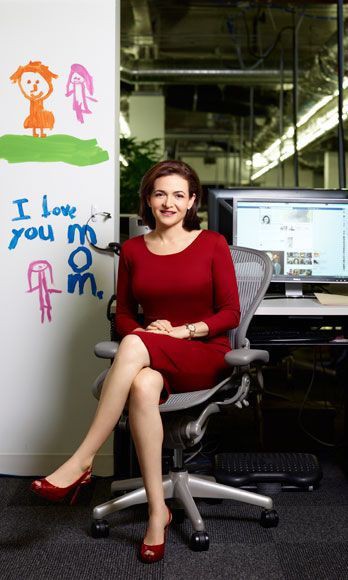

जगातील आघाडीच्या सोशल मीडिया प्लॅटफॉर्मचे मुख्य कार्यकारी अधिकारी, फेसबुकने मध्ये काम करत असताना शेरिल या मुद्द्यांकडे जागतिक लक्ष वेधून घेते. शेरिलची स्वतःची एक संस्था लीन इन आहे,

यार! आम्ही 21 व्या शतकात आहोत, बरोबर ??
एक चांगली प्रभावशाली व्यक्ती म्हणून तिने खाली येऊन अवास्तव वस्तुस्थितीची तपासणी का करावी… का? बरं हे काही एक सोपं काम



That's it.
#SherylSandberg
#IshwariMurudkar
@siddharthsuffi4 @Digvijay_004 @DrVidyaDeshmukh @Archanagsanap2 @Manoj2212Khare @Truepat19189910 @AdiitiiiMetkari @MeeTejaBoltoy

More from Book

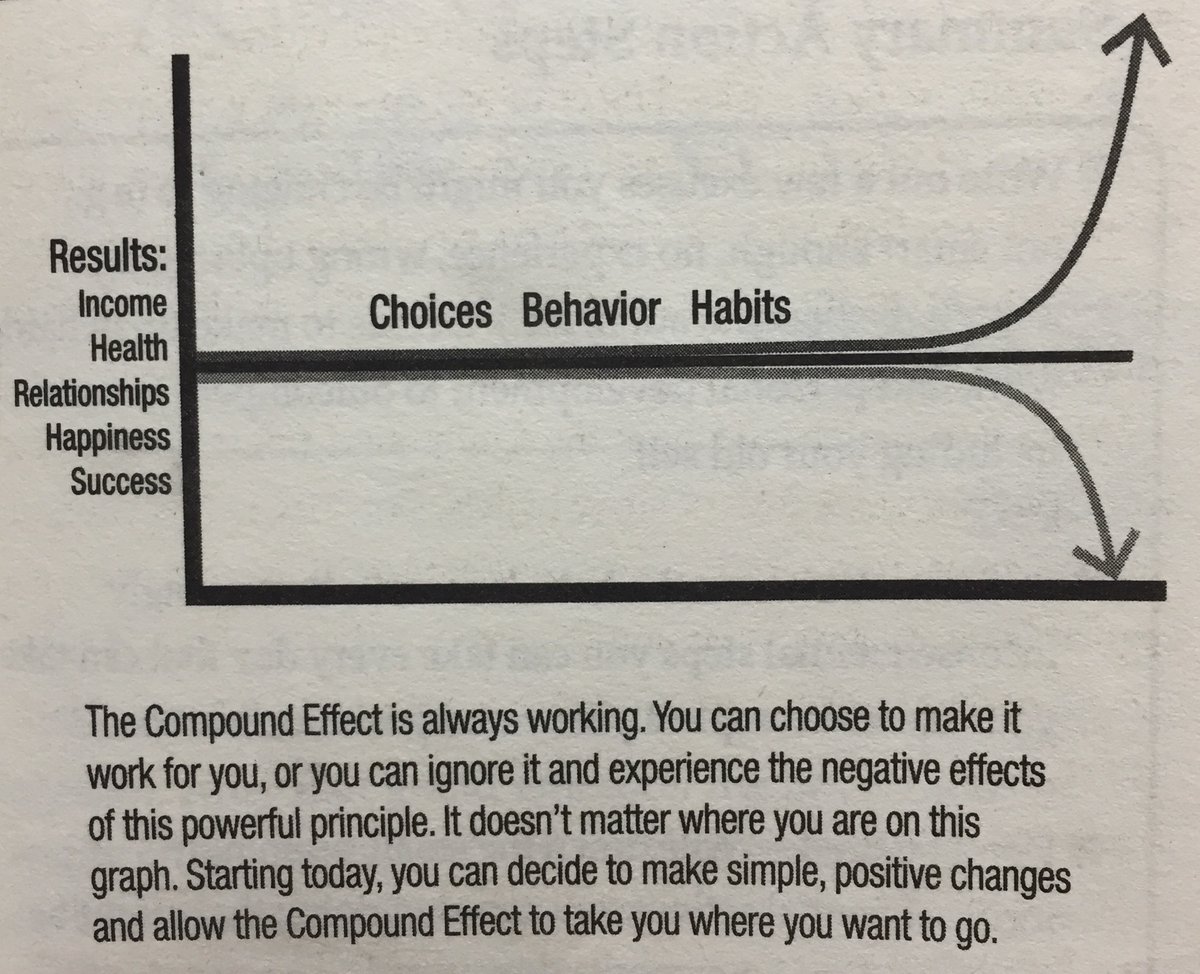

I've gotten a few questions about this, so let me clarify and provide as much helpful information as this medium will allow.
To begin, both of my parents are MBA's and are assertive. They taught us four kids to be assertive. 1/x
Honestly, what's the worst a publisher can do, say no? If the worst that can happen is a rejection email (and believe me I've gotten ALOT), then it's pretty "safe" to at least ask.
But there were tricks that I learned about getting books from publishers. 2/x
The 1st was to request exam copies. I was a very part-time adjunct faculty for an online-only seminary in the UK. I designed two classes for them and requested books to consider as assigned reading for the classes. I still do this, since I'm full-time teaching/administrating. 3/x
The second was to become an approved/recognized reviewer for journals--it doesn't matter which ones. Thanks to a previous professor I'm a reviewer at the website for a research center. And through nothing but email, I'm a frequent reviewer for 3 journals (JESOT, JHS, RRT). 4/x
This is a helpful approach. When you know exactly where the review is going to be submitted and you know that the journal's review editor wants the review, then (in most cases) the review editor's job is to contact the publisher and make sure you get the book. That's it. 5/x
To begin, both of my parents are MBA's and are assertive. They taught us four kids to be assertive. 1/x
Many underestimate the generosity of (most) publishers. I probably got $10,000 worth of free books during my 4 years in Durham by request exam or review copies. Sometimes, I just emailed a publisher and said, "I need this book, but I can't afford it. Can you help me out?"
— Stephen D. Campbell, Dr. theol. (@the_OT_Campbell) December 13, 2020
Honestly, what's the worst a publisher can do, say no? If the worst that can happen is a rejection email (and believe me I've gotten ALOT), then it's pretty "safe" to at least ask.
But there were tricks that I learned about getting books from publishers. 2/x
The 1st was to request exam copies. I was a very part-time adjunct faculty for an online-only seminary in the UK. I designed two classes for them and requested books to consider as assigned reading for the classes. I still do this, since I'm full-time teaching/administrating. 3/x
The second was to become an approved/recognized reviewer for journals--it doesn't matter which ones. Thanks to a previous professor I'm a reviewer at the website for a research center. And through nothing but email, I'm a frequent reviewer for 3 journals (JESOT, JHS, RRT). 4/x
This is a helpful approach. When you know exactly where the review is going to be submitted and you know that the journal's review editor wants the review, then (in most cases) the review editor's job is to contact the publisher and make sure you get the book. That's it. 5/x

Aboriginal self-government - legal and constitutional issues 1995 Ottawa, Canada- Royal Commission on Aboriginal Peoples #Metis
Aboriginal self-government - legal and constitutional issues 1995 Ottawa, Canada- Royal Commission on Aboriginal Peoples- pg141. - papers argues that it is logical and sensible to consider persons of mixed ancestry of all kinds to be within sec. 91(24) jurisdiction and that the
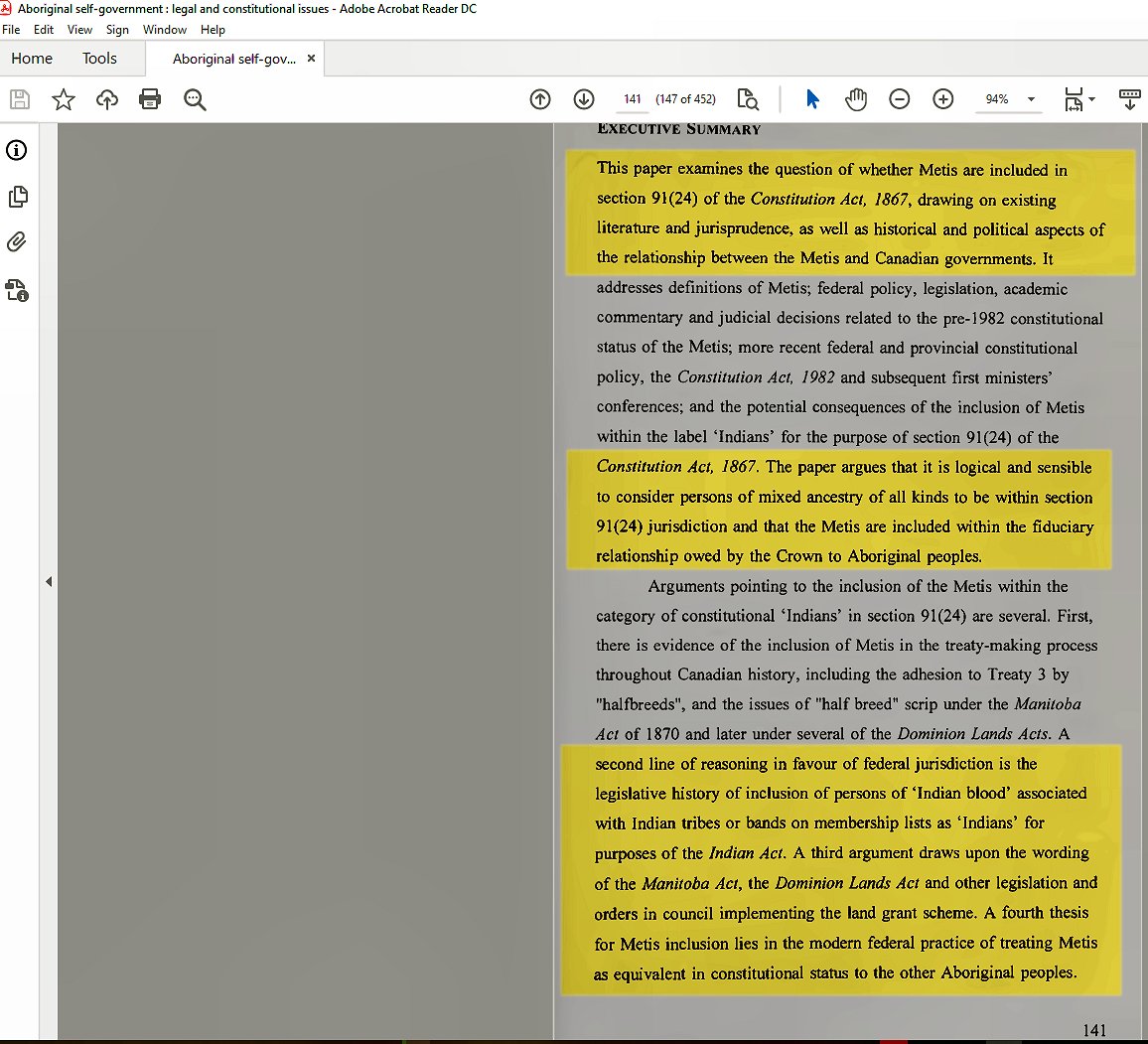
Metis are included within the fiduciary relationship owed by the crown to the Aboriginal peoples. (pg142) The recognition of Metis as one of the "aboriginal peoples of Canada" in section 35 of the Constitution Act 1982, reinforces this federal practice. "It is concluded that
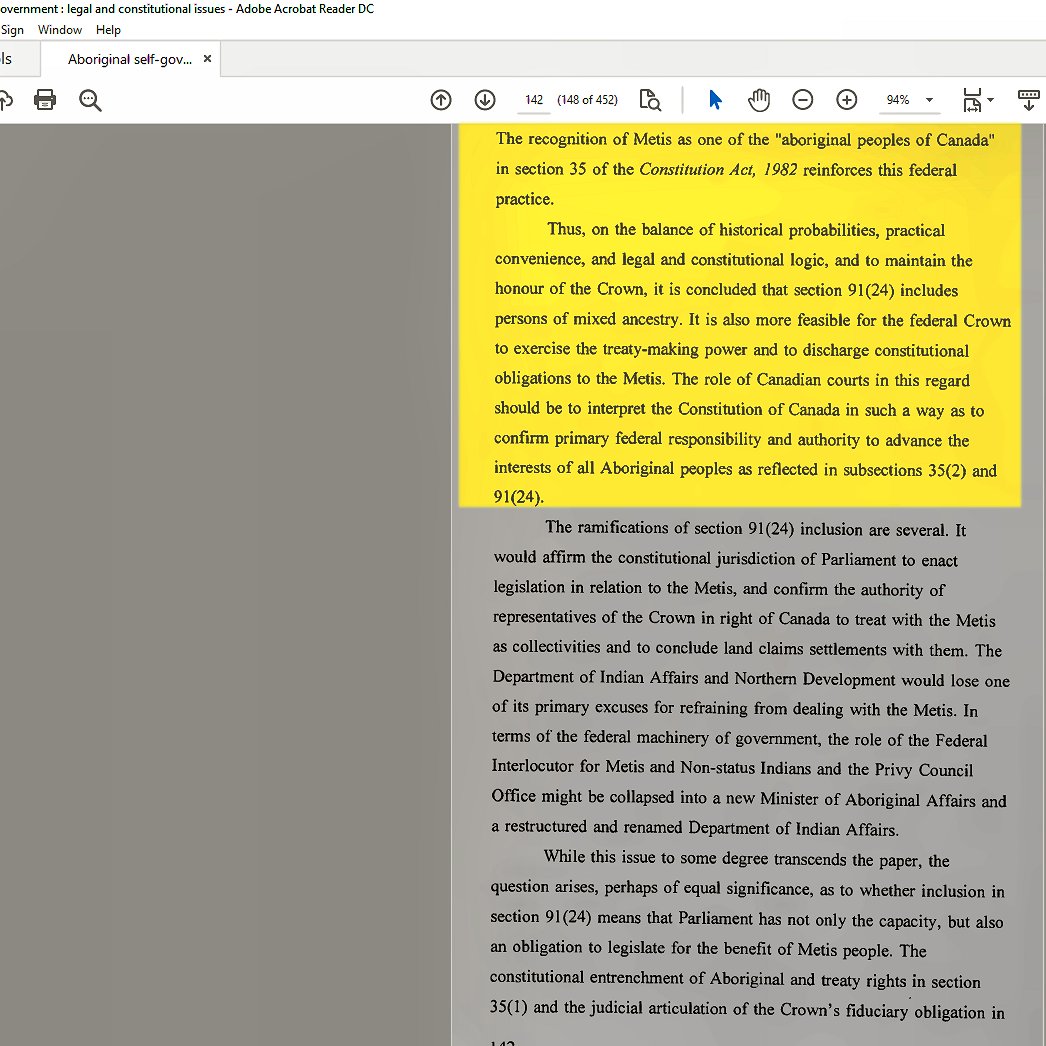
sec 91(24) includes persons of mixed ancestry." pg143- "the Guerin case suggests that the federal gov. may be breaching its fiduciary obligations if it refuses to initiate legislation needed to acknowledge the existence of certain Aboriginal peoples or to meet basic economic
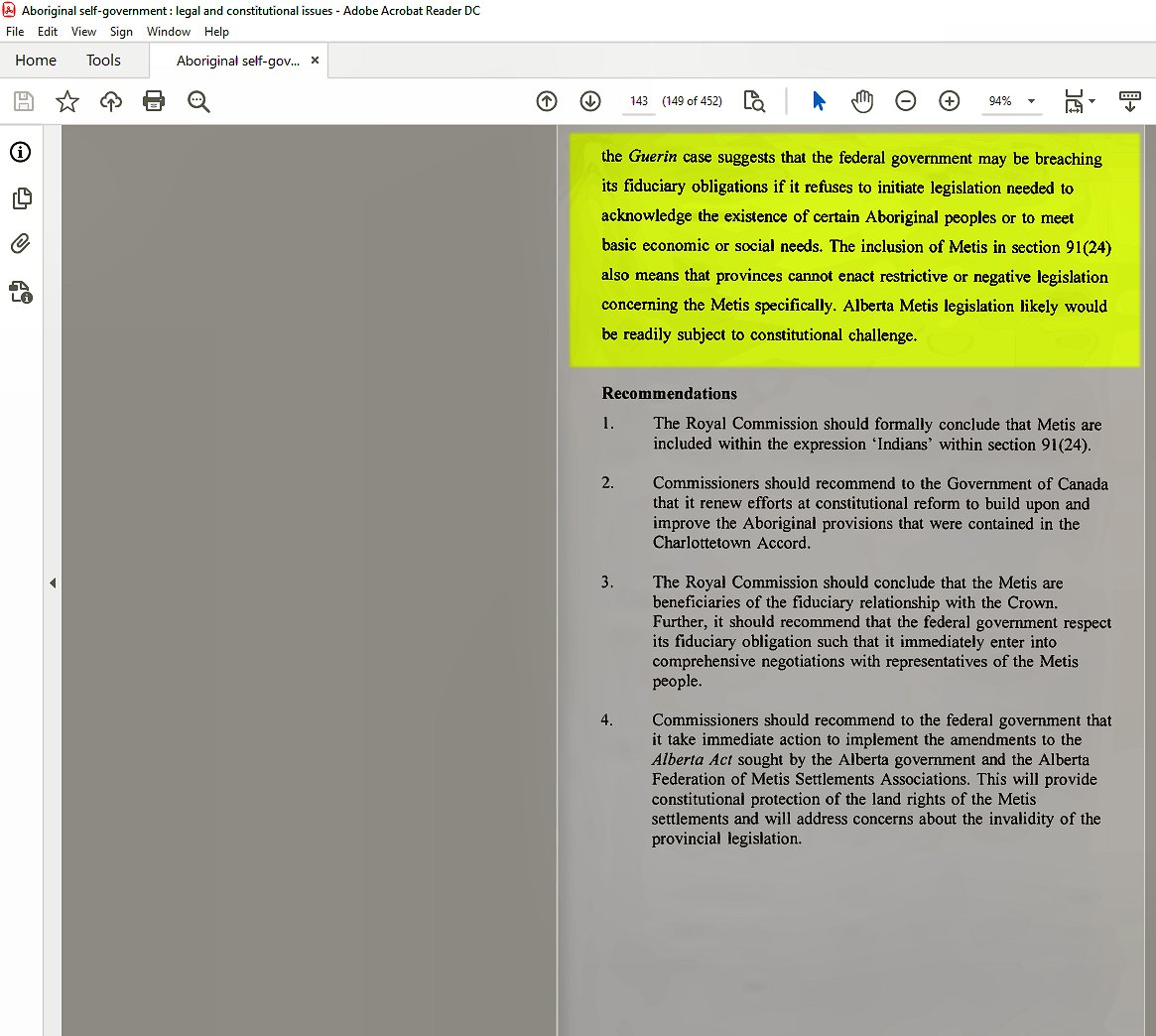
or social needs." https://t.co/90gG3LeCFC -
RELATED CASES AND POSTS
Guerin v. The Queen, [1984] 2 SCR 335
Aboriginal self-government - legal and constitutional issues 1995 Ottawa, Canada- Royal Commission on Aboriginal Peoples- pg141. - papers argues that it is logical and sensible to consider persons of mixed ancestry of all kinds to be within sec. 91(24) jurisdiction and that the
Metis are included within the fiduciary relationship owed by the crown to the Aboriginal peoples. (pg142) The recognition of Metis as one of the "aboriginal peoples of Canada" in section 35 of the Constitution Act 1982, reinforces this federal practice. "It is concluded that
sec 91(24) includes persons of mixed ancestry." pg143- "the Guerin case suggests that the federal gov. may be breaching its fiduciary obligations if it refuses to initiate legislation needed to acknowledge the existence of certain Aboriginal peoples or to meet basic economic
or social needs." https://t.co/90gG3LeCFC -
RELATED CASES AND POSTS
Guerin v. The Queen, [1984] 2 SCR 335






You May Also Like



**Thread on Bravery of Sikhs**
(I am forced to do this due to continuous hounding of Sikh Extremists since yesterday)
Rani Jindan Kaur, wife of Maharaja Ranjit Singh had illegitimate relations with Lal Singh (PM of Ranjit Singh). Along with Lal Singh, she attacked Jammu, burnt - https://t.co/EfjAq59AyI

Hindu villages of Jasrota, caused rebellion in Jammu, attacked Kishtwar.
Ancestors of Raja Ranjit Singh, The Sansi Tribe used to give daughters as concubines to Jahangir.

The Ludhiana Political Agency (Later NW Fronties Prov) was formed by less than 4000 British soldiers who advanced from Delhi and reached Ludhiana, receiving submissions of all sikh chiefs along the way. The submission of the troops of Raja of Lahore (Ranjit Singh) at Ambala.
Dabistan a contemporary book on Sikh History tells us that Guru Hargobind broke Naina devi Idol Same source describes Guru Hargobind serving a eunuch
YarKhan. (ref was proudly shared by a sikh on twitter)
Gobind Singh followed Bahadur Shah to Deccan to fight for him.

In Zafarnama, Guru Gobind Singh states that the reason he was in conflict with the Hill Rajas was that while they were worshiping idols, while he was an idol-breaker.
And idiot Hindus place him along Maharana, Prithviraj and Shivaji as saviours of Dharma.

(I am forced to do this due to continuous hounding of Sikh Extremists since yesterday)
Rani Jindan Kaur, wife of Maharaja Ranjit Singh had illegitimate relations with Lal Singh (PM of Ranjit Singh). Along with Lal Singh, she attacked Jammu, burnt - https://t.co/EfjAq59AyI
Tomorrow again same thing happens bcoz fudus like you are creating a narrative oh Khalistan. when farmers are asking MSP. (RSS ki tatti khane wale Kerni sena ke kutte).
— Ancient Economist (@_stock_tips) December 5, 2020
U kill sikhs in 1984 just politics. To BC low IQ fudu Saale entire history was politics.
Hindu villages of Jasrota, caused rebellion in Jammu, attacked Kishtwar.
Ancestors of Raja Ranjit Singh, The Sansi Tribe used to give daughters as concubines to Jahangir.
The Ludhiana Political Agency (Later NW Fronties Prov) was formed by less than 4000 British soldiers who advanced from Delhi and reached Ludhiana, receiving submissions of all sikh chiefs along the way. The submission of the troops of Raja of Lahore (Ranjit Singh) at Ambala.
Dabistan a contemporary book on Sikh History tells us that Guru Hargobind broke Naina devi Idol Same source describes Guru Hargobind serving a eunuch
YarKhan. (ref was proudly shared by a sikh on twitter)
Gobind Singh followed Bahadur Shah to Deccan to fight for him.
In Zafarnama, Guru Gobind Singh states that the reason he was in conflict with the Hill Rajas was that while they were worshiping idols, while he was an idol-breaker.
And idiot Hindus place him along Maharana, Prithviraj and Shivaji as saviours of Dharma.