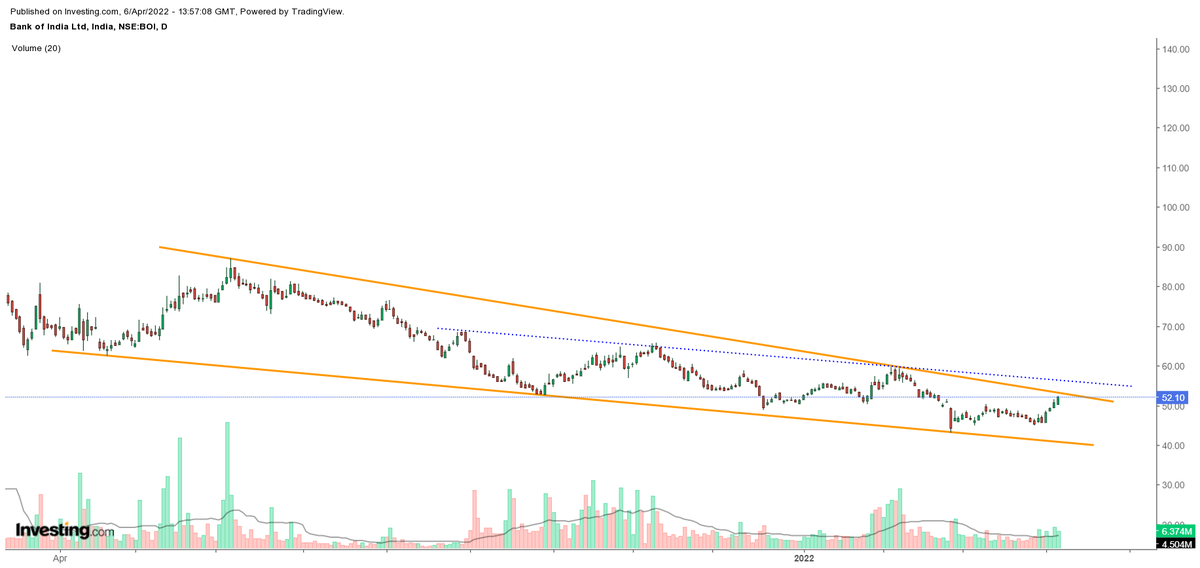
#BankofIndia -- Volumes picking up, need to breakout from wedge and cross dotted blue line to kick start the move.
Underperformer so far in PSU Space @prashant280294
Just a matter of time
More from Shivaji Vitthalrao🇮🇳
When you see 4 digit in this stock give me a party 😀🤪(Kidding)
Today I see a very strong signal of this happening in 3-4 years. Trail sl as pernur risk.
#Indiacem
Today I see a very strong signal of this happening in 3-4 years. Trail sl as pernur risk.
#Indiacem
India Cement Could not cross 226 in the last attempt to trigger multi year breakout.
— Shivaji Vitthalrao\U0001f1ee\U0001f1f3 (@shivaji_1983) September 2, 2021
Stock in this leg crossing 212 can trigger this 14 years breakout. CMP 180 taking a SL 150
Revised Target 4 digits by 2024-2025. I am not kidding \U0001f600#Indiacement https://t.co/xhWjqrJm4j pic.twitter.com/42Q8qO7tO7
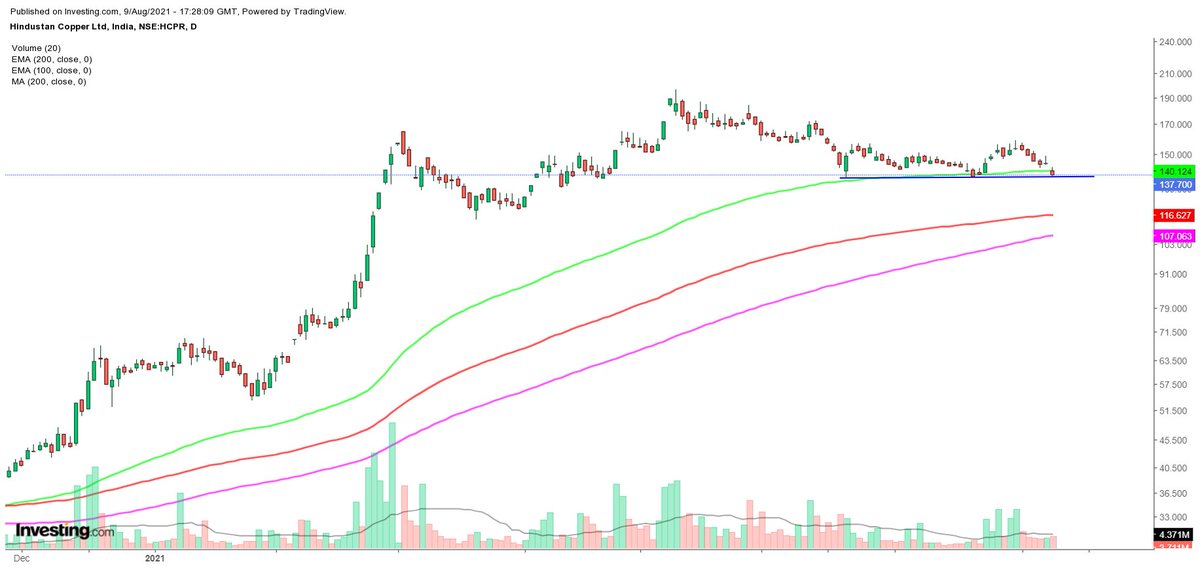
Hindcopper - Below 135 doors open for 108-117 (200 SMA and DEMA).
Longs Alert take care. Stock looks weak to me below 135.
#hindcopper https://t.co/hnXBWmcPEX
Longs Alert take care. Stock looks weak to me below 135.
#hindcopper https://t.co/hnXBWmcPEX
Hindcopper unable to cross 158 and required bullish momentum missing.
— Shivaji Vitthalrao\U0001f1ee\U0001f1f3 (@shivaji_1983) August 9, 2021
Closing below 135 is weak signal.
Would like to wait n watch before commenting further on this stock.
Dosc: Holding "NO Longs" in this stock. https://t.co/qGAnigXBB7
#NTPC when was the last time stock moved 20rs(15%) in 4 days?
What was on the charts ?
Once 135 was crossed there was no looking back @moneyworks4u_fa
Lots of hints given 😊🙏
What was on the charts ?
Once 135 was crossed there was no looking back @moneyworks4u_fa
Lots of hints given 😊🙏
#NTPC -- On the verge of 13yr breakout above 140-144 can do 170-180 pic.twitter.com/eDBGHVqlYz
— Shivaji Vitthalrao\U0001f1ee\U0001f1f3 (@shivaji_1983) March 24, 2022

You May Also Like


A brief analysis and comparison of the CSS for Twitter's PWA vs Twitter's legacy desktop website. The difference is dramatic and I'll touch on some reasons why.
Legacy site *downloads* ~630 KB CSS per theme and writing direction.
6,769 rules
9,252 selectors
16.7k declarations
3,370 unique declarations
44 media queries
36 unique colors
50 unique background colors
46 unique font sizes
39 unique z-indices
https://t.co/qyl4Bt1i5x

PWA *incrementally generates* ~30 KB CSS that handles all themes and writing directions.
735 rules
740 selectors
757 declarations
730 unique declarations
0 media queries
11 unique colors
32 unique background colors
15 unique font sizes
7 unique z-indices
https://t.co/w7oNG5KUkJ

The legacy site's CSS is what happens when hundreds of people directly write CSS over many years. Specificity wars, redundancy, a house of cards that can't be fixed. The result is extremely inefficient and error-prone styling that punishes users and developers.
The PWA's CSS is generated on-demand by a JS framework that manages styles and outputs "atomic CSS". The framework can enforce strict constraints and perform optimisations, which is why the CSS is so much smaller and safer. Style conflicts and unbounded CSS growth are avoided.
Legacy site *downloads* ~630 KB CSS per theme and writing direction.
6,769 rules
9,252 selectors
16.7k declarations
3,370 unique declarations
44 media queries
36 unique colors
50 unique background colors
46 unique font sizes
39 unique z-indices
https://t.co/qyl4Bt1i5x
PWA *incrementally generates* ~30 KB CSS that handles all themes and writing directions.
735 rules
740 selectors
757 declarations
730 unique declarations
0 media queries
11 unique colors
32 unique background colors
15 unique font sizes
7 unique z-indices
https://t.co/w7oNG5KUkJ
The legacy site's CSS is what happens when hundreds of people directly write CSS over many years. Specificity wars, redundancy, a house of cards that can't be fixed. The result is extremely inefficient and error-prone styling that punishes users and developers.
The PWA's CSS is generated on-demand by a JS framework that manages styles and outputs "atomic CSS". The framework can enforce strict constraints and perform optimisations, which is why the CSS is so much smaller and safer. Style conflicts and unbounded CSS growth are avoided.