
Just because it’s true that all squares are rectangles, you argued that all rectangles must be squares. (And you did it with so much swagger.)
A surprisingly high % of stupid arguments & fights on Twitter are rooted in a tiny number of fairly obvious fallacies.
Stupid arguments & the fallacies that feed them, a thread:
Just because it’s true that all squares are rectangles, you argued that all rectangles must be squares. (And you did it with so much swagger.)
X says: Successful people aren’t afraid of hard work.
Y argues: That’s BS. I work 90 hours a week at Tech Co and am still stuck in this dead-end job.
Just because you found an exception to a general pattern, you argued that the entire pattern is false.
X says: Venture capital is useful for startups.
Y argues: Not true. Foo’s startup took VC money and they crashed & burned.
Z piles on: I agree with Y. In fact, Bar’s startup did not take VC money and it’s worth a bajillion.
Just because you found an exception to a general pattern, you argued that the exception *is* the pattern.
Just because you did not agree with one small aspect of what someone said, you argued that it makes sense to ignore everything they said.
Just because you found one thing missing in a list of generally useful things, you argued that the entire list is useless.
Just because a thing worked for you, you argued that everyone should do that thing, all the time.
Just because a thing worked for Musk / Bezos / Jobs / [insert your idol], you argued that everyone should do that thing, all the time.
Just because a thing worked for you, you argued that no one should do the opposite of that thing, ever, under any circumstance.
Just because a thing worked for Musk / Bezos / Jobs / [insert your idol], you argued that no one should do the opposite of that thing, ever, under any circumstance.
Just because a good idea wouldn’t work if “everyone did it”, you argued that it is in fact a terrible idea and *no one* should do it.
More from Shreyas Doshi
A thread of resources for aspiring & new Product Managers:
(should also be useful for Eng, Design, Data Science, Mktg, Ops folks who want to get better at PM work or want to build more empathy for your PM friends ☺️)
(oh, and pls also share *your* favorite resources below)
👇🏾
1/
Product Management - Start Here by @cagan
(hard to go wrong if you start with Marty Cagan’s
2/
Tips for Breaking into PM by @sriramk
(I’ve recommended this thread in my DMs more often than any other thread, by a pretty wide
3/
Top 100 Product Management Resources by @sachinrekhi
(well-categorized index so you can focus on whatever’s most useful right
4/
Brief interruption.
It’s important to understand your preferred learning style and go all in on that learning style (vs. struggling / procrastinating as you force a non-preferred learning
(should also be useful for Eng, Design, Data Science, Mktg, Ops folks who want to get better at PM work or want to build more empathy for your PM friends ☺️)
(oh, and pls also share *your* favorite resources below)
👇🏾
1/
Product Management - Start Here by @cagan
(hard to go wrong if you start with Marty Cagan’s
2/
Tips for Breaking into PM by @sriramk
(I’ve recommended this thread in my DMs more often than any other thread, by a pretty wide
Breaking into PMing - a \U0001f9f5 // A question folks from eng/design/other functions often have how to become a PM in a tech co.
— Sriram Krishnan (@sriramk) April 14, 2020
It can seem non-obvious and differs with each company but here are some patterns I've seen work. All the below assumes you have no PMing on your resume.
3/
Top 100 Product Management Resources by @sachinrekhi
(well-categorized index so you can focus on whatever’s most useful right
4/
Brief interruption.
It’s important to understand your preferred learning style and go all in on that learning style (vs. struggling / procrastinating as you force a non-preferred learning
There is no One Correct Way\u2122 to learn
— Shreyas Doshi (@shreyas) August 15, 2020
Don\u2019t feel pressured to read 70 books/year just becos Super-Successful Person X does that
Videos, Podcasts, Audiobooks, Discussions\u2014all are fine
What to do:
Understand your preferred learning style
Don't resist it, embrace it
Commit to it


You May Also Like
















So friends here is the thread on the recommended pathway for new entrants in the stock market.
Here I will share what I believe are essentials for anybody who is interested in stock markets and the resources to learn them, its from my experience and by no means exhaustive..
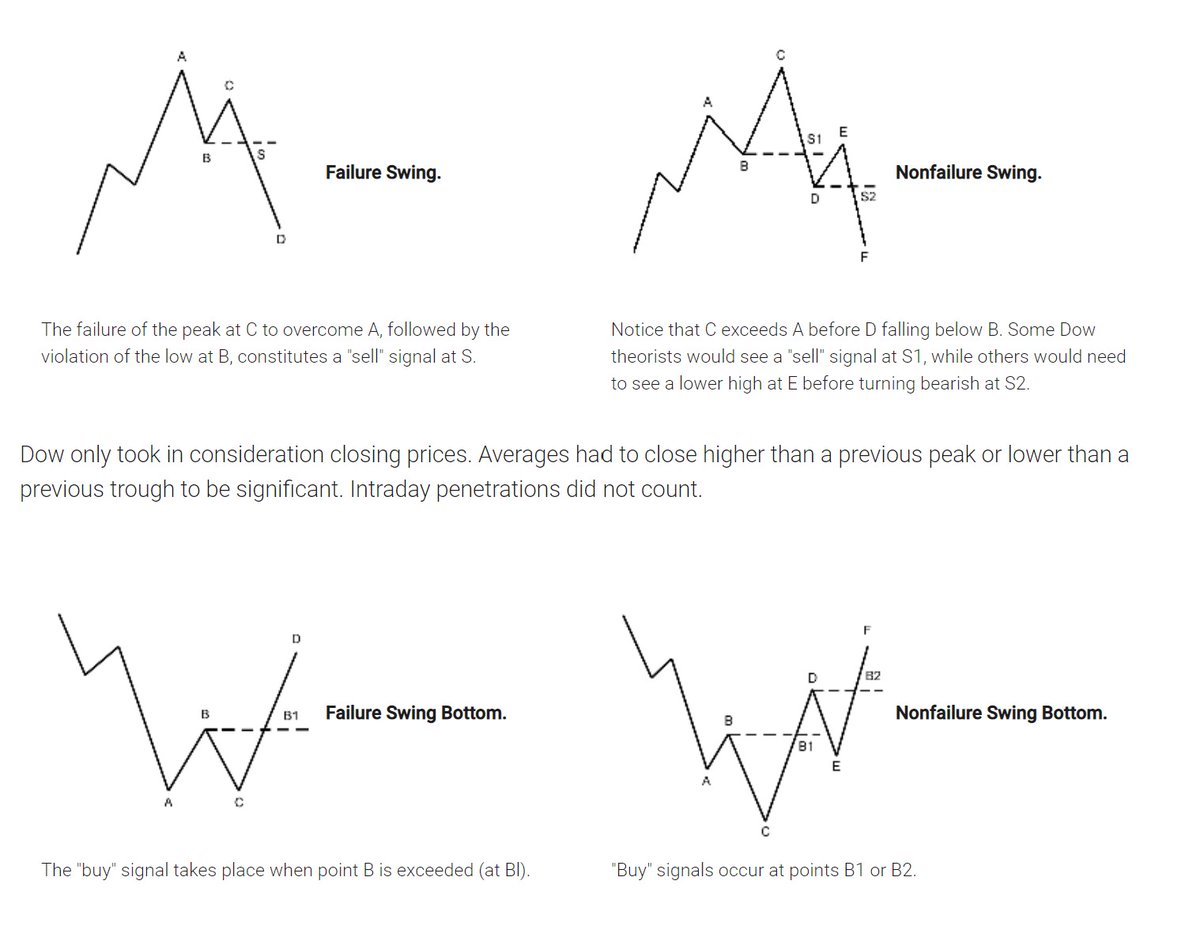
First the very basic : The Dow theory, Everybody must have basic understanding of it and must learn to observe High Highs, Higher Lows, Lower Highs and Lowers lows on charts and their
Even those who are more inclined towards fundamental side can also benefit from Dow theory, as it can hint start & end of Bull/Bear runs thereby indication entry and exits.
Next basic is Wyckoff's Theory. It tells how accumulation and distribution happens with regularity and how the market actually
Dow theory is old but
Here I will share what I believe are essentials for anybody who is interested in stock markets and the resources to learn them, its from my experience and by no means exhaustive..
First the very basic : The Dow theory, Everybody must have basic understanding of it and must learn to observe High Highs, Higher Lows, Lower Highs and Lowers lows on charts and their
Even those who are more inclined towards fundamental side can also benefit from Dow theory, as it can hint start & end of Bull/Bear runs thereby indication entry and exits.
Next basic is Wyckoff's Theory. It tells how accumulation and distribution happens with regularity and how the market actually
Dow theory is old but
Old is Gold....
— Professor (@DillikiBiili) January 23, 2020
this Bharti Airtel chart is a true copy of the Wyckoff Pattern propounded in 1931....... pic.twitter.com/tQ1PNebq7d