We're excited to announce WILDS v2.0, which adds unlabeled data to 8 datasets! This lets us benchmark methods for domain adaptation & representation learning. All labeled data & evaluations are unchanged.

(New) paper: https://t.co/9MaYUFluu7
Website: https://t.co/vA5KxsZf6c

🧵

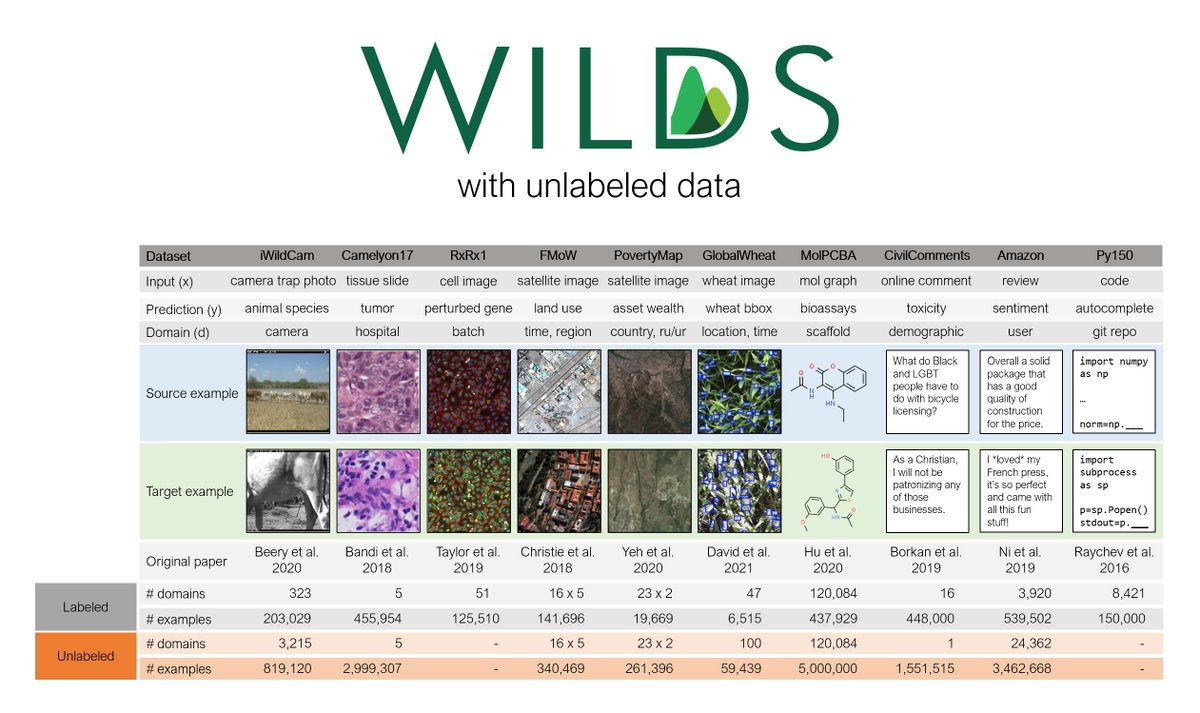
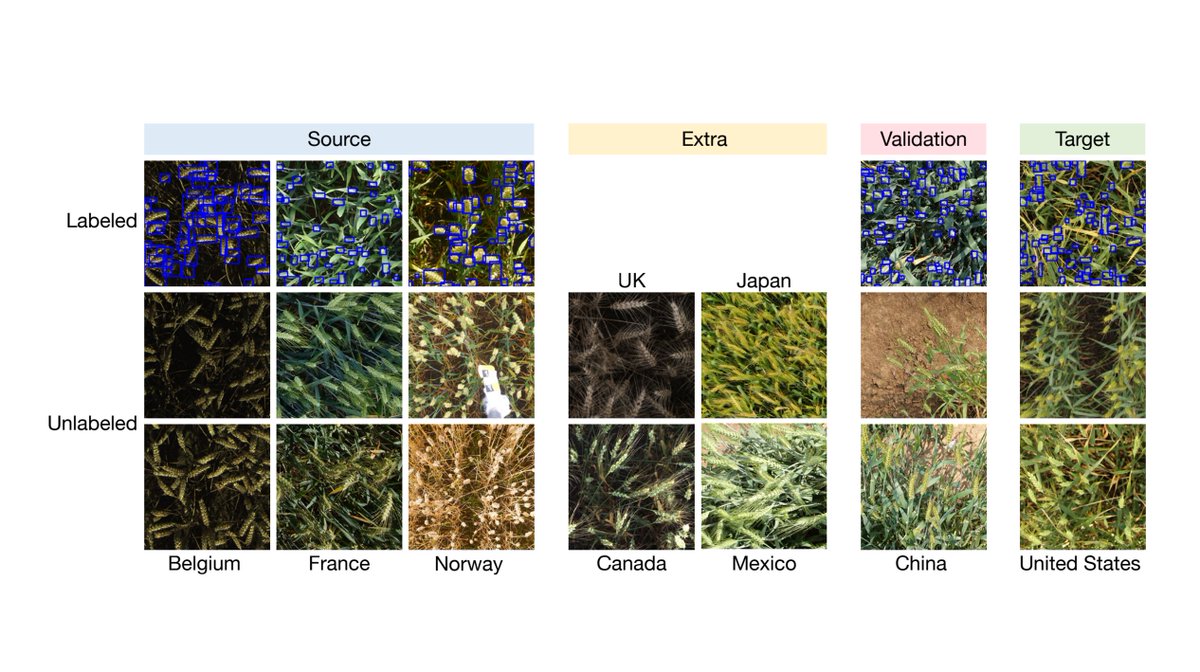
Unlabeled data can be a powerful source of leverage. It comes from a mixture of:
- source domains (same as the labeled training data)
- target domains (same as the labeled test data)
- extra domains with no labeled data.

We illustrate this for the GlobalWheat dataset:
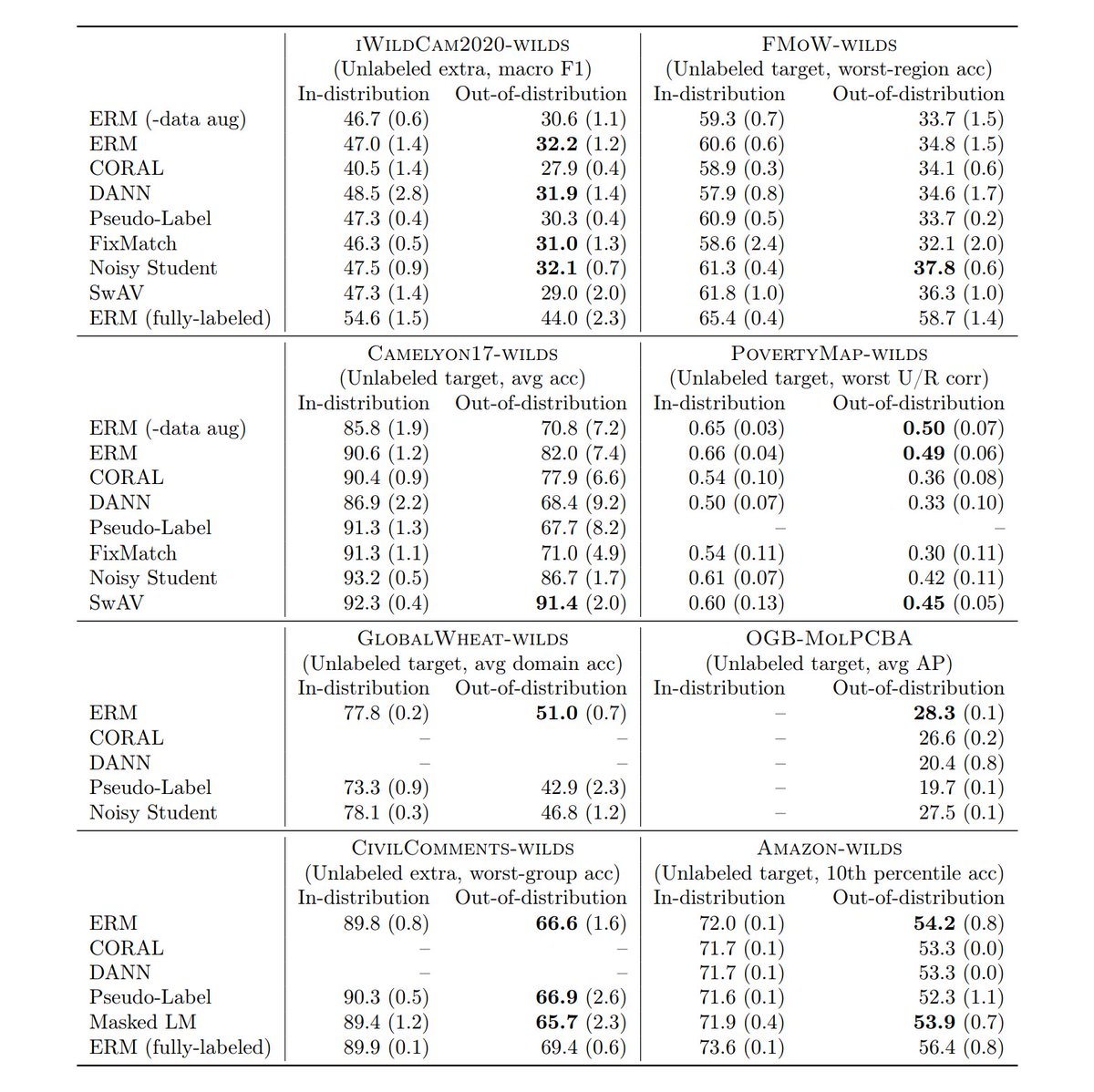
We evaluated domain adaptation, self-training, & self-supervised methods on these datasets. Unfortunately, many methods did not do better than standard supervised training, despite using additional unlabeled data.

This table shows OOD test performance; higher numbers are better.
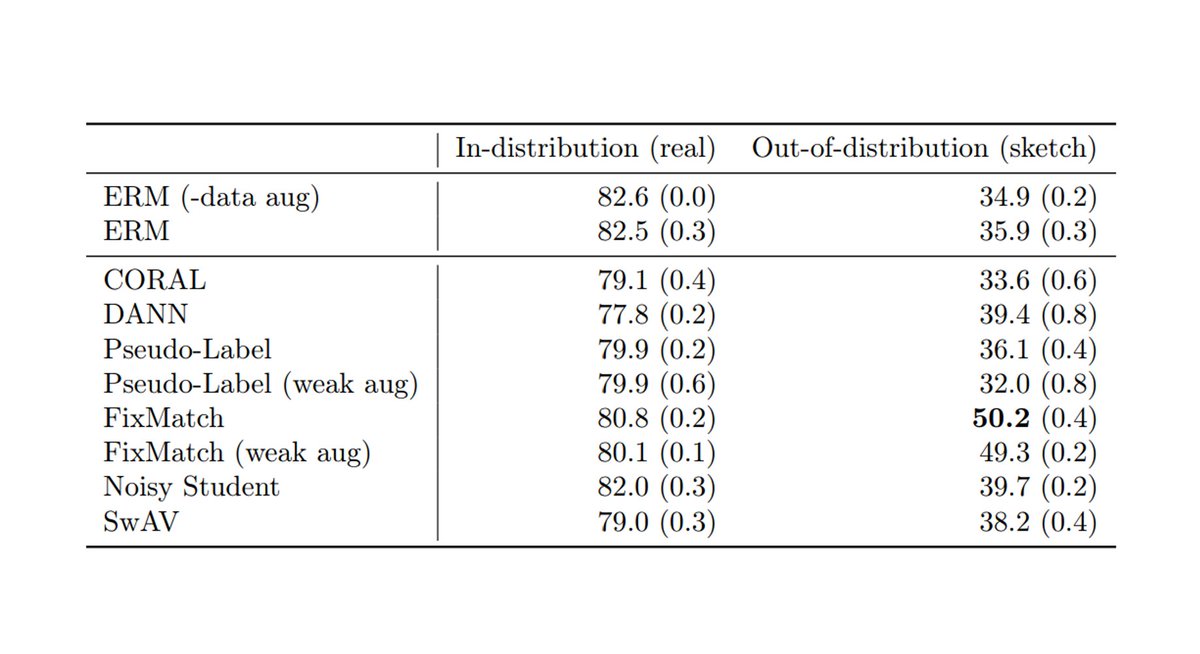
In contrast, prior work has shown these methods to be successful on standard domain adaptation tasks such as DomainNet, which we replicate below. This underscores the importance of developing and evaluating methods on a broad variety of distribution shifts.
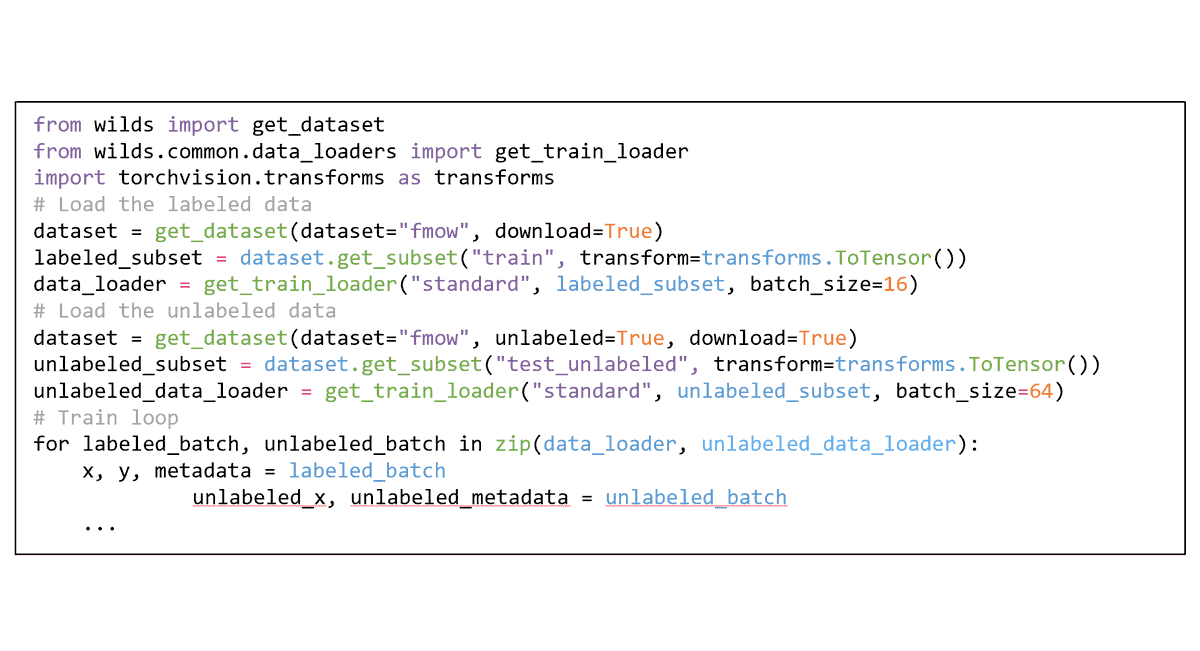
We've added the unlabeled data loaders + method implementations to our Python package: https://t.co/S73kjDxMis. They're easy to use: check out the code snippet below!

We've also updated our leaderboards to accept submissions with and without unlabeled data.
We've uploaded the exact commands and hyperparameters used in our paper, as well as trained model checkpoints, to https://t.co/qI7yvTWGsT. This is thanks to @tonyh_lee, who oversaw all of the experimental infrastructure and made it fully reproducible on @CodaLabWS.
We're grateful to everyone who helped us with WILDS and the v2.0 update: https://t.co/1CAsr8JV99.

We'd also like to thank Jiang et al. for https://t.co/CSIYF8gcFT and Zhang et al. for https://t.co/Kla5i4C9Y9, which were very helpful references for our method implementations.
This was joint work with @shiorisagawa* @tonyh_lee* IrenaGao*, and @sangmichaelxie @kendrick_shen @ananyaku @weihua916 @michiyasunaga HenrikMarklund @sarameghanbeery @EtienneDavid @IanStavness @guowei_net @jure @kate_saenko_ @tatsu_hashimoto @svlevine @chelseabfinn @percyliang.
We'll be presenting this at the DistShift workshop at NeurIPS. Find us at our poster on Dec 13, 1-3pm Pacific Time: https://t.co/gid3wBSqb6

Read our paper for more details and analysis: https://t.co/m95JSY9LbJ

More from All

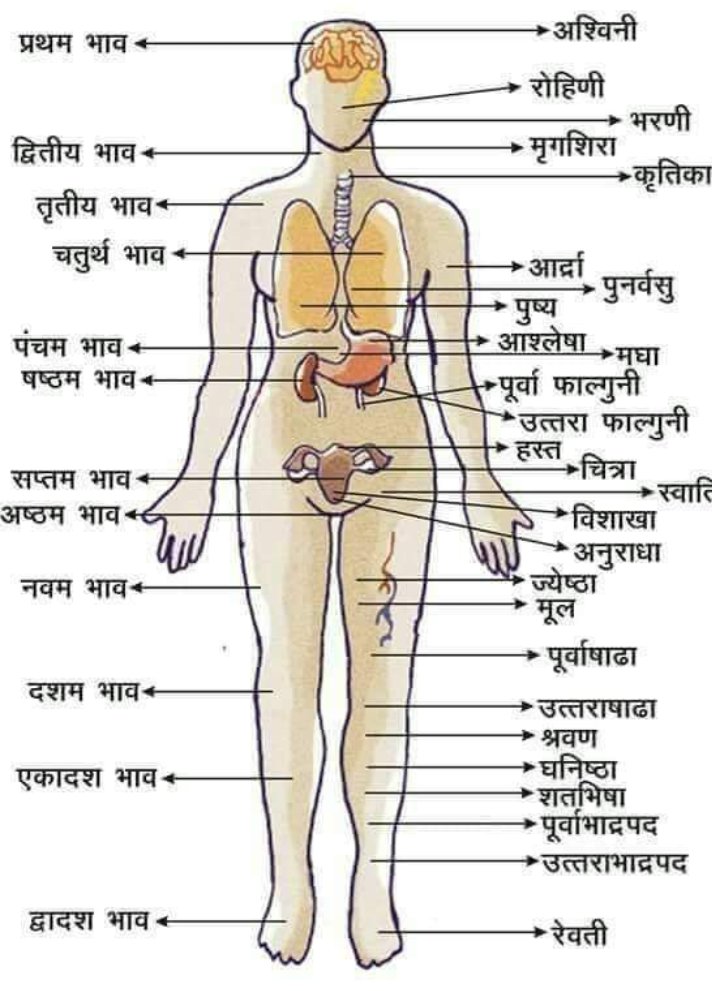
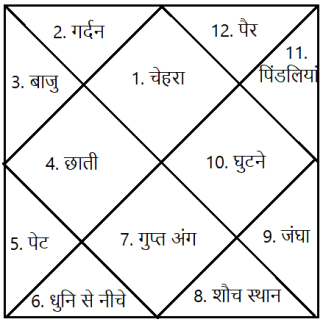
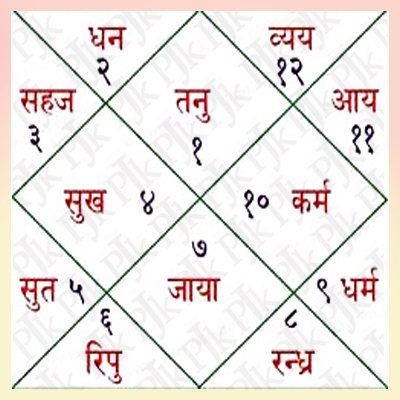
कुंडली में 12 भाव होते हैं। कैसे ज्योतिष द्वारा रोग के आंकलन करते समय कुंडली के विभिन्न भावों से गणना करते हैं आज इस पर चर्चा करेंगे।
कुण्डली को कालपुरुष की संज्ञा देकर इसमें शरीर के अंगों को स्थापित कर उनसे रोग, रोगेश, रोग को बढ़ाने घटाने वाले ग्रह


रोग की स्थिति में उत्प्रेरक का कार्य करने वाले ग्रह, आयुर्वेदिक/ऐलोपैथी/होमियोपैथी में से कौन कारगर होगा इसका आँकलन, रक्त विकार, रक्त और आपरेशन की स्थिति, कौन सा आंतरिक या बाहरी अंग प्रभावित होगा इत्यादि गणना करने में कुंडली का प्रयोग किया जाता है।


मेडिकल ज्योतिष में आज के समय में Dr. K. S. Charak का नाम निर्विवाद रूप से प्रथम स्थान रखता है। उनकी लिखी कई पुस्तकें आज इस क्षेत्र में नए ज्योतिषों का मार्गदर्शन कर रही हैं।
प्रथम भाव -
इस भाव से हम व्यक्ति की रोगप्रतिरोधक क्षमता, सिर, मष्तिस्क का विचार करते हैं।


द्वितीय भाव-
दाहिना नेत्र, मुख, वाणी, नाक, गर्दन व गले के ऊपरी भाग का विचार होता है।
तृतीय भाव-
अस्थि, गला,कान, हाथ, कंधे व छाती के आंतरिक अंगों का शुरुआती भाग इत्यादि।

चतुर्थ भाव- छाती व इसके आंतरिक अंग, जातक की मानसिक स्थिति/प्रकृति, स्तन आदि की गणना की जाती है


पंचम भाव-
जातक की बुद्धि व उसकी तीव्रता,पीठ, पसलियां,पेट, हृदय की स्थिति आंकलन में प्रयोग होता है।

षष्ठ भाव-
रोग भाव कहा जाता है। कुंडली मे इसके तत्कालिक भाव स्वामी, कालपुरुष कुंडली के स्वामी, दृष्टि संबंध, रोगेश की स्थिति, रोगेश के नक्षत्र औऱ रोगेश व भाव की डिग्री इत्यादि।

You May Also Like

These 10 threads will teach you more than reading 100 books

Five billionaires share their top lessons on startups, life and entrepreneurship (1/10)


10 competitive advantages that will trump talent (2/10)


Some harsh truths you probably don’t want to hear (3/10)


10 significant lies you’re told about the world (4/10)