In Vedic literature, one of the most frequent names of Rudra is शर्व ("archer").
Yajurveda 4.5 (Taittiriya Samhita) is popularly known as Shri Rudram or Śatarudrīya
Its fifth Anuvaka starts with
नमोभवाय च रुद्राय च नमः शर्वाय च पशुपतयेच
Infact, the Śatarudrīya starts with:
नमस्तेरुद्रमन्यव उतोत इषवेनमः ।
नमस्ते अस्तुधन्वनेबाहुभ्यामुततेनमः ॥
"Veneration to your wrath, O Rudra. Veneration to your arrow as well; Veneration to your bow and veneration to your arms" (Yajurveda 4.5.1.1).
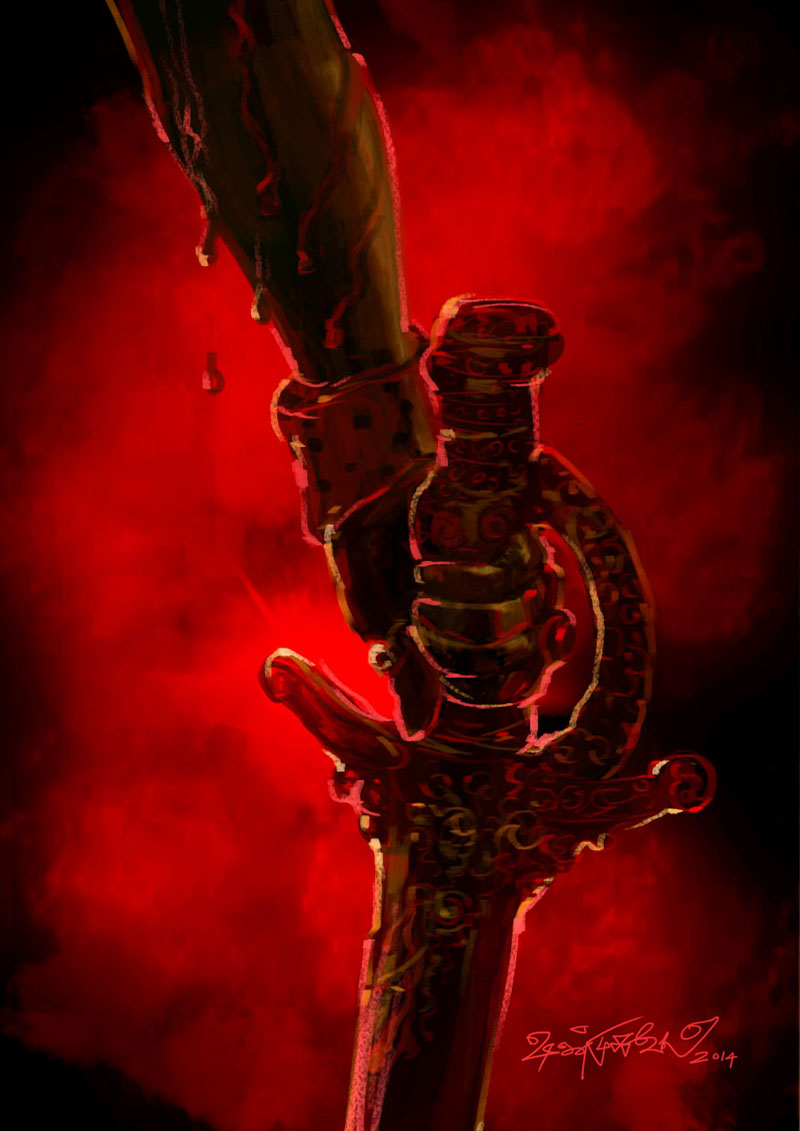
The bow of Rudra was पिनाक
In fact, in the entire Vedic literature, triśūla is not mentioned anywhere as the weapon of Rudra-Śiva. This is only mentioned in Post Vedic literature(Epic and Puranic)
Likewise, God Apollo is renowned in Ancient Greek literature as "The Archer".
In Illiad (c. 800 BC), The most frequent phrase used by Homer to describe Apollo is "Apollo who shoots from afar"
The Homeric hymn to Apollo starts with
"I will remember and not forget Apollo who shoots from afar."
"Apollo who kiIIs from afar"- Euripedes
This phrase has a parallel in Śatarudrīya which describes Rudra as दूरेवधाय ( he who shoots/kiIIs from afar)
https://t.co/SZQshE8PgP
In Illiad, Homer describes Apollo as παιών ("healer").
In the later Greek literature, "divine healer" is the most common epithet for Apollo.
Before the advent of Christianity. The Greek physicians ritually worshiped Apollo before commencing their craft.
Infact, one of the names of Apollo is ἰατρός/iatros ("doctor").
This terms is now found as the suffix "iatry" in several medical terms.
Pediatry,Psychiatry,holiatry, chemiatry, hippiatry etc.
Again, a parallel can be found in the Śatarudrīya.
In the very first Anuvaka, Rudra is defined as Daivyobhishak("divine healer").
Ayurvedic doctors traditionally began their craft by praying to Rudra.
This is why Rudra-Śiva is called "Vaidyanath" ("Lord of doctors")
Caution: Before ignorant outrage activists descend again to pollute my mentions, here is the caveat.
Am I saying that Rudra and Apollo are one and the same? No, I am NOT.
Am I comparing Rudra to Apollo? No, I am NOT. In my personal belief, there is no one equal to Rudra.
I am a Vaidika & like my forefathers did for thousands of years, I chant Śatarudrīya almost everyday.
I noticed some connections that I document in this thread.
If you cannot keep an open mind, there is no need to read this thread. I will block anyone misinterpreting/abusing
Are there differences between Apollo and Rudra?
Yes, there are many. But most of these differences spring from later, post Homeric times. Greek society has made innovations and the sect of Apollo kept changing with time, associating Apollo with attributes not originally found.
The Greek frequently depicted Apollo as Apollo Didymeus.
In this form, Apollo was depicted as half male & half female, encompassing both masculine & feminine forms of reality.
There was a large temple dedicated to Apollo Didymeus.
at Miletus (Anatolia)
https://t.co/f71xdtuQVp
The Ardhanārīśvara form of Rudra-Siva is quite well known in India and the earliest representations date back to the Kushan age.
Apollo was considered as the God of Music and Dance.
Before the advent of Christianity, the Greek Pagan Musicians and Dancers worshiped Apollo as their patron deity.
Apollo is frequently shown dancing with Muses (who are minor Greek goddesses personifying arts)
Infact, the Homeric hymn to Apollo opens with a scene of Apollo singing and dancing at mount Olympus.
This Ballet of the Greek age is infact the originator of modern western Ballet.
https://t.co/QloIMbKXLJ
The modern American Ballet was has the theme of Dancing Apollo and his muses as its subject and takes its name from Apollo: Apollon musagète
https://t.co/L5cVLG7BAf
Likewise, Rudra-Shiva is well known in India as Nataraja: "The king of dance"
Apollo is known as the protector of animals, cattle, herds and shepherds.
One of his epithets is Νυμφηγέτης. He is also known as ζοοποσισ("Lord of animals"). From Zoo=animals+ Posis=protector/Lord.
Rudra is called 'Pashupati' which literally means "Lord/Protector of animals".
In the Śatarudrīya, Rudra is thrice addressed as "Pashupati".
In Anuvaka 2:
नमो॑ वृ॒क्षेभ्यो॒ हरि॑केशेभ्यः पशू॒नां पत॑ये॒ नमो॒ (Yajurveda 4.5.2.2)
Anuvaka 5:
नमो॑ भ॒वाय॑ च रु॒द्राय॑ च॒ नमः॑ श॒र्वाय॑ च पशु॒पत॑ये च॒ (4.5.5.2)
Anuvaka 8:
नमः॑ शं॒गाय॑ च पशु॒पत॑ये च॒(4.5.8.2)
In Greek art, both Apollo and his twin Artemis are frequently shown holding a deer in their hands.
At Gudimallam, in what could one of the earliest known Anthropomorphic representations of Shiva, he is showing holding a deer in his right hand.
It is dated to 3rd-2nd century BC & is considered by many historians as "one of the earliest surviving &unequivocal images of Shiva"
In his Bhikṣāṭanamūrti form, he is showing holding the deer with his fingers. Sometimes, the deer's head just points towards his finger.
Even in many of the Utsavamurtis of Shiva, he is shown holding the deer with his fingers.
There are many other similarities too, which I will write at some point.
What do we make of this? I leave the interpretation to the readers. But there is a pattern.
In the earlier Homeric age, Apollo shares many attributes with Rudra. There are many differences too.
Of course, the interpretation and perception of the deities is different.
A religion is a continuum. Even if we talk about the common attributes, their perception is different across cultures. Interpretation and perception is a continuous product and keeps changing with time
Perhaps a deity similar to an early Vedic form of Rudra was indeed worshiped in Ancient Pre Homeric Greece. However, his worship was later mixed with many local Greek beliefs and customs. With time, the deity grew apart and developed into classical Apollo.
As cautioned earlier, this thread does not intend to compare Rudra and Apollo. It points out certain similarities just to explore how extensive the geographic horizon of Rudra worship and Sanatana Dharma was in the past.
ॐ नमो भगवते रुद्राय