1/ As far back as the mid 300's BC, humans were fascinated by the power of persuasion.
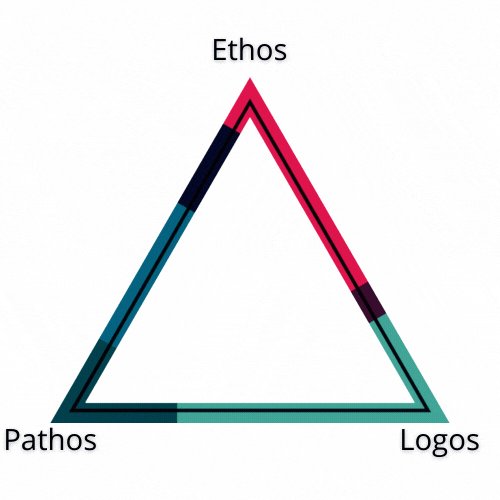
In light of this, Aristotle developed what is known as the "Rhetorical Triangle."
A framework for persuading any audience using 3 simple appeals:
•Ethos
•Pathos
•Logos
Let's dig in...
2/ Ethos (Ethics / Character)
The first of the 3 appeals, Ethos speaks to the perceived character of the speaker.
In order to persuade anyone to do anything, they must first believe you are a credible and trustworthy source.
How do you accomplish this?
3/ Establishing Ethos: (1)
•Language: Choose verbiage that is fitting to the subject matter and audience you are trying to persuade.
•Pedigree: Do you have specific credentials or education relating to the topic being covered? If so, make it known.
👇🏻
4/ Establishing Ethos: (2)
•Rapport: Your audience must feel as though you are "in sync."
You understand and can relate to their feelings or ideas.
TL;DR
•Choose the right language
•Communicate pedigree
•Build Rapport
Trust becomes a byproduct.
Let's see an example 👇🏻
5/ Establishing Ethos: (3)
If you want to learn how to do something, why not learn from the best?
In his famous Stanford Commencement speech, Steve Jobs delivered a masterclass on establishing Ethos.
@SahilBloom covers it well here:
https://t.co/E6FRNToo4L
6/ Pathos (Emotion)
The 2nd of the 3 appeals, Pathos draws on the need to elicit emotion from your audience.
You need to make them "feel."
Whether the emotion is happiness, anger, or something else, what matters is that the emotion exists.
7/ Establishing Pathos (1)
Pathos can be established in a number of ways:
•Humor: A timeless tactic for increasing engagement and winning people over.
•Imagery: The use of images is a simple way to evoke emotion from your audience.
8/ Establishing Pathos (2)
•Narrative: Everyone loves a good story.
Wrap your message in a great story and people will be on your side before they even realize their mind has been changed.
9/ Establishing Pathos (3)
One of the greatest orators in history, JFK rallied millions of people using Pathos as a driving force.
"Those who make peaceful revolution impossible will make violent revolution inevitable."
"Forgive your enemies, but never forget their names."
10/ Logos (Logic)
The last of the 3 appeals, Logos refers to the idea of building a logical argument in favor of your position.
In order to move a group of people toward your line of thinking, you must present verifiable proof as to the claims you are making.
Here's how 👇🏻
11/ Establishing Logos (1)
•Facts & statistics: Cite data supporting your argument from authorities or well-known experts.
•Rule out alternatives: State your claim in a manner that convinces your audience that your point of view is not simply "an option" but "THE option."
12/ Establishing Logos (2)
•Aristotle's Goal: Lead the conversation in a way that guides the audience to believe they have drawn their own conclusion.
The trick? You've established Ethos, Pathos, & Logos prior to this point to ensure they will draw the conclusion you desire.
13/ Establishing Logos (3)
The most common example of Logos we see today is found within the speeches of our politicians.
Often referring to statistics in support of their stance or citing alternate statics to degrade the views of their opponents.
Either way, Logos works.
14/ TL;DR
To influence your audience & change someone's mind, focus on the 3 Rhetorical Appeals:
•Ethos (Ethics) - Convey Credibility
•Pathos (Emotion) - Elicit Emotion
•Logos (Logic) - Utilize facts & stats
15/ Thank you!
Enjoy this? Want more like it?
👉🏻 Follow me
@blakeaburge 💥 Retweet and Share: I'd be grateful!
👉🏻 Quote Tweet / Comment - Let me know your thoughts!
I write 1-2 threads/week. You can find them all below. Check it out 👇🏻
https://t.co/9gdTmHKY4X