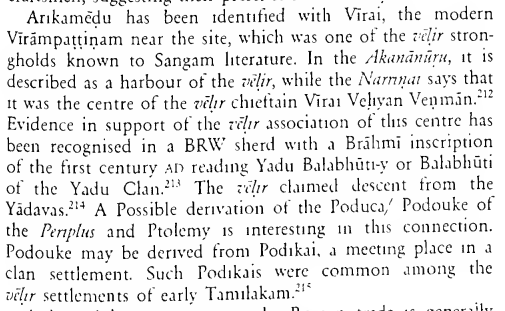
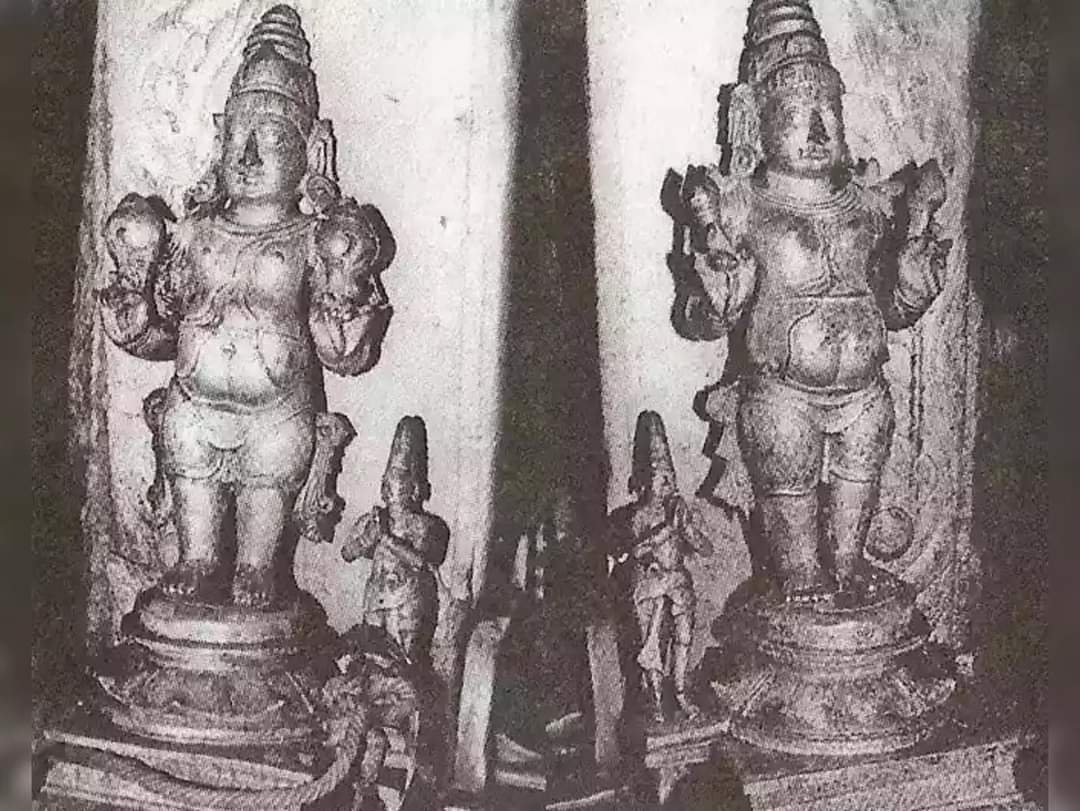
Ancient Tamil Sangam age site Arikamedu was under Velir clans. A Brahmi inscription associated with Black & Red ware (BRW) culture mentions a Velir ruler named Yadu Balabhuti in Sanskrit. This indicates Tamil kings also had Sanskritic names along with Tamil during Sangam age.

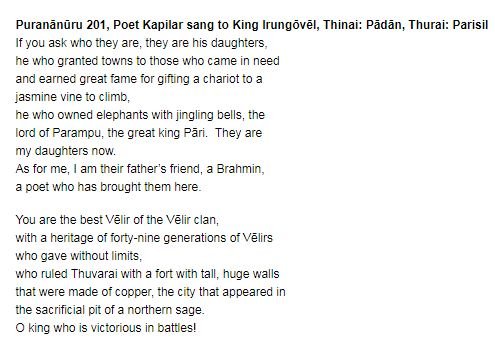
The Velir clans traced origins to Yadavas who migrated from Dvaraka along with Rishi Agastya and settled down in south. Sangam age text Purananuru 201 mentions Velirs from Thuvarai (Dwarka?) associated with 'northern sage', possibly Agastya.
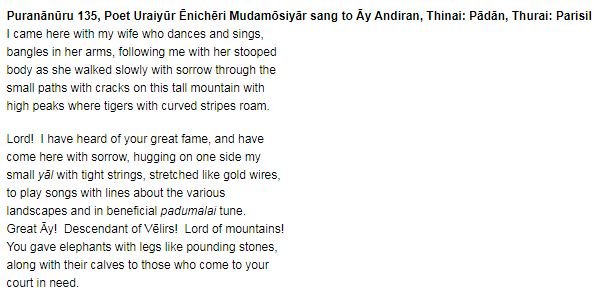
The Ay rulers who ruled southern Kerala also traced origins to the Velir clan as stated in Purananuru 135 where an Ay king is said to be descendant of Velirs.
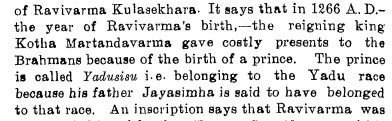
The Ay rulers continued to associate with Yadus even after mixing with Cheras who migrated from Mahodayapuram ( now Kodungallur) long after Sangam age. Samgramadhira Ravi Varma Kulashekhara, the ruler of hybrid Chera-Ay kingdom held the title 'Yadu-shishu' in 13th century
After reign of Ravi Varma, the old Tamil patrilineal succession system was changed to matrilineal system of Nairs (marumakkathayam) with adoption of princesses from north Malabar's Kolathiri line.
Kolathiris traced origins to Mushika Rajavamsha, who were offshoot of the Heheyas of Mahishmati, who were in turn related to Yadavas. The Yadava connection could explain why rulers of Travancore, whenever lacked heirs, adopted them from Kolathiri line.
Kolathiri's Mushika line was the first royal house to shift from patrilineal to matrlineal tradition. They eventually became Samantans (vassals) of the Mahodayapuram Cheras.
Perhaps the early history of Shri Padmanabha Swamy temple is closley associated with Ay kings who ruled the region independently.
Taken as whole, what all these points prove is that ancient Tamils were never under an independent non-Vedic or non-Hindu 'Dravidian civilization'. They were associated with popular Hindu legends since the dawn of their recorded history. Tamils also share Vedic heritage.
Tamils (& Mallus) should take pride in having ancient kingdoms directly tracing origins to Lord Krishna's lineage from Dwarka (we now have epigraphical & textual evidence for it) instead of imaginary non-Vedic 'Dravidian civilization' fantasies.

More from All

॥ॐ॥
अस्य श्री गायत्री ध्यान श्लोक:
(gAyatri dhyAna shlOka)
• This shloka to meditate personified form of वेदमाता गायत्री was given by Bhagwaan Brahma to Sage yAgnavalkya (याज्ञवल्क्य).

• 14th shloka of गायत्री कवचम् which is taken from वशिष्ठ संहिता, goes as follows..


• मुक्ता-विद्रुम-हेम-नील धवलच्छायैर्मुखस्त्रीक्षणै:।
muktA vidruma hEma nIla dhavalachhAyaiH mukhaistrlkShaNaiH.

• युक्तामिन्दुकला-निबद्धमुकुटां तत्वार्थवर्णात्मिकाम्॥
yuktAmindukalA nibaddha makutAm tatvArtha varNAtmikam.

• गायत्रीं वरदाभयाङ्कुश कशां शुभ्रं कपालं गदाम्।
gAyatrIm vardAbhayANkusha kashAm shubhram kapAlam gadAm.

• शंखं चक्रमथारविन्दयुगलं हस्तैर्वहन्ती भजै॥
shankham chakramathArvinda yugalam hastairvahantIm bhajE.

This shloka describes the form of वेदमाता गायत्री.

• It says, "She has five faces which shine with the colours of a Pearl 'मुक्ता', Coral 'विद्रुम', Gold 'हेम्', Sapphire 'नील्', & a Diamond 'धवलम्'.

• These five faces are symbolic of the five primordial elements called पञ्चमहाभूत:' which makes up the entire existence.

• These are the elements of SPACE, FIRE, WIND, EARTH & WATER.

• All these five faces shine with three eyes 'त्रिक्षणै:'.

You May Also Like