How to get rich, learn anything, and get more done.

11 Tweets to change your life. 🧵

1/ Learn Anything:

A masterclass from my friend @SahilBloom

The 6-step framework he uses to learn anything.

(1) Identify & Establish
(2) Research
(3) Skin in the Game
(4) Engage Community
(5) Teach
(6) Reflect & Review

https://t.co/HOUoZFnAHK
2/ A cheat sheet for building your career:

20 things you'll wish you knew sooner.

An amazing piece by @RomeenSheth on career growth.
https://t.co/bEn3fTH4xs
3/ The 5 Traits of Elite Individuals:

I'm not sure what rock I've been living under...

I've somehow just now stumbled across @NdamukongSuh's Twitter content.

It's a goldmine.

Case in point 👇🏻
https://t.co/mI35Q1PLUt
4/ Where you are -> Where you're going:

•Be consistent
•Set higher standards
•Learn to say "no" more often.

https://t.co/3MhbepoAHw
5/ Finding success-Your own way.

Everyone's definition of success, and their path to get there, is different.

A great thread from @heykahn on finding yours.
https://t.co/6CF0RzIAiF
6/ Stop procrastinating:

A simple and effective framework from @Julian for deciding what to do, how to do it, and how to get yourself moving.
https://t.co/P5FaWSAN0J
7/ You're never too old to learn something new:

My friend @jposhaughnessy shared this link a while back.

It's an amazing resource.
https://t.co/zt01x7Yvzy
8/ How to become indispensable:

When I became active on Twitter earlier this year, @heyblake was one of the first accounts that caught my eye.

Consistent, high-value, content.

Case in point:👇🏻
https://t.co/0YoPwJKG2c
9/ Learn how to market anything:

I look up to @alexgarcia_atx.

He's a machine.

Be warned.

You may spend the rest of your day doing nothing but reading Alex's work.

It's that good.
https://t.co/r0JJqh48ya
10/ A guide to startups:

What @gregisenberg has accomplished before the age of 30 is nothing short of amazing.

Twitter is insanely valuable in many ways...

For me, the ability to learn from those who are already where you want to be tops the list.
https://t.co/uVtQHCKr4Y
11/ Get Rich without getting lucky:

Perhaps the 🐐 of all threads.

@naval's piece on building wealth is timeless.

Do yourself a favor.

Read. It. All.
https://t.co/sUz6gnhDj7
As for me...

If you found this thread helpful, please:

• Retweet the first tweet and help others find this thread

• Follow me at @blakeaburge

I write about mental models, productivity, and building a better you. https://t.co/9gdTmHKY4X

More from Blake Burge 💡

More from All

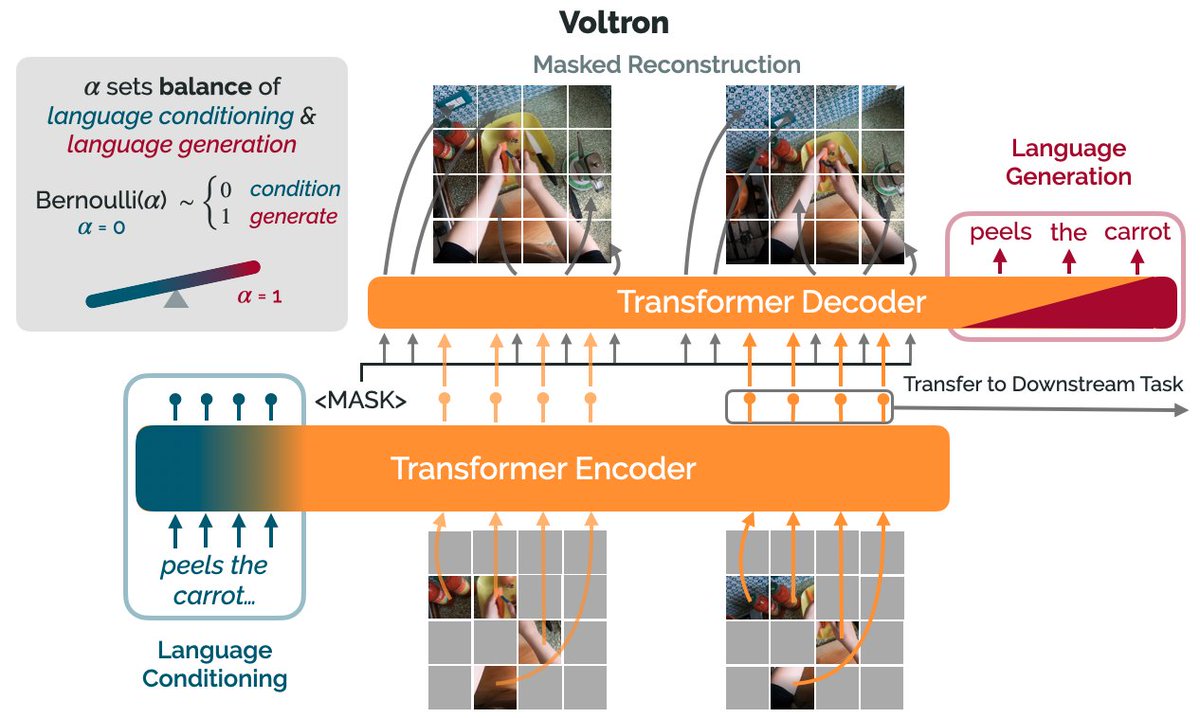
How can we use language supervision to learn better visual representations for robotics?

Introducing Voltron: Language-Driven Representation Learning for Robotics!

Paper: https://t.co/gIsRPtSjKz
Models: https://t.co/NOB3cpATYG
Evaluation: https://t.co/aOzQu95J8z

🧵👇(1 / 12)


Videos of humans performing everyday tasks (Something-Something-v2, Ego4D) offer a rich and diverse resource for learning representations for robotic manipulation.

Yet, an underused part of these datasets are the rich, natural language annotations accompanying each video. (2/12)

The Voltron framework offers a simple way to use language supervision to shape representation learning, building off of prior work in representations for robotics like MVP (
https://t.co/Pb0mk9hb4i) and R3M (https://t.co/o2Fkc3fP0e).

The secret is *balance* (3/12)

Starting with a masked autoencoder over frames from these video clips, make a choice:

1) Condition on language and improve our ability to reconstruct the scene.

2) Generate language given the visual representation and improve our ability to describe what's happening. (4/12)

By trading off *conditioning* and *generation* we show that we can learn 1) better representations than prior methods, and 2) explicitly shape the balance of low and high-level features captured.

Why is the ability to shape this balance important? (5/12)

You May Also Like