His parents lovingly called him ‘Baba’ and the name stuck with him. At a very young age, Baba owned a gun and used to hunt wild boar and deer.
Thread on #RealHeroesofIndia
Murlidhar Devidas Amte was the eldest son of Devidas and Laxmibai Amte. His father Devidas was a powerful bureaucrat with the pre-independence British administration and a wealthy landowner in the Wardha district.
His parents lovingly called him ‘Baba’ and the name stuck with him. At a very young age, Baba owned a gun and used to hunt wild boar and deer.
Baba studied law and earned his LLB degree from Law College in Wardha. He set up a law practice in his native town which soon became successful.
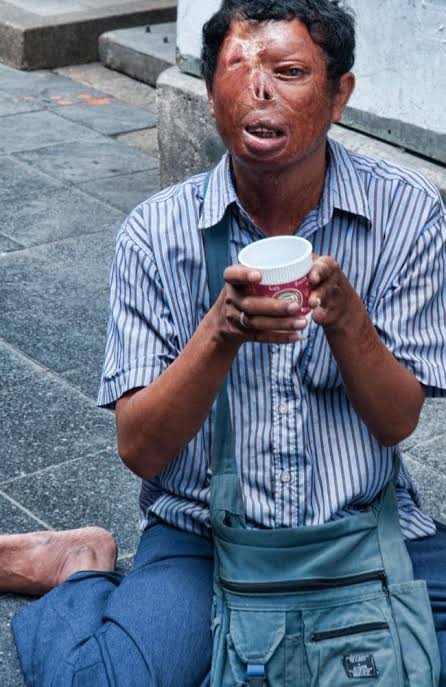
He had no idea about leprosy and its treatment.
Their decision welcomed extreme criticism from their parents and society.
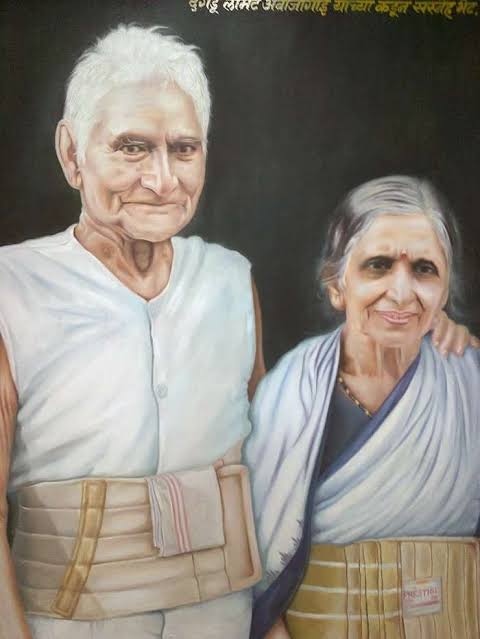
With Rs 14 and six leprosy patients, he approached the Maharashtra government and was granted 250 acres of land for the same.
Later he found two more ashrams and was awarded with Padma Shri, Padma Vibhushan and several such awards.

More from Āyudhika




Total 20 paras of this poem.
🔸️Being Balanced🔸️
1/
अतीकोपता कार्य जाते लयाला,
अती नम्रता पात्र होते भयाला ।
अती काम ते कोणतेही नसावे,
प्रमाणामधे सर्व काही असावे ।।
Translation👇🏽
The Act of Aggression/Anger strains the work,
Extreme humility leads to fear,
There shouldn't be any kind of work in excess,
Everything should be in proportion.
2/
अती लोभ आणी जना नित्य लाज,
अती त्याग तो रोकडा मृत्य आज ।
सदा तृप्त नेमस्त सर्वां दिसावे,
प्रमाणामधे सर्व काही असावे ।।
Excess greed can bring shame in the eyes of people,
If you overdo sacrifice, death will stand before you,
Always look deeply contented and disciplined,
Everything should be in proportion.
(Check greed and sacrifice are opposites of each other)
3/
अती मोह हा दु:ख शोकास मूळ,
अती काळजी टाकणे हेही खूळ ।
सदा चित्त हे सद्विचारे कसावे,
प्रमाणामधे सर्व काही असावे ।।
Translation 👇🏽👇🏽
🔸️Being Balanced🔸️
1/
अतीकोपता कार्य जाते लयाला,
अती नम्रता पात्र होते भयाला ।
अती काम ते कोणतेही नसावे,
प्रमाणामधे सर्व काही असावे ।।
Translation👇🏽
#\u0926\u093e\u0938\u0928\u0935\u092e\u0940 \u0928\u093f\u092e\u093f\u0924\u094d\u0924 #\u0938\u092e\u0930\u094d\u0925_\u0930\u093e\u092e\u0926\u093e\u0938_\u0938\u094d\u0935\u093e\u092e\u0940 \u092f\u093e\u0902\u091a\u094d\u092f\u093e \u091a\u0930\u0923\u0940 \u0915\u094b\u091f\u0940 \u0915\u094b\u091f\u0940 \u0935\u0902\u0926\u0928 !
— \u0100yudhika (@Satyamev1310) February 25, 2022
The best Guru - Shishya relationship ever!
I'll try and explain some of his beautiful teachings from tomorrow onwards for a week.\U0001f64f\U0001f3fd\U0001f60a pic.twitter.com/DHFIwselht
The Act of Aggression/Anger strains the work,
Extreme humility leads to fear,
There shouldn't be any kind of work in excess,
Everything should be in proportion.
2/
अती लोभ आणी जना नित्य लाज,
अती त्याग तो रोकडा मृत्य आज ।
सदा तृप्त नेमस्त सर्वां दिसावे,
प्रमाणामधे सर्व काही असावे ।।
Excess greed can bring shame in the eyes of people,
If you overdo sacrifice, death will stand before you,
Always look deeply contented and disciplined,
Everything should be in proportion.
(Check greed and sacrifice are opposites of each other)
3/
अती मोह हा दु:ख शोकास मूळ,
अती काळजी टाकणे हेही खूळ ।
सदा चित्त हे सद्विचारे कसावे,
प्रमाणामधे सर्व काही असावे ।।
Translation 👇🏽👇🏽
Barley became the Aryans' initial staple food, and is also mentioned in the Rigveda.
Later texts mention wheat, lentils, millets, and sugarcane.
The most popular lentils used were red lentils, green lentils, and black lentils. Apupa is a form of cake prepared by frying barley
Khapli wheat was grown commercially in the Indian subcontinent since historic times.
Moreover, khapli is hulled wheat, which means that husks enclose the grain. During threshing, the outer chaff does not release the grain.
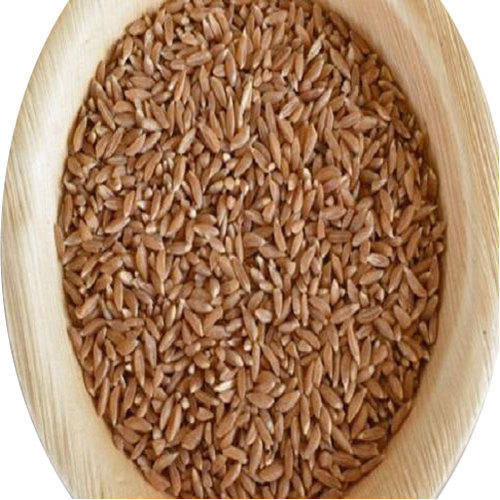
Another wheat species called Mihi, cultivated in Punjab during the Indus Valley Civilization (2600 - 1900 BCE) has vanished completely today.
The Aryans brought wheat grains to India & possibly this crop spread from its place of origin to European countries
The importance of hulled wheat in past societies is hardly reflected in their current status as a minor and ever declining crop grown in isolated and marginal areas in the world.
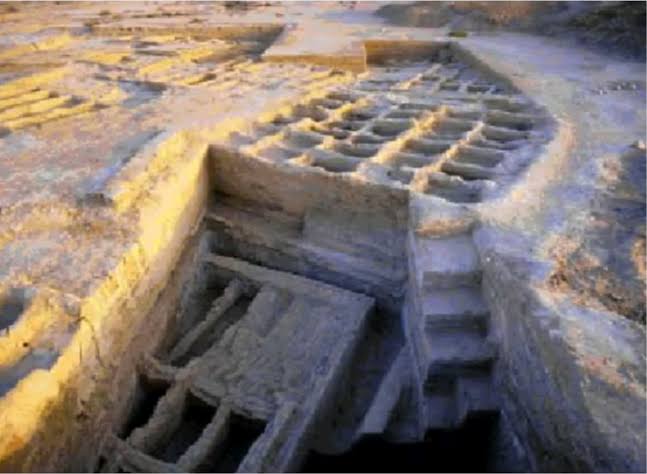
The earliest evidence of cultivation of Khapli wheat comes from the Neolithic archaeological site of Mehrgarh (6000 - 5000 BCE), currently in Pak.
However archaeological findings from Kunal in Haryana, Kanishkapura in Kashmir, Harappan settlement of Rohira in Punjab
Later texts mention wheat, lentils, millets, and sugarcane.
The most popular lentils used were red lentils, green lentils, and black lentils. Apupa is a form of cake prepared by frying barley
What are your thoughts about wheat?
— \u0100yudhika \U0001f1ee\U0001f1f3 (@Satyamev1310) July 19, 2021
Did our ancestors eat wheat as a staple food?
Once I see people interested, I've something interesting to share.
Khapli wheat was grown commercially in the Indian subcontinent since historic times.
Moreover, khapli is hulled wheat, which means that husks enclose the grain. During threshing, the outer chaff does not release the grain.
Another wheat species called Mihi, cultivated in Punjab during the Indus Valley Civilization (2600 - 1900 BCE) has vanished completely today.
The Aryans brought wheat grains to India & possibly this crop spread from its place of origin to European countries
The importance of hulled wheat in past societies is hardly reflected in their current status as a minor and ever declining crop grown in isolated and marginal areas in the world.
The earliest evidence of cultivation of Khapli wheat comes from the Neolithic archaeological site of Mehrgarh (6000 - 5000 BCE), currently in Pak.
However archaeological findings from Kunal in Haryana, Kanishkapura in Kashmir, Harappan settlement of Rohira in Punjab
More from All


https://t.co/6cRR2B3jBE
Viruses and other pathogens are often studied as stand-alone entities, despite that, in nature, they mostly live in multispecies associations called biofilms—both externally and within the host.
https://t.co/FBfXhUrH5d

Microorganisms in biofilms are enclosed by an extracellular matrix that confers protection and improves survival. Previous studies have shown that viruses can secondarily colonize preexisting biofilms, and viral biofilms have also been described.

...we raise the perspective that CoVs can persistently infect bats due to their association with biofilm structures. This phenomenon potentially provides an optimal environment for nonpathogenic & well-adapted viruses to interact with the host, as well as for viral recombination.

Biofilms can also enhance virion viability in extracellular environments, such as on fomites and in aquatic sediments, allowing viral persistence and dissemination.

Viruses and other pathogens are often studied as stand-alone entities, despite that, in nature, they mostly live in multispecies associations called biofilms—both externally and within the host.
https://t.co/FBfXhUrH5d
Microorganisms in biofilms are enclosed by an extracellular matrix that confers protection and improves survival. Previous studies have shown that viruses can secondarily colonize preexisting biofilms, and viral biofilms have also been described.
...we raise the perspective that CoVs can persistently infect bats due to their association with biofilm structures. This phenomenon potentially provides an optimal environment for nonpathogenic & well-adapted viruses to interact with the host, as well as for viral recombination.
Biofilms can also enhance virion viability in extracellular environments, such as on fomites and in aquatic sediments, allowing viral persistence and dissemination.




You May Also Like

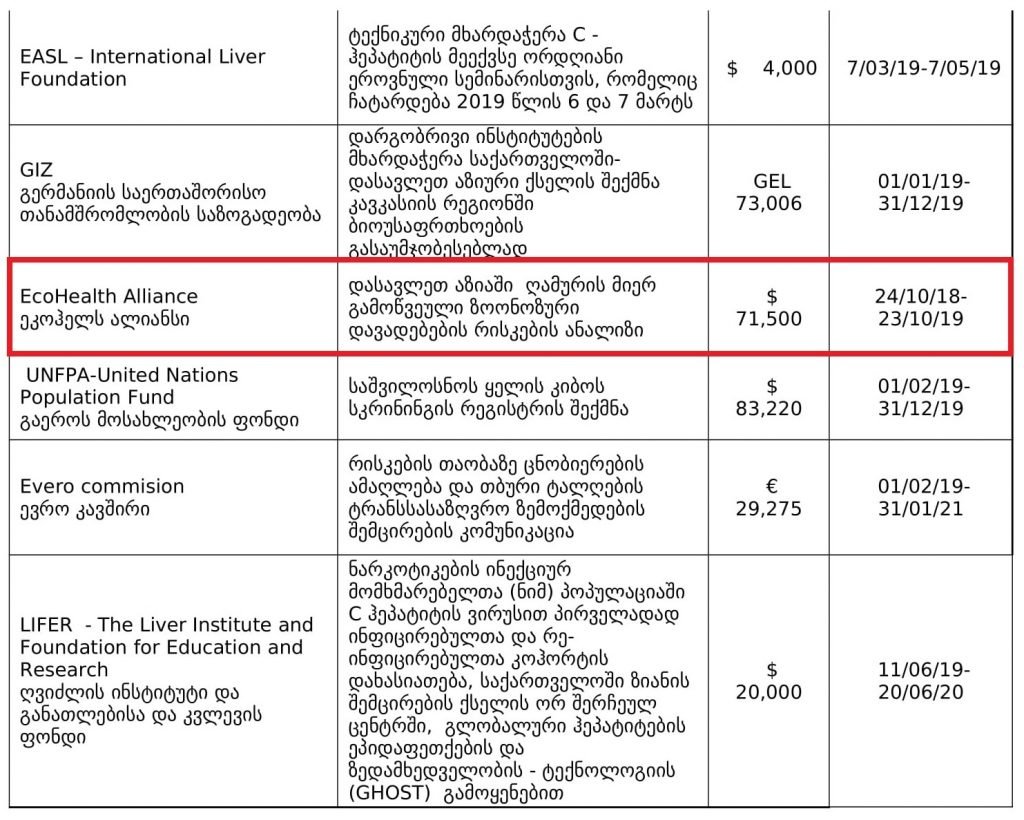
1. Project 1742 (EcoHealth/DTRA)
Risks of bat-borne zoonotic diseases in Western Asia
Duration: 24/10/2018-23 /10/2019
Funding: $71,500
@dgaytandzhieva
https://t.co/680CdD8uug
2. Bat Virus Database
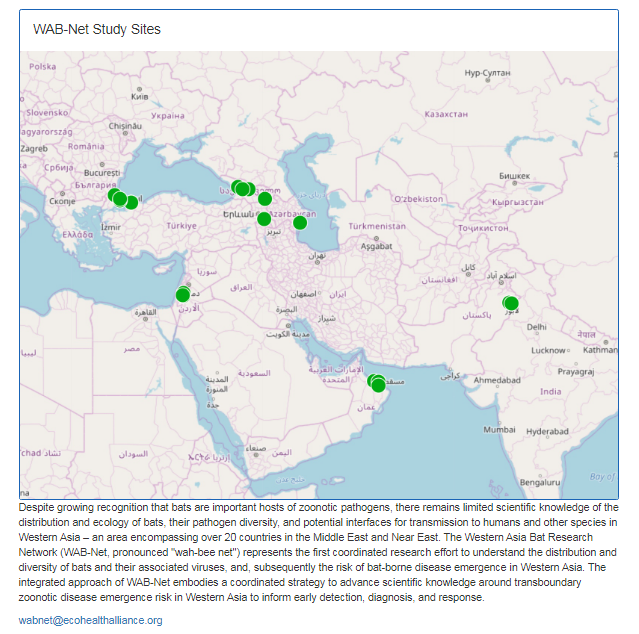
Access to the database is limited only to those scientists participating in our ‘Bats and Coronaviruses’ project
Our intention is to eventually open up this database to the larger scientific community
https://t.co/mPn7b9HM48
3. EcoHealth Alliance & DTRA Asking for Trouble
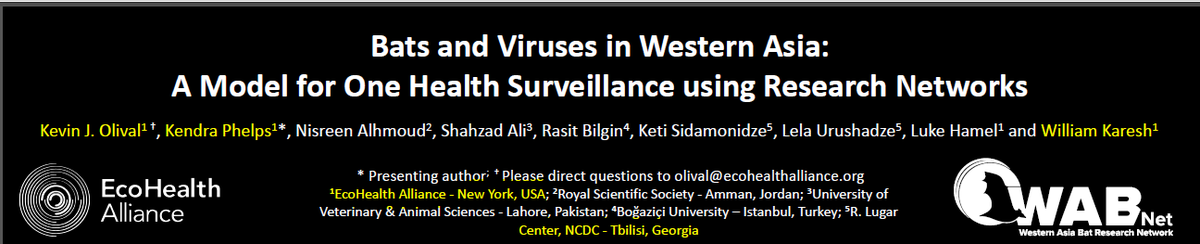
One Health research project focused on characterizing bat diversity, bat coronavirus diversity and the risk of bat-borne zoonotic disease emergence in the region.
https://t.co/u6aUeWBGEN
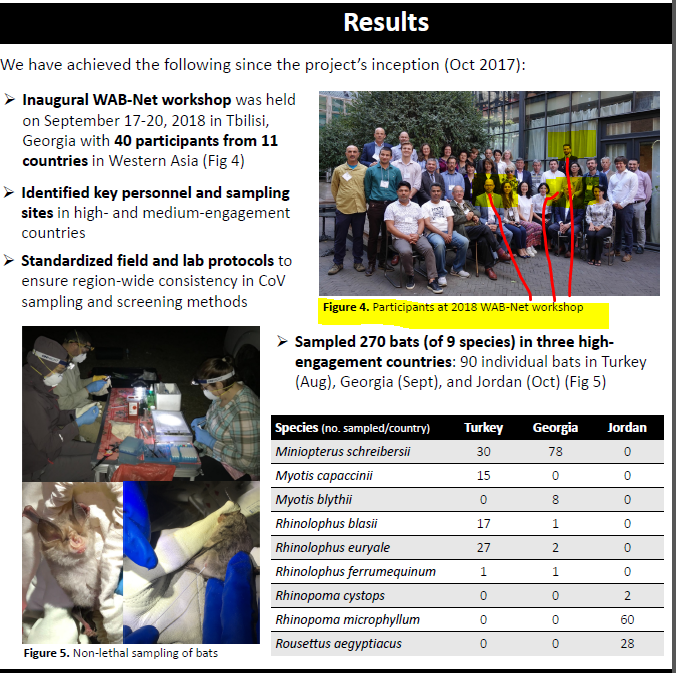
4. Phelps, Olival, Epstein, Karesh - EcoHealth/DTRA
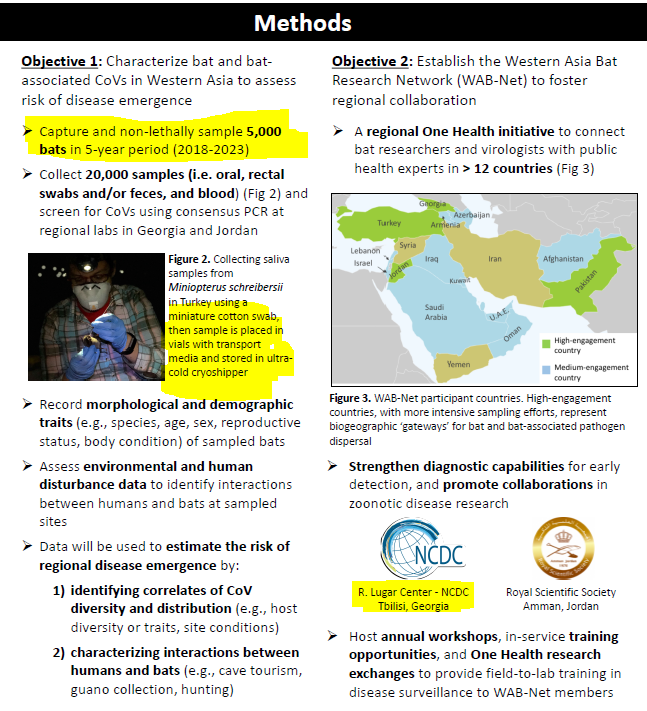
5, Methods and Expected Outcomes
(Unexpected Outcome = New Coronavirus Pandemic)
Risks of bat-borne zoonotic diseases in Western Asia
Duration: 24/10/2018-23 /10/2019
Funding: $71,500
@dgaytandzhieva
https://t.co/680CdD8uug
2. Bat Virus Database
Access to the database is limited only to those scientists participating in our ‘Bats and Coronaviruses’ project
Our intention is to eventually open up this database to the larger scientific community
https://t.co/mPn7b9HM48
3. EcoHealth Alliance & DTRA Asking for Trouble
One Health research project focused on characterizing bat diversity, bat coronavirus diversity and the risk of bat-borne zoonotic disease emergence in the region.
https://t.co/u6aUeWBGEN
4. Phelps, Olival, Epstein, Karesh - EcoHealth/DTRA
5, Methods and Expected Outcomes
(Unexpected Outcome = New Coronavirus Pandemic)