Welcome to 'Wealth Inequality Across the Globe' With Professor Li Chunling, Professor Louis Chauvel, Sventlana Mareeva, Professor Celi Scalon, Professor Kwang-Yeong Shin and @MikeSav47032563

The theme today is to understand how we respond to the challenge of intense inequality in many parts of the world. Today we have a group of sociologists who want to respond to the challenge economists have laid down. @MikeSav47032563
Professor Louis Chauvel lays out the debate. Why is wealth crucial now? Compared to income there is no middle class of wealth, you have simply a mass of people with no wealth or negative wealth.
Professor Louis Chauvel: In France you would need 123 years of accumulated average income to reach the wealth of the top 1%. This is a problem for the middle class, but it is even worse for the working class
The need for multi-thematic international comparisons: Today is an opportunity to discuss wealth inequality across the globe.
It's important to hear voices from other parts of the globe - we begin with Professor Li Chunling speaking about her research on China and Housing-based wealthization. From a society with high equality and scarce wealth to a society with high inequality.
Professor Li Chunling: China has 86,000 families with wealth of more than $30 million. A process of new wealth accumulation driven by marketisation and privatisation. There has been rapid growth of family housing wealth, from communal living to private housing.
China has experienced a different process of wealthization to Western countries but faces similar social consequences - emergent class systems
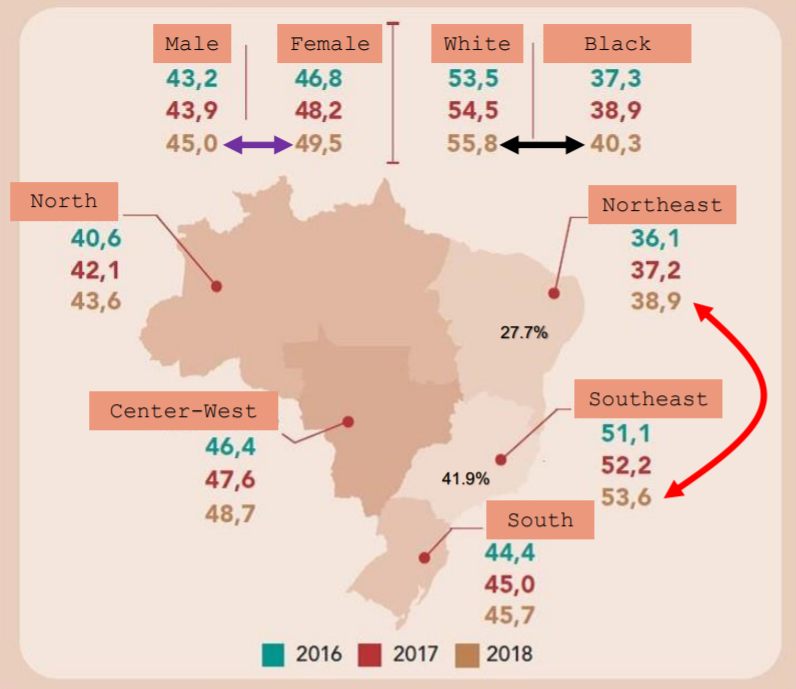
We move onto the case of Brazil, another rapidly growing economy. Andre J. Caetano discusses the gains and losses in Brazilian society. We must understand the importance of gender, race and region.
The modest advances between 2001 and 2008 were overturned in the following 7 eyars, Brazil is heading neither towards a less unequal income or a more middle class society
Professor Kwang-Yeong Shin talks to us about his research from South Korea. Survey data is not useful for inequality research as it focusses on income inequality, wealth inequality is much greater than income inequality. The main reason for this is the lack of wealth data.
A new trend in South Korea of increasing polarisation of income and wealth. Conventional factors like education cannot explain this. Professor Shin focusses on the impact of loans. The rich tend to have larger debt, the poor cannot access loans because of poor credit.
We now turn to Svetlana Mareeva from Moscow. Russia has transformed from a society of mass poverty to a mass middle-income society. During the last 20 years the middle income group has expanded while the low and high income groups have contracted
However, if we look about income/wealth concentration we see a very different picture. If we measure income through wealth Russia is one of the most unequal societies in the world. The top 1% hold 43-56% of wealth.
Across society Russians perceive this inequality as unfair and believe the government should reduce the gap between the rich and the poor.
All of our panellists have demonstrated that accounting for wealth gives us a much bleaker image of inequality across the globe. @MikeSav47032563

More from All

You May Also Like

1/ Here’s a list of conversational frameworks I’ve picked up that have been helpful.

Please add your own.

2/ The Magic Question: "What would need to be true for you


3/ On evaluating where someone’s head is at regarding a topic they are being wishy-washy about or delaying.

“Gun to the head—what would you decide now?”

“Fast forward 6 months after your sabbatical--how would you decide: what criteria is most important to you?”

4/ Other Q’s re: decisions:

“Putting aside a list of pros/cons, what’s the *one* reason you’re doing this?” “Why is that the most important reason?”

“What’s end-game here?”

“What does success look like in a world where you pick that path?”

5/ When listening, after empathizing, and wanting to help them make their own decisions without imposing your world view:

“What would the best version of yourself do”?
MASTER THREAD on Short Strangles.

Curated the best tweets from the best traders who are exceptional at managing strangles.

• Positional Strangles
• Intraday Strangles
• Position Sizing
• How to do Adjustments
• Plenty of Examples
• When to avoid
• Exit Criteria

How to sell Strangles in weekly expiry as explained by boss himself. @Mitesh_Engr

• When to sell
• How to do Adjustments
• Exit


Beautiful explanation on positional option selling by @Mitesh_Engr
Sir on how to sell low premium strangles yourself without paying anyone. This is a free mini course in


1st Live example of managing a strangle by Mitesh Sir. @Mitesh_Engr

• Sold Strangles 20% cap used
• Added 20% cap more when in profit
• Booked profitable leg and rolled up
• Kept rolling up profitable leg
• Booked loss in calls
• Sold only


2nd example by @Mitesh_Engr Sir on converting a directional trade into strangles. Option Sellers can use this for consistent profit.

• Identified a reversal and sold puts

• Puts decayed a lot

• When achieved 2% profit through puts then sold