India is on the verge of a once-in-a-generation explosion in edtech.

I've invested in 2 co's that are growing like wildfire and want to do more. Let's talk if you're building in this space.

Here's what's going on and why you should pay attention now, if you weren't before:

1/ There are 5 factors that are simultaneously driving the rapid rise of edtech in India.

- Favorable demographics
- At scale internet adoption
- Deteriorating incumbent quality
- Declining budget / capacity
- Cultural relevance

Let's talk about how all 5 are interconnected.
2/ The quantum of "digital first" Indians that will need to be educated is like nothing the world has ever seen.

India has:

- 500M+ people under 25
- 125M+ English speakers
- 250M+ people that will be added to its population over the next 40 years (est. peak is 1.6B)
3/ In parallel, increased internet accessibility at very low prices has resulted in a massive surge of online users

- 830M internet users in 2021 (+83% from 2019)
- 860M smartphone users in 2022 (+84% from 2017)
- 8.3GB monthly data consumption (+100x from 2014)
4/ India's existing education system is rampant with outdated curricula, low quality instructors and inflexibility. India:

- Ranks 49/50 in higher ed
- Spends <5% GDP on higher ed
- Teaches "to the test" - the system is oriented around entrance exams
5/ Even if the centralized system magically fixed all its issues, it's not positioned to meet the demand surge.

The India Brand Equity Foundation estimates that an additional 700 universities and 35,000 colleges (!!!) will need to be built to keep up with demographic trends.
6/ Education has always been culturally important to Indians (cue the doctor/engineer memes 😂), but it's gone into overdrive in the last 5 years.

Why? Purchasing power.

The Chazen Institute predicts India's middle class will have 583M people by 2025 (~2x the US population).
7/ So what happens when you have:

A ton of customers + The ability to reach them through the internet + A bad incumbent product + Consumer purchasing power?

A dream market.
8/ If that wasn't already enough, COVID all but broke the camel's back.

The unexpected and prolonged closure has impacted 320M+ learners.

Now the decision makers (parents, advisors) are exploring alternative methods so students don't fall behind.

(Indian parent nightmare..)
9/ And outsiders have taken notice.

From April 2000 to December 2019, India’s education sector received $3B of FDI (foreign direct investment).

In 2020, BYJU's alone has raised $1.1B.
10/ Companies are growing FAST

6 months ago, BYJU's bought White Hat Jr. for $300M in an all cash transaction.

White Hat Jr. was a canonical blitzscaling example - they got to $150M run rate on ~$11M raised in less than 20 months.
11/ So who else is exciting? In addition to BYJU's / White Hat, I have my eyes on:

@wiseapplive, @Skill_Lync, @vedantu_learn, @myToppr,
@unacademy, @ClassplusLite
12/ The time is now for edtech in India. Multiple multi-billion dollar companies will be built over the next 5 years.

If you're building in the space or actively investing in it, reach out - would love to trade notes!
13/ Oh and if you needed any more proof, the "man-of-the-future" @balajis himself just relocated to India.

It's about to go down.

More from Romeen Sheth

More from All

https://t.co/6cRR2B3jBE
Viruses and other pathogens are often studied as stand-alone entities, despite that, in nature, they mostly live in multispecies associations called biofilms—both externally and within the host.

https://t.co/FBfXhUrH5d


Microorganisms in biofilms are enclosed by an extracellular matrix that confers protection and improves survival. Previous studies have shown that viruses can secondarily colonize preexisting biofilms, and viral biofilms have also been described.


...we raise the perspective that CoVs can persistently infect bats due to their association with biofilm structures. This phenomenon potentially provides an optimal environment for nonpathogenic & well-adapted viruses to interact with the host, as well as for viral recombination.


Biofilms can also enhance virion viability in extracellular environments, such as on fomites and in aquatic sediments, allowing viral persistence and dissemination.
1. Mini Thread on Conflicts of Interest involving the authors of the Nature Toilet Paper:
https://t.co/VUYbsKGncx
Kristian G. Andersen
Andrew Rambaut
Ian Lipkin
Edward C. Holmes
Robert F. Garry

2. Thanks to @newboxer007 for forwarding the link to the research by an Australian in Taiwan (not on

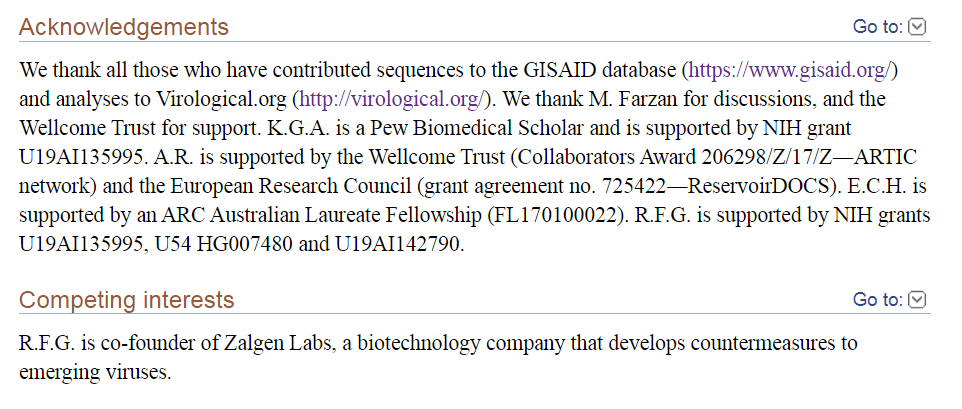
3. K.Andersen didn't mention "competing interests"
Only Garry listed Zalgen Labs, which we will look at later.
In acknowledgements, Michael Farzan, Wellcome Trust, NIH, ERC & ARC are mentioned.
Author affiliations listed as usual.
Note the 328 Citations!
https://t.co/nmOeohM89Q


4. Kristian Andersen (1)
Andersen worked with USAMRIID & Fort Detrick scientists on research, with Robert Garry, Jens Kuhn & Sina Bavari among


5. Kristian Andersen (2)
Works at Scripps Research Institute, which WAS in serious financial trouble, haemorrhaging 20 million $ a year.
But just when the first virus cases were emerging, they received great news.
They issued a press release dated November 27, 2019:

You May Also Like

“We don’t negotiate salaries” is a negotiation tactic.

Always. No, your company is not an exception.

A tactic I don’t appreciate at all because of how unfairly it penalizes low-leverage, junior employees, and those loyal enough not to question it, but that’s negotiation for you after all. Weaponized information asymmetry.

Listen to Aditya


And by the way, you should never be worried that an offer would be withdrawn if you politely negotiate.

I have seen this happen *extremely* rarely, mostly to women, and anyway is a giant red flag. It suggests you probably didn’t want to work there.

You wish there was no negotiating so it would all be more fair? I feel you, but it’s not happening.

Instead, negotiate hard, use your privilege, and then go and share numbers with your underrepresented and underpaid colleagues. […]