
/thread/ It has been almost 2 months since the end of the 2020 Nagorno Karabakh war and after observing it from the start and talking about it with (or listening to) some really smart people, here are IMO important lessons (new or old) from that conflict:
cc @Elizrael @MENA_Conflict @GregoryPWaters @putintintin1 @MinsterTX @QalaatAlMudiq @vpkivimaki @N_Waters89 @AbraxasSpa @Nrg8000 @oryxspioenkop @MJ_Cruickshank @faysalitani @HKaaman @tobiaschneider
cc @Jake_Hanrahan @NeilPHauer @arawnsley @ryanmofarrell @APHClarkson @henrikrpaulsson @AnalystMick @MathieuMorant @Danspiun @COIN_V2 @ArmsControlWonk @aaronstein1
More from World

fascinated by this man, mario cortellucci, and his outsized influence on ontario and GTA politics. cortellucci, who lives in vaughan and ran as a far-right candidate for the italian senate back in 2018 - is a major ford donor...

his name might sound familiar because the new cortellucci vaughan hospital at mackenzie health, the one doug ford has been touting lately as a covid-centric facility, is named after him and his family
but his name also pops up in a LOT of other ford projects. for instance - he controls the long term lease on big parts of toronto's portlands... where doug ford once proposed building an nfl stadium and monorail... https://t.co/weOMJ51bVF
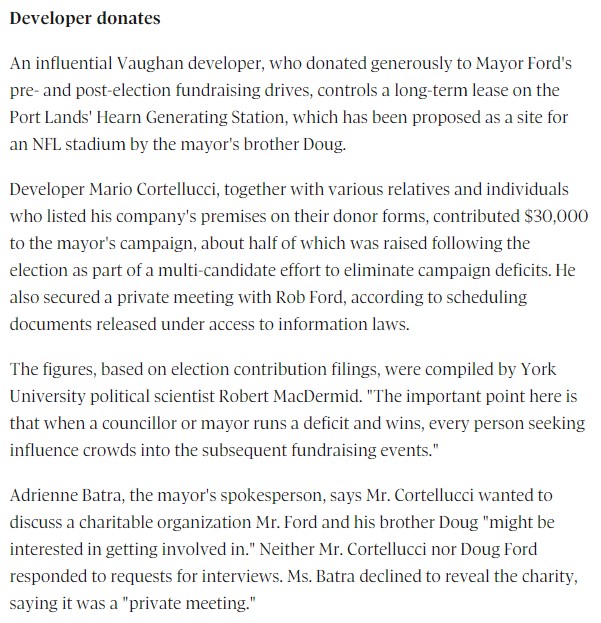
cortellucci, who is a developer, also owns a large chunk of the greenbelt. doug ford's desire to develop the greenbelt has been
and late last year he rolled back the mandate of conservation authorities there, prompting the resignations of several members of the greenbelt advisory
his name might sound familiar because the new cortellucci vaughan hospital at mackenzie health, the one doug ford has been touting lately as a covid-centric facility, is named after him and his family
but his name also pops up in a LOT of other ford projects. for instance - he controls the long term lease on big parts of toronto's portlands... where doug ford once proposed building an nfl stadium and monorail... https://t.co/weOMJ51bVF
cortellucci, who is a developer, also owns a large chunk of the greenbelt. doug ford's desire to develop the greenbelt has been
and late last year he rolled back the mandate of conservation authorities there, prompting the resignations of several members of the greenbelt advisory







Ladies and Gentlemen, it's time! https://t.co/xPMGL36VGy

So today, I am going to quickly talk about 4 or 5 countries where you can get residence visas.
Why residence visas?
For starters, they are cheaper, FAR CHEAPER than passports, and offer almost all the benefits, not not, but a large swathe of them.
Second, residencies can be...
a pathway to citizenship.
In one or two of the countries I will talk about tonight, if you renew your residencies long enough, and fulfill all requirements, according to their law, which differs from country to country, you become eligible to apply for full citizenship.
So...
you can see why they are good enough?
Cool. Alright, let's begin.
The first country is
1. Barbados
Yes, @Rihanna's country.
The first thing I love about it is it's fully black, majority descendants of ex-slaves of Igbo extraction.
That's why they refer to their country...
Barbados last year officially launched its 12-month Barbados Welcome Stamp, a new visa that allows remote workers to live and work from the Caribbean country for up to a year.
Applicants must electronically submit documents, such as a copy of their international passport and...
I'll do a thread of countries outside Nigeria where you younglings + all of you "young at heart" making smart internet money can get Permanent and Temporary residencies, allowing multiple entries and exits.
— Ikenna Ronald Nzimora (@ronaldnzimora) February 18, 2021
As always the idea is for you guys to have a PLAN B.
Tonight. 8 PM.
So today, I am going to quickly talk about 4 or 5 countries where you can get residence visas.
Why residence visas?
For starters, they are cheaper, FAR CHEAPER than passports, and offer almost all the benefits, not not, but a large swathe of them.
Second, residencies can be...
a pathway to citizenship.
In one or two of the countries I will talk about tonight, if you renew your residencies long enough, and fulfill all requirements, according to their law, which differs from country to country, you become eligible to apply for full citizenship.
So...
you can see why they are good enough?
Cool. Alright, let's begin.
The first country is
1. Barbados
Yes, @Rihanna's country.
The first thing I love about it is it's fully black, majority descendants of ex-slaves of Igbo extraction.
That's why they refer to their country...
Barbados last year officially launched its 12-month Barbados Welcome Stamp, a new visa that allows remote workers to live and work from the Caribbean country for up to a year.
Applicants must electronically submit documents, such as a copy of their international passport and...
You May Also Like



A brief analysis and comparison of the CSS for Twitter's PWA vs Twitter's legacy desktop website. The difference is dramatic and I'll touch on some reasons why.
Legacy site *downloads* ~630 KB CSS per theme and writing direction.
6,769 rules
9,252 selectors
16.7k declarations
3,370 unique declarations
44 media queries
36 unique colors
50 unique background colors
46 unique font sizes
39 unique z-indices
https://t.co/qyl4Bt1i5x

PWA *incrementally generates* ~30 KB CSS that handles all themes and writing directions.
735 rules
740 selectors
757 declarations
730 unique declarations
0 media queries
11 unique colors
32 unique background colors
15 unique font sizes
7 unique z-indices
https://t.co/w7oNG5KUkJ

The legacy site's CSS is what happens when hundreds of people directly write CSS over many years. Specificity wars, redundancy, a house of cards that can't be fixed. The result is extremely inefficient and error-prone styling that punishes users and developers.
The PWA's CSS is generated on-demand by a JS framework that manages styles and outputs "atomic CSS". The framework can enforce strict constraints and perform optimisations, which is why the CSS is so much smaller and safer. Style conflicts and unbounded CSS growth are avoided.
Legacy site *downloads* ~630 KB CSS per theme and writing direction.
6,769 rules
9,252 selectors
16.7k declarations
3,370 unique declarations
44 media queries
36 unique colors
50 unique background colors
46 unique font sizes
39 unique z-indices
https://t.co/qyl4Bt1i5x
PWA *incrementally generates* ~30 KB CSS that handles all themes and writing directions.
735 rules
740 selectors
757 declarations
730 unique declarations
0 media queries
11 unique colors
32 unique background colors
15 unique font sizes
7 unique z-indices
https://t.co/w7oNG5KUkJ
The legacy site's CSS is what happens when hundreds of people directly write CSS over many years. Specificity wars, redundancy, a house of cards that can't be fixed. The result is extremely inefficient and error-prone styling that punishes users and developers.
The PWA's CSS is generated on-demand by a JS framework that manages styles and outputs "atomic CSS". The framework can enforce strict constraints and perform optimisations, which is why the CSS is so much smaller and safer. Style conflicts and unbounded CSS growth are avoided.

1/ Here’s a list of conversational frameworks I’ve picked up that have been helpful.
Please add your own.
2/ The Magic Question: "What would need to be true for you
3/ On evaluating where someone’s head is at regarding a topic they are being wishy-washy about or delaying.
“Gun to the head—what would you decide now?”
“Fast forward 6 months after your sabbatical--how would you decide: what criteria is most important to you?”
4/ Other Q’s re: decisions:
“Putting aside a list of pros/cons, what’s the *one* reason you’re doing this?” “Why is that the most important reason?”
“What’s end-game here?”
“What does success look like in a world where you pick that path?”
5/ When listening, after empathizing, and wanting to help them make their own decisions without imposing your world view:
“What would the best version of yourself do”?
Please add your own.
2/ The Magic Question: "What would need to be true for you
1/\u201cWhat would need to be true for you to\u2026.X\u201d
— Erik Torenberg (@eriktorenberg) December 4, 2018
Why is this the most powerful question you can ask when attempting to reach an agreement with another human being or organization?
A thread, co-written by @deanmbrody: https://t.co/Yo6jHbSit9
3/ On evaluating where someone’s head is at regarding a topic they are being wishy-washy about or delaying.
“Gun to the head—what would you decide now?”
“Fast forward 6 months after your sabbatical--how would you decide: what criteria is most important to you?”
4/ Other Q’s re: decisions:
“Putting aside a list of pros/cons, what’s the *one* reason you’re doing this?” “Why is that the most important reason?”
“What’s end-game here?”
“What does success look like in a world where you pick that path?”
5/ When listening, after empathizing, and wanting to help them make their own decisions without imposing your world view:
“What would the best version of yourself do”?


