
Interesting to realize that the living things that lay the foundation of the biosphere are extremely robust as compared to the humans that are destroying the biosphere.
More from Carlos E. Perez
Programming in abstractions is very different from a system that is capable of its own 'abstracting'. But what does abstracting mean? We only know of its inputs and outputs, but we fail to describe its inner workings.
I like this short video about living in space. This is because it makes you realize the gaps in your knowledge when you turn off something (i.e. gravity) that you have always assumed to be present.
Perhaps we can understand 'abstracting' better if we turn of many assumptions that we unconsciously carry around. Perhaps we need to get rid of the excess baggage that is confusing our thinking about abstraction.
Turning off gravity and living in space is a perfect analogy. We somehow have to turn off a cognitive process to understand the meaning of abstraction.
The first step to divorce ourselves from our habitual cognitive processes is to realize the pervasiveness of 'noun-thinking' .
I like this short video about living in space. This is because it makes you realize the gaps in your knowledge when you turn off something (i.e. gravity) that you have always assumed to be present.
What does living in space do to the human body? pic.twitter.com/kzIlEEr7pp
— Tech Insider (@techinsider) December 20, 2020
Perhaps we can understand 'abstracting' better if we turn of many assumptions that we unconsciously carry around. Perhaps we need to get rid of the excess baggage that is confusing our thinking about abstraction.
Turning off gravity and living in space is a perfect analogy. We somehow have to turn off a cognitive process to understand the meaning of abstraction.
The first step to divorce ourselves from our habitual cognitive processes is to realize the pervasiveness of 'noun-thinking' .
Nice to discover Judea Pearl ask a fundamental question. What's an 'inductive bias'?
I crucial step on the road towards AGI is a richer vocabulary for reasoning about inductive biases.
explores the apparent impedance mismatch between inductive biases and causal reasoning. But isn't the logical thinking required for good causal reasoning also not an inductive bias?
An inductive bias is what C.S. Peirce would call a habit. It is a habit of reasoning. Logical thinking is like a Platonic solid of the many kinds of heuristics that are discovered.
The kind of black and white logic that is found in digital computers is critical to the emergence of today's information economy. This of course is not the same logic that drives the general intelligence that lives in the same economy.
Help! What precisely is "inductive bias"? Some ML researchers are in the opinion that the machine learning category of \u2018inductive biases\u2019 can allow us to build a causal understanding of the world. My Ladder of Causation says: "This is mathematically impossible". Who is right? 1/
— Judea Pearl (@yudapearl) February 14, 2021
I crucial step on the road towards AGI is a richer vocabulary for reasoning about inductive biases.
explores the apparent impedance mismatch between inductive biases and causal reasoning. But isn't the logical thinking required for good causal reasoning also not an inductive bias?
An inductive bias is what C.S. Peirce would call a habit. It is a habit of reasoning. Logical thinking is like a Platonic solid of the many kinds of heuristics that are discovered.
The kind of black and white logic that is found in digital computers is critical to the emergence of today's information economy. This of course is not the same logic that drives the general intelligence that lives in the same economy.
More from World




Ladies and Gentlemen, it's time! https://t.co/xPMGL36VGy

So today, I am going to quickly talk about 4 or 5 countries where you can get residence visas.
Why residence visas?
For starters, they are cheaper, FAR CHEAPER than passports, and offer almost all the benefits, not not, but a large swathe of them.
Second, residencies can be...
a pathway to citizenship.
In one or two of the countries I will talk about tonight, if you renew your residencies long enough, and fulfill all requirements, according to their law, which differs from country to country, you become eligible to apply for full citizenship.
So...
you can see why they are good enough?
Cool. Alright, let's begin.
The first country is
1. Barbados
Yes, @Rihanna's country.
The first thing I love about it is it's fully black, majority descendants of ex-slaves of Igbo extraction.
That's why they refer to their country...
Barbados last year officially launched its 12-month Barbados Welcome Stamp, a new visa that allows remote workers to live and work from the Caribbean country for up to a year.
Applicants must electronically submit documents, such as a copy of their international passport and...
I'll do a thread of countries outside Nigeria where you younglings + all of you "young at heart" making smart internet money can get Permanent and Temporary residencies, allowing multiple entries and exits.
— Ikenna Ronald Nzimora (@ronaldnzimora) February 18, 2021
As always the idea is for you guys to have a PLAN B.
Tonight. 8 PM.
So today, I am going to quickly talk about 4 or 5 countries where you can get residence visas.
Why residence visas?
For starters, they are cheaper, FAR CHEAPER than passports, and offer almost all the benefits, not not, but a large swathe of them.
Second, residencies can be...
a pathway to citizenship.
In one or two of the countries I will talk about tonight, if you renew your residencies long enough, and fulfill all requirements, according to their law, which differs from country to country, you become eligible to apply for full citizenship.
So...
you can see why they are good enough?
Cool. Alright, let's begin.
The first country is
1. Barbados
Yes, @Rihanna's country.
The first thing I love about it is it's fully black, majority descendants of ex-slaves of Igbo extraction.
That's why they refer to their country...
Barbados last year officially launched its 12-month Barbados Welcome Stamp, a new visa that allows remote workers to live and work from the Caribbean country for up to a year.
Applicants must electronically submit documents, such as a copy of their international passport and...
You May Also Like




And here they are...
THE WINNERS OF THE 24 HOUR STARTUP CHALLENGE
Remember, this money is just fun. If you launched a product (or even attempted a launch) - you did something worth MUCH more than $1,000.
#24hrstartup
The winners 👇
#10
Lattes For Change - Skip a latte and save a life.
https://t.co/M75RAirZzs
@frantzfries built a platform where you can see how skipping your morning latte could do for the world.
A great product for a great cause.
Congrats Chris on winning $250!
#9
Instaland - Create amazing landing pages for your followers.
https://t.co/5KkveJTAsy
A team project! @bpmct and @BaileyPumfleet built a tool for social media influencers to create simple "swipe up" landing pages for followers.
Really impressive for 24 hours. Congrats!
#8
SayHenlo - Chat without distractions
https://t.co/og0B7gmkW6
Built by @DaltonEdwards, it's a platform for combatting conversation overload. This product was also coded exclusively from an iPad 😲
Dalton is a beast. I'm so excited he placed in the top 10.
#7
CoderStory - Learn to code from developers across the globe!
https://t.co/86Ay6nF4AY
Built by @jesswallaceuk, the project is focused on highlighting the experience of developers and people learning to code.
I wish this existed when I learned to code! Congrats on $250!!
THE WINNERS OF THE 24 HOUR STARTUP CHALLENGE
Remember, this money is just fun. If you launched a product (or even attempted a launch) - you did something worth MUCH more than $1,000.
#24hrstartup
The winners 👇
#10
Lattes For Change - Skip a latte and save a life.
https://t.co/M75RAirZzs
@frantzfries built a platform where you can see how skipping your morning latte could do for the world.
A great product for a great cause.
Congrats Chris on winning $250!
#9
Instaland - Create amazing landing pages for your followers.
https://t.co/5KkveJTAsy
A team project! @bpmct and @BaileyPumfleet built a tool for social media influencers to create simple "swipe up" landing pages for followers.
Really impressive for 24 hours. Congrats!
#8
SayHenlo - Chat without distractions
https://t.co/og0B7gmkW6
Built by @DaltonEdwards, it's a platform for combatting conversation overload. This product was also coded exclusively from an iPad 😲
Dalton is a beast. I'm so excited he placed in the top 10.
#7
CoderStory - Learn to code from developers across the globe!
https://t.co/86Ay6nF4AY
Built by @jesswallaceuk, the project is focused on highlighting the experience of developers and people learning to code.
I wish this existed when I learned to code! Congrats on $250!!

H was always unseen in S2NL :)
Those who exited at 1500 needed money. They can always come back near 969. Those who exited at 230 also needed money. They can come back near 95.
Those who sold L @ 660 can always come back at 360. Those who sold S last week can be back @ 301
Those who exited at 1500 needed money. They can always come back near 969. Those who exited at 230 also needed money. They can come back near 95.
Those who sold L @ 660 can always come back at 360. Those who sold S last week can be back @ 301
Sir, Log yahan.. 13 days patience nhi rakh sakte aur aap 2013 ki baat kar rahe ho. Even Aap Ready made portfolio banakar bhi de do to bhi wo 1 month me hi EXIT kar denge \U0001f602
— BhavinKhengarSuratGujarat (@IntradayWithBRK) September 19, 2021
Neuland 2700 se 1500 & Sequent 330 to 230 kya huwa.. 99% retailers/investors twitter par charcha n EXIT\U0001f602

🌿𝑻𝒉𝒆 𝒔𝒕𝒐𝒓𝒚 𝒐𝒇 𝒂 𝑺𝒕𝒂𝒓 : 𝑫𝒉𝒓𝒖𝒗𝒂 & 𝑽𝒊𝒔𝒉𝒏𝒖
Once upon a time there was a Raja named Uttānapāda born of Svayambhuva Manu,1st man on earth.He had 2 beautiful wives - Suniti & Suruchi & two sons were born of them Dhruva & Uttama respectively.
#talesofkrishna https://t.co/E85MTPkF9W
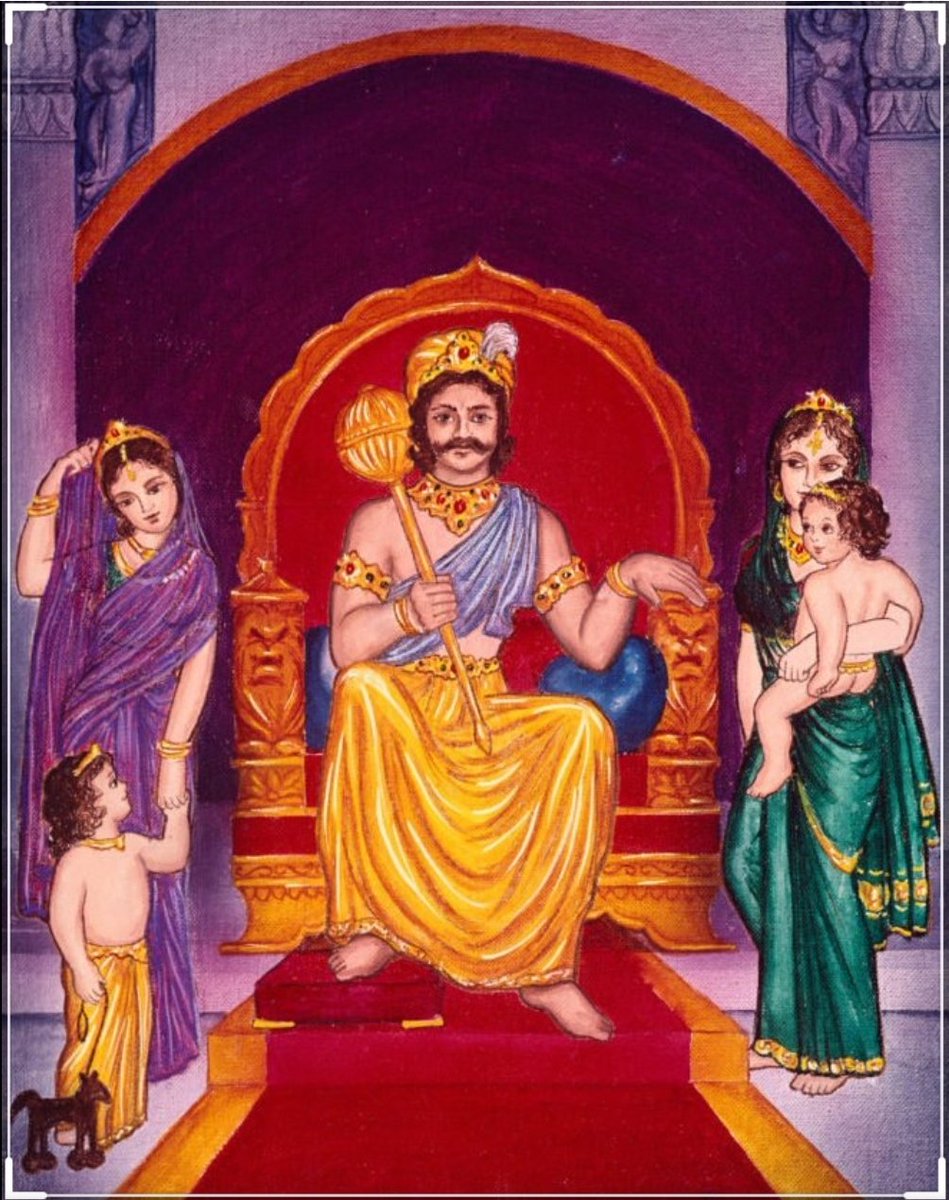
Now Suniti was the daughter of a tribal chief while Suruchi was the daughter of a rich king. Hence Suruchi was always favored the most by Raja while Suniti was ignored. But while Suniti was gentle & kind hearted by nature Suruchi was venomous inside.
#KrishnaLeela
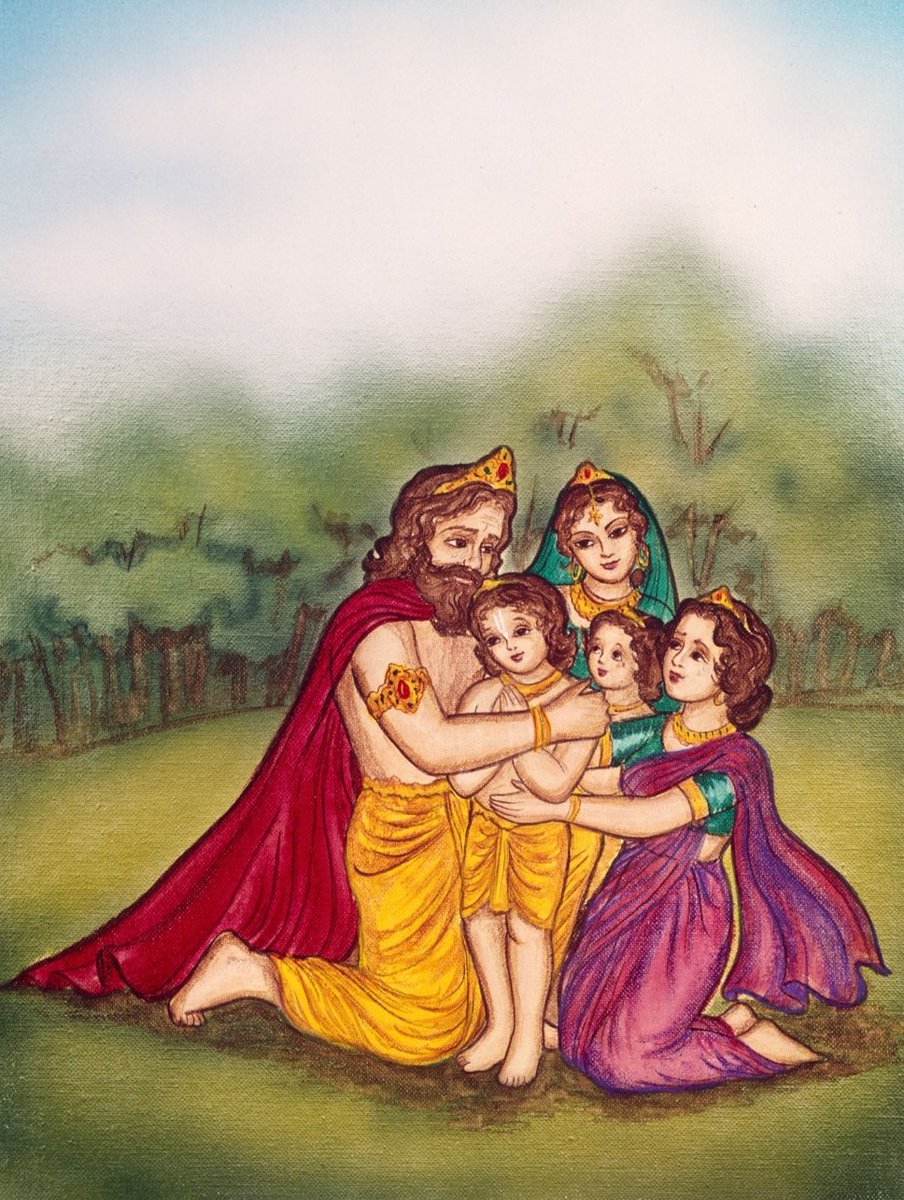
The story is of a time when ideally the eldest son of the king becomes the heir to the throne. Hence the sinhasan of the Raja belonged to Dhruva.This is why Suruchi who was the 2nd wife nourished poison in her heart for Dhruva as she knew her son will never get the throne.
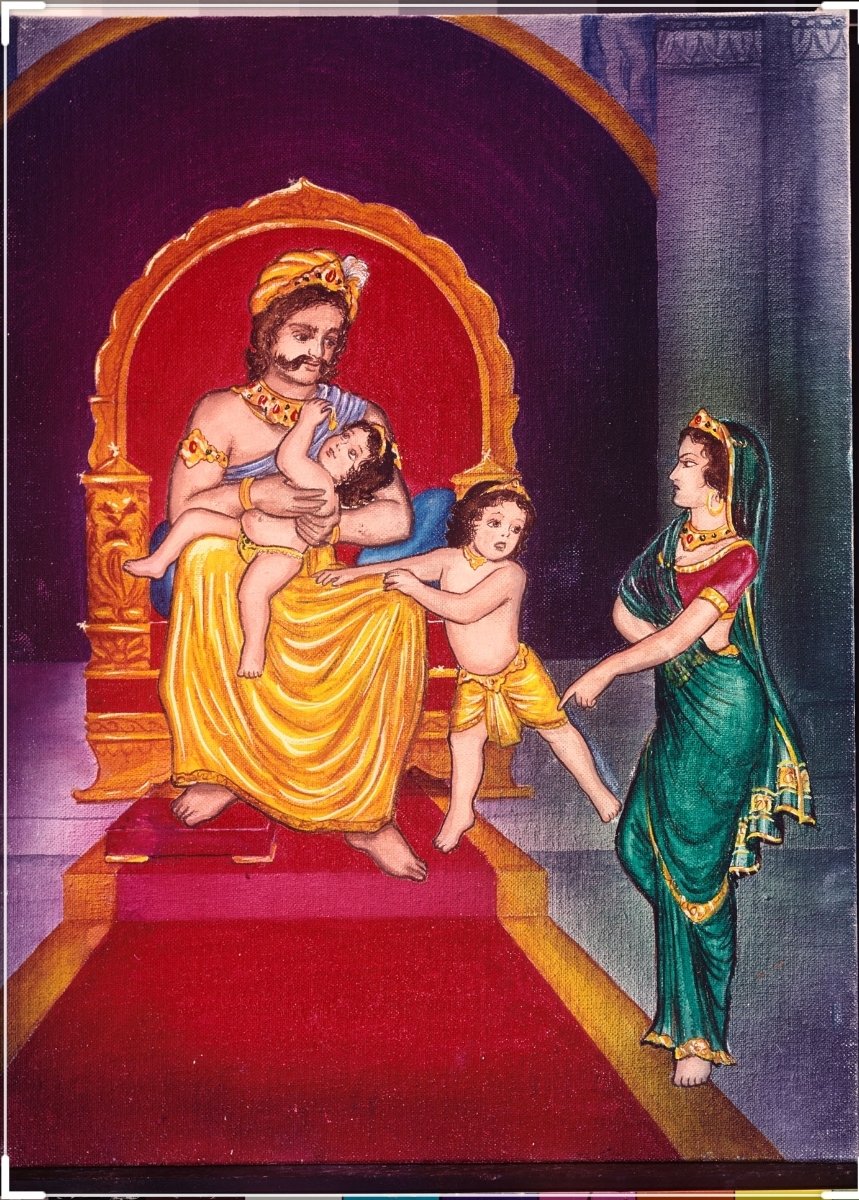
One day when Dhruva was just 5 years old he went on to sit on his father's lap. Suruchi, the jealous queen, got enraged and shoved him away from Raja as she never wanted Raja to shower Dhruva with his fatherly affection.
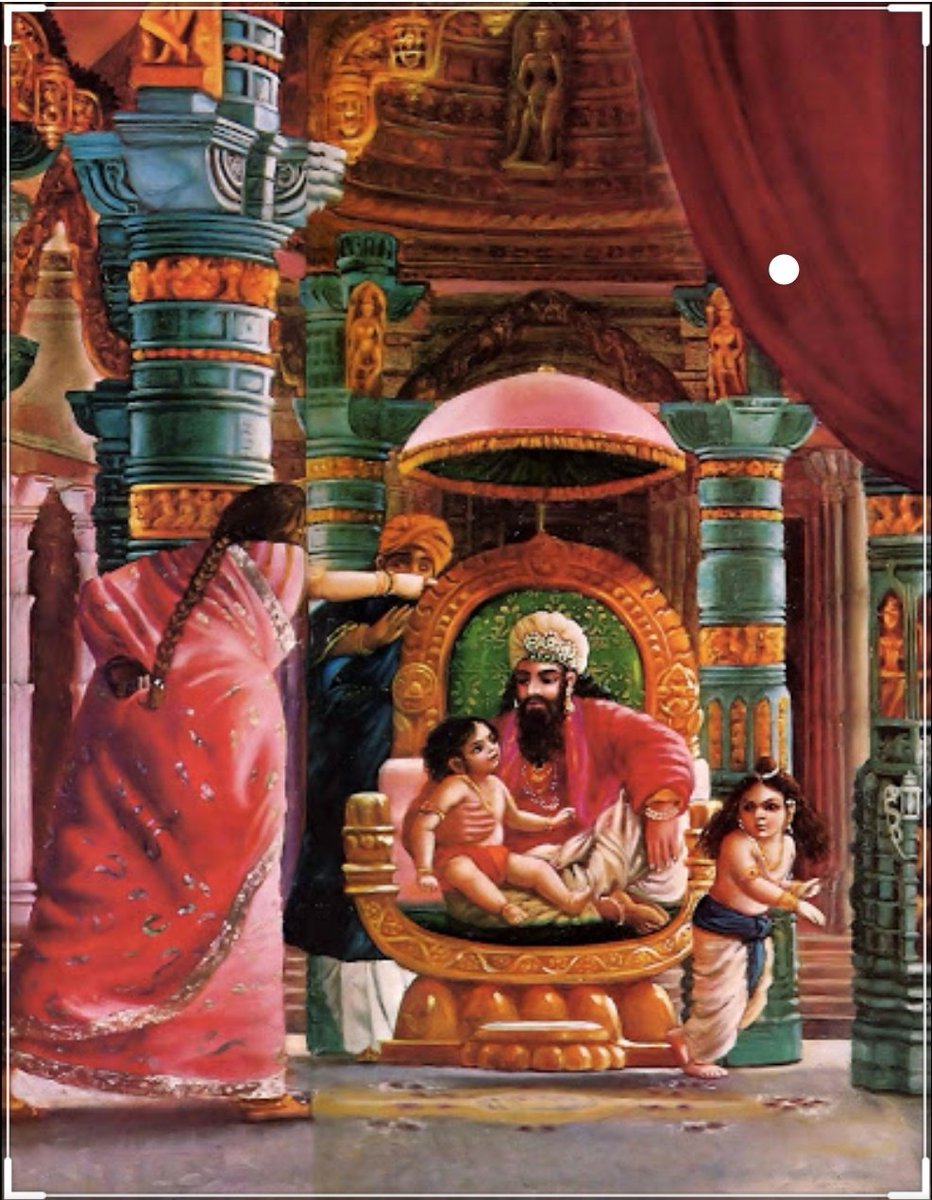
Dhruva protested questioning his step mother "why can't i sit on my own father's lap?" A furious Suruchi berated him saying "only God can allow him that privilege. Go ask him"
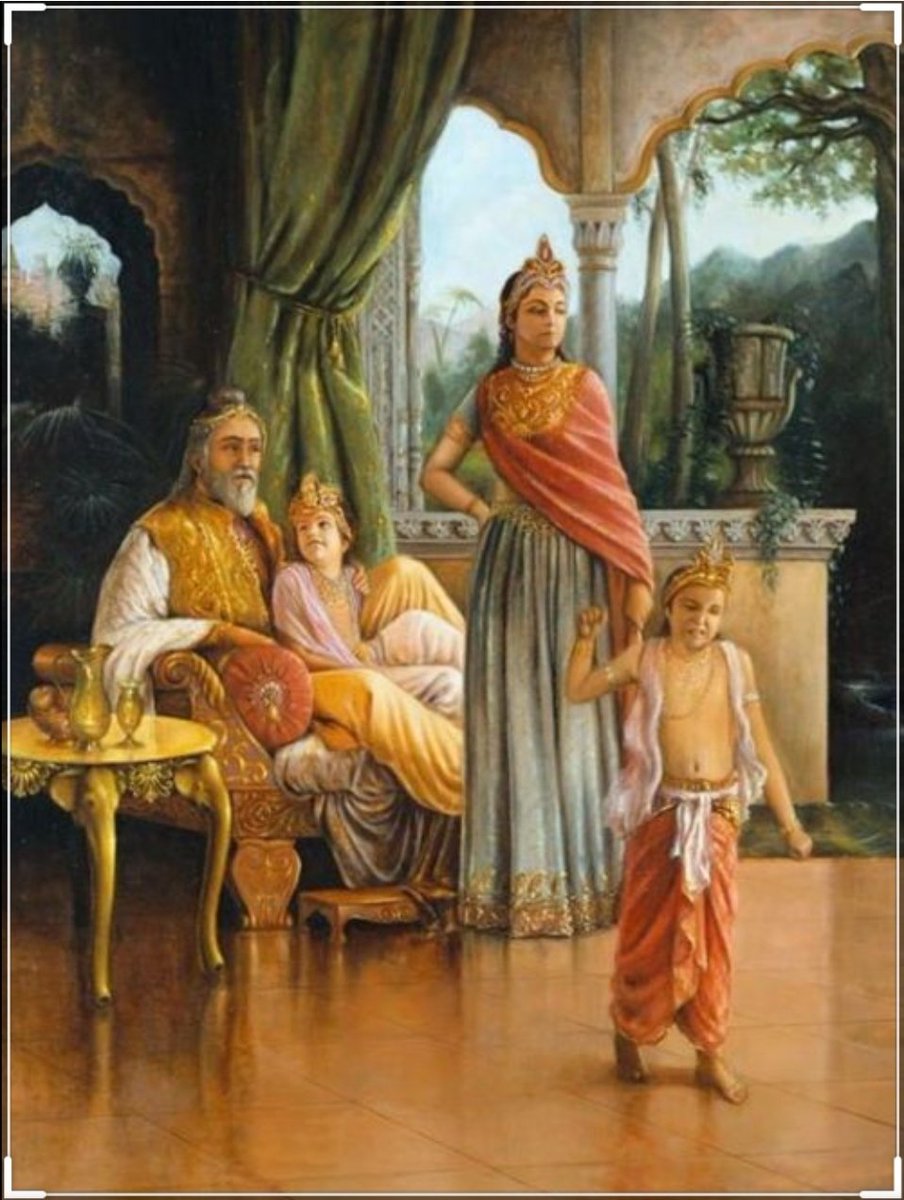
Once upon a time there was a Raja named Uttānapāda born of Svayambhuva Manu,1st man on earth.He had 2 beautiful wives - Suniti & Suruchi & two sons were born of them Dhruva & Uttama respectively.
#talesofkrishna https://t.co/E85MTPkF9W
Prabhu says i reside in the heart of my bhakt.
— Right Singh (@rightwingchora) December 21, 2020
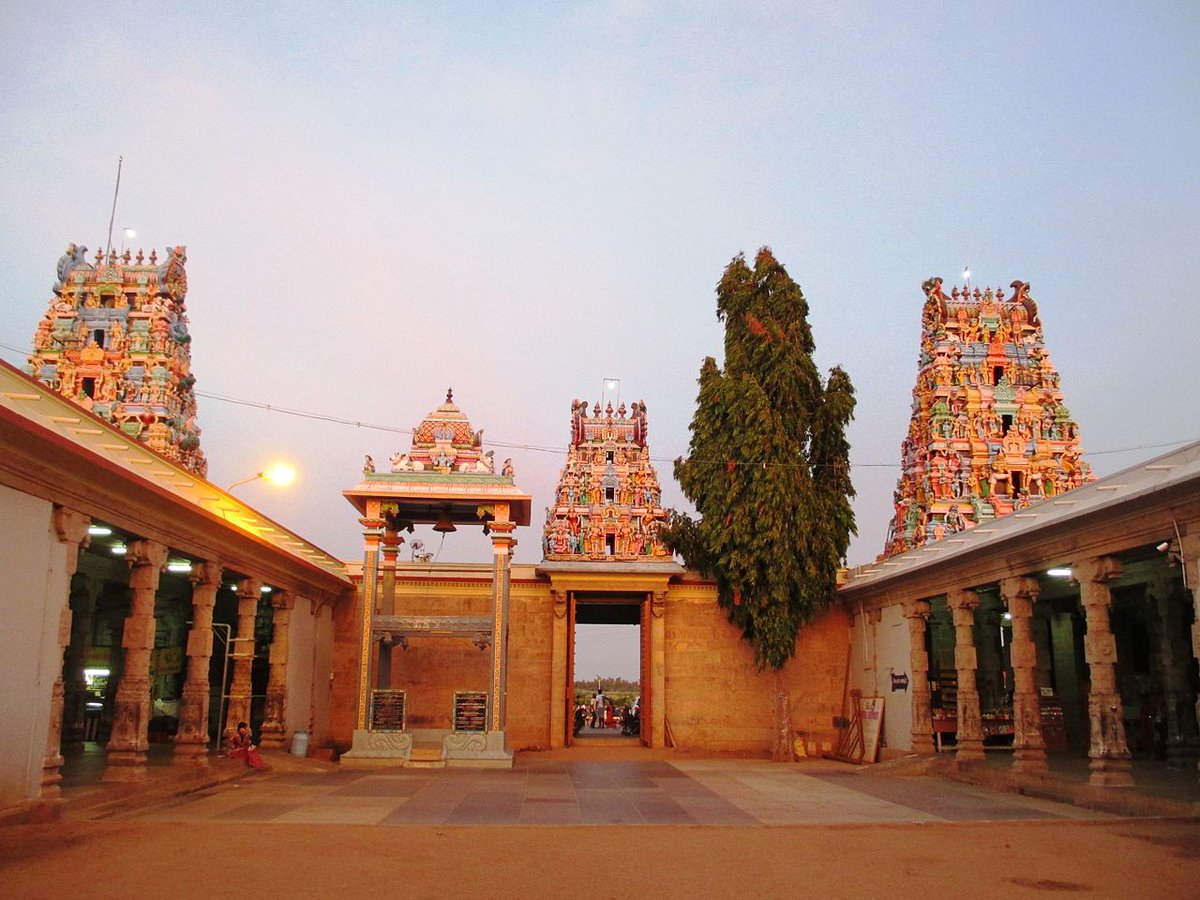
Guess the event. pic.twitter.com/yFUmbfe5KL
Now Suniti was the daughter of a tribal chief while Suruchi was the daughter of a rich king. Hence Suruchi was always favored the most by Raja while Suniti was ignored. But while Suniti was gentle & kind hearted by nature Suruchi was venomous inside.
#KrishnaLeela
The story is of a time when ideally the eldest son of the king becomes the heir to the throne. Hence the sinhasan of the Raja belonged to Dhruva.This is why Suruchi who was the 2nd wife nourished poison in her heart for Dhruva as she knew her son will never get the throne.
One day when Dhruva was just 5 years old he went on to sit on his father's lap. Suruchi, the jealous queen, got enraged and shoved him away from Raja as she never wanted Raja to shower Dhruva with his fatherly affection.
Dhruva protested questioning his step mother "why can't i sit on my own father's lap?" A furious Suruchi berated him saying "only God can allow him that privilege. Go ask him"