[THREAD]

@azulfeehely describes Jules Koundé as one of Europe's most promising centre-backs. Let's take a look at why that might be.

#SquawkaScout x @LaLigaLowdown

@azulfeehely @LaLigaLowdown "There’s few with as high a ceiling as the young Frenchman."

The full lowdown from @azulfeehely. 🔎
@azulfeehely @LaLigaLowdown Koundé is an excellent defender, but when you consider the amount of space he has to cover due to the buccaneering Jesús Navas his work becomes even more impressive.

Just look at that coverage.
@azulfeehely @LaLigaLowdown First and foremost, defenders should love defending. Koundé does.

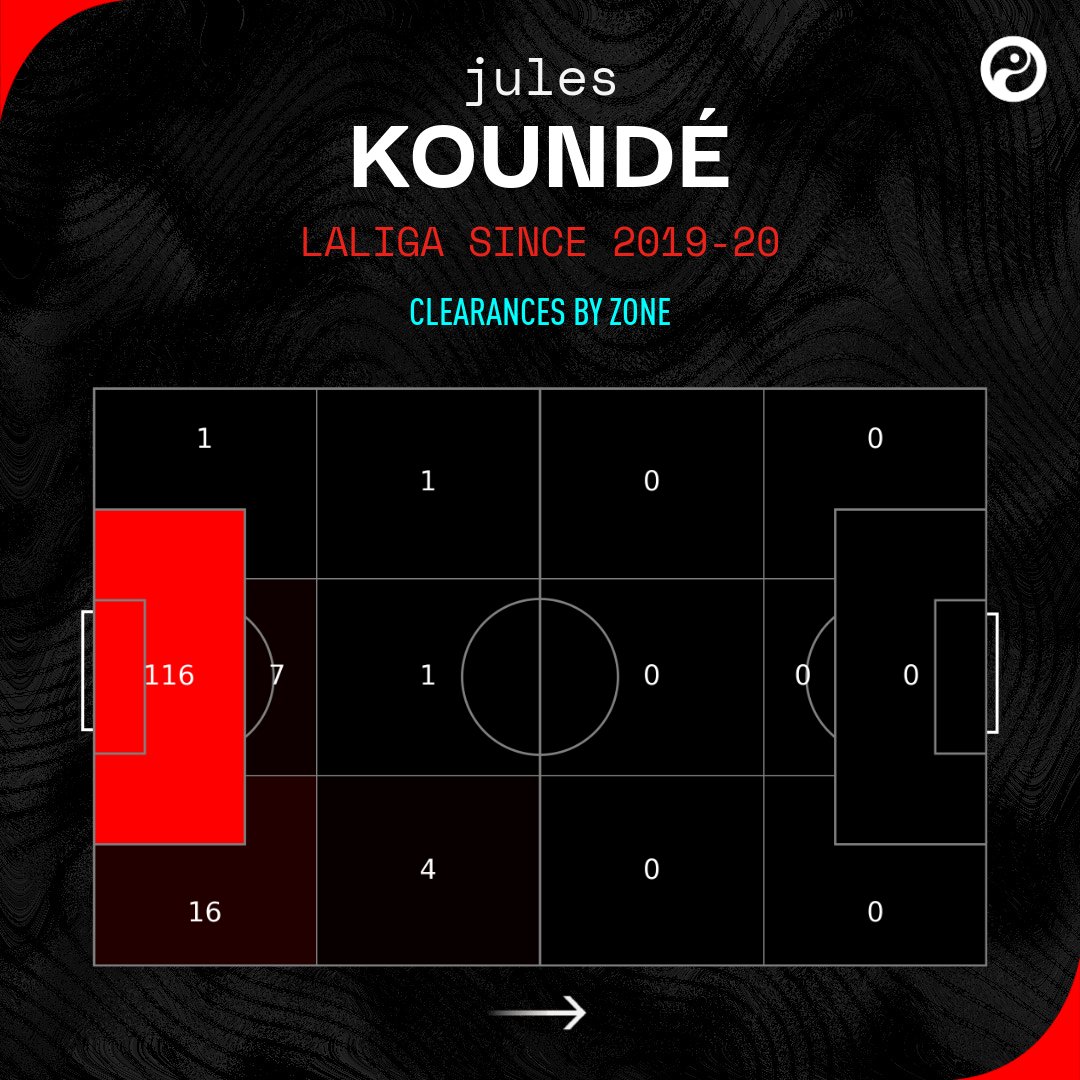
Since the start of last season, he’s made more goal-line clearances (5) than any other player in Europe’s top five leagues - a testament to his awareness, anticipation & concentration.

A busy boy inside the box.
@azulfeehely @LaLigaLowdown At 5’11, Koundé is relatively small for a centre-back. But it doesn’t seem to have an impact on his aerial ability:

He contests 5.7 aerial duels per 90 with a win rate of 61%.
@azulfeehely @LaLigaLowdown Since joining Sevilla, Koundé has completed more take-ons per 90 minutes than any other centre-back in LaLiga.

@muhammadbutt has previously labelled him a "box-to-box centre-back", which sounds a bit silly… but it’s exactly what he is.

And we can prove it.
@azulfeehely @LaLigaLowdown @muhammadbutt In total, Sergio Ramos is the only centre-back in LaLiga with more touches in the opposition the box since the start of the 2019-20 season.

But when looking at per 90, Koundé is King.
@azulfeehely @LaLigaLowdown @muhammadbutt Diego Carlos was signed the same summer as Koundé and they have gone on to form a Europa League-winning centre-back partnership.

Are they the best duo in LaLiga? You tell us. 🤔
@azulfeehely @LaLigaLowdown @muhammadbutt We shouldn't be surprised.

Jules Koundé was one of TWENTY-SEVEN French centre-backs we profiled when looking at their depth in that position.

Learn about the other 26 here - https://t.co/k3IoqtRdyc

More from World

You May Also Like

First thread of the year because I have time during MCO. As requested, a thread on the gods and spirits of Malay folk religion. Some are indigenous, some are of Indian origin, some have Islamic


Before I begin, it might be worth explaining the Malay conception of the spirit world. At its deepest level, Malay religious belief is animist. All living beings and even certain objects are said to have a soul. Natural phenomena are either controlled by or personified as spirits

Although these beings had to be respected, not all of them were powerful enough to be considered gods. Offerings would be made to the spirits that had greater influence on human life. Spells and incantations would invoke their


Two known examples of such elemental spirits that had god-like status are Raja Angin (king of the wind) and Mambang Tali Arus (spirit of river currents). There were undoubtedly many more which have been lost to time

Contact with ancient India brought the influence of Hinduism and Buddhism to SEA. What we now call Hinduism similarly developed in India out of native animism and the more formal Vedic tradition. This can be seen in the multitude of sacred animals and location-specific Hindu gods
I just finished Eric Adler's The Battle of the Classics, and wanted to say something about Joel Christiansen's review linked below. I am not sure what motivates the review (I speculate a bit below), but it gives a very misleading impression of the book. 1/x


The meat of the criticism is that the history Adler gives is insufficiently critical. Adler describes a few figures who had a great influence on how the modern US university was formed. It's certainly critical: it focuses on the social Darwinism of these figures. 2/x

Other insinuations and suggestions in the review seem wildly off the mark, distorted, or inappropriate-- for example, that the book is clickbaity (it is scholarly) or conservative (hardly) or connected to the events at the Capitol (give me a break). 3/x

The core question: in what sense is classics inherently racist? Classics is old. On Adler's account, it begins in ancient Rome and is revived in the Renaissance. Slavery (Christiansen's primary concern) is also very old. Let's say classics is an education for slaveowners. 4/x

It's worth remembering that literacy itself is elite throughout most of this history. Literacy is, then, also the education of slaveowners. We can honor oral and musical traditions without denying that literacy is, generally, good. 5/x