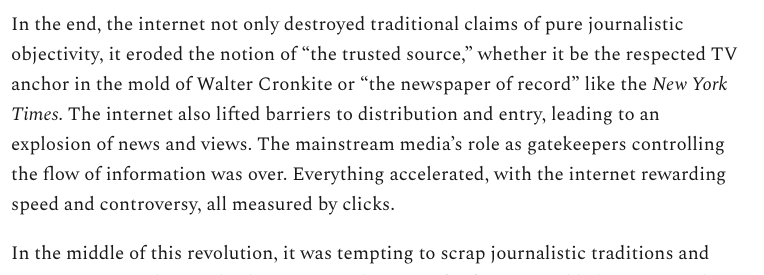
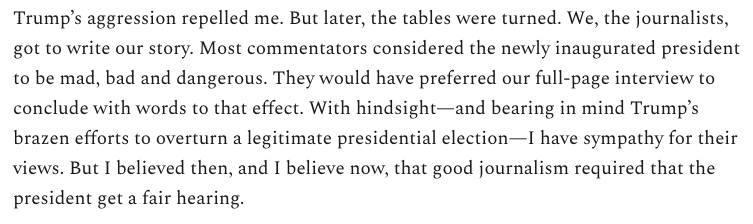
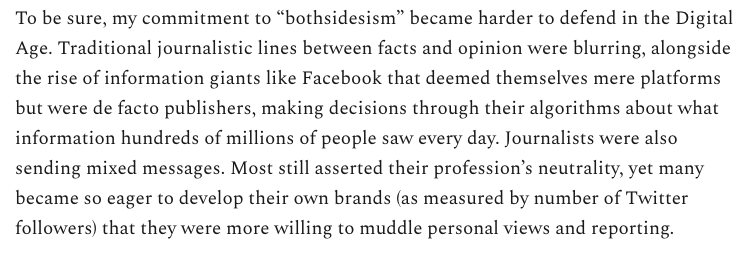
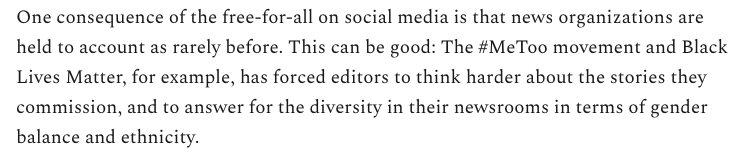
Oh, my. Former FT Editor @lionelbarber defends bothsideism, impartiality, objectivity and other recent journalistic tradition.
More from Trump

1. Yes, Trump will claim to intend to target GOP senators up for reelection in '22 (like he did to Thune with Kristi Noem) if they don't join in @HawleyMO's sedition on Jan. 6, but the fact is, it's not clear whether Trump will be successful in ANY of those efforts & voting yes
2. to hedge off these threats will also create fissures & fractures for these incumbents among other elements of their party that could complicate their renominations. Indeed, what worries me the most about the potential for the country to slip into @anneapplebaum territory is
3. that what should be robust and intense push back from the party establishment against actually ending democracy- bc that's what Trump's request would do, if it was granted, is fairly muted. What we SHOULD be seeing from the mainstream of the party is threats to strip committee
4. assignments, chairs, privileges, even reelection funds, if anyone gets involved in this bullshit- in the House & the Senate, and the fact that you don't see it is more than a story of McConnell & McCarthy being afraid of Trump & his base. Its a story of receptivity, of the
5. level of receptivity the congressional and party leadership is dealing with both within the rank and file membership of the party and within its donor class, and THAT, my friends, is why you find me so concerned. That, and my decision to finally pull @anneapplebaum's book
A lot of conversations today among Republican senators over move by @HawleyMO to challenge the certification of Biden\u2019s Electoral College victory. Small groups of Rs were huddling on & off the floor trying to game out the politics of what will happen Jan. 6
— John Bresnahan (@bresreports) January 1, 2021
2. to hedge off these threats will also create fissures & fractures for these incumbents among other elements of their party that could complicate their renominations. Indeed, what worries me the most about the potential for the country to slip into @anneapplebaum territory is
3. that what should be robust and intense push back from the party establishment against actually ending democracy- bc that's what Trump's request would do, if it was granted, is fairly muted. What we SHOULD be seeing from the mainstream of the party is threats to strip committee
4. assignments, chairs, privileges, even reelection funds, if anyone gets involved in this bullshit- in the House & the Senate, and the fact that you don't see it is more than a story of McConnell & McCarthy being afraid of Trump & his base. Its a story of receptivity, of the
5. level of receptivity the congressional and party leadership is dealing with both within the rank and file membership of the party and within its donor class, and THAT, my friends, is why you find me so concerned. That, and my decision to finally pull @anneapplebaum's book

💥💥💥Situation Update, Dec. 3rd – Trump invokes foreign interference provision of his 2018 executive order, authorizing military response to cyber warfare, see NSPM 13 💥💥💥 [M.Adams]

⁉️ ✅ Ask yourself this question: What was the purpose of yesterday’s White House speech about election fraud and vote-rigging?
✅ If you think it was all about Trump communicating to the people, think again. This speech was really about Trump communicating with Chris Miller
✅ and the DoD about foreign interference in the U.S. election while laying out the key national security justifications that are necessary to invoke what I’m calling the “national security option” for defending the United States against an attempted cyber warfare coup.
⭕️ Decoding President Trump’s Dec. 2nd speech:
https://t.co/G9kmUfVQzS
🇺🇸Consider what Trump said in yesterday’s speech. About 95% of this speech was filler. Only 5% really matters, as I detail below:
1. First, he lays out that he has a sworn oath to defend the United States
2. Constitution against the wartime “siege” that’s underway:
As President, I have no higher duty than to defend the laws and the constitution of the United States. That is why I am determined to protect our election system, which is now under coordinated assault and siege.
⁉️ ✅ Ask yourself this question: What was the purpose of yesterday’s White House speech about election fraud and vote-rigging?
✅ If you think it was all about Trump communicating to the people, think again. This speech was really about Trump communicating with Chris Miller
✅ and the DoD about foreign interference in the U.S. election while laying out the key national security justifications that are necessary to invoke what I’m calling the “national security option” for defending the United States against an attempted cyber warfare coup.
⭕️ Decoding President Trump’s Dec. 2nd speech:
https://t.co/G9kmUfVQzS
🇺🇸Consider what Trump said in yesterday’s speech. About 95% of this speech was filler. Only 5% really matters, as I detail below:
1. First, he lays out that he has a sworn oath to defend the United States
2. Constitution against the wartime “siege” that’s underway:
As President, I have no higher duty than to defend the laws and the constitution of the United States. That is why I am determined to protect our election system, which is now under coordinated assault and siege.

This is mostly right but strikes me as it needing said that I don't think the left or the intelligentsia have the slightest idea how low institutional trust in anything coming from a left mouthpiece is now. Except in-network, the best heuristic is "the opposite of what they said"
If you look at the situation from a predictive models perspective instead of the more rigorous and appropriate (under normal circumstances) "prove your case or gtfo" perspective, trusting the opposite of whatever the left side says has an AMAZING track record, as we know it.
Literally, the best heuristic most people have right now, in terms of how often it gets things right versus *completely* wrong, is "whatever CNN, the NYT, public health officials, and the Democrats said... yeah, the opposite." That is, they're wrong WAY outside of statistics.
They're also not just wrong. They're *completely* wrong, backwards, often transparently covering something up that they don't want known or refuse to believe. This isn't just a legitimation crisis because there's a heuristic: whatever the official left narrative is, is wrong.
There are a few reasons why such a heuristic would be more predictive than not. One of those is conspiracy, and another is mass hysteria with ideological capture. We know at least one of those is happening and have rather strong evidence both are. That makes conspiracy reasonable
I read part of the transcript of the Trump call.
— Eric Weinstein (@EricRWeinstein) January 4, 2021
The following strikes me.
A) Trump is a true political outsider & the only one to reach the Presidency with zero government experience.
B) There is an obvious open institutional conspiracy to prevent any outsider gaining power.
If you look at the situation from a predictive models perspective instead of the more rigorous and appropriate (under normal circumstances) "prove your case or gtfo" perspective, trusting the opposite of whatever the left side says has an AMAZING track record, as we know it.
Literally, the best heuristic most people have right now, in terms of how often it gets things right versus *completely* wrong, is "whatever CNN, the NYT, public health officials, and the Democrats said... yeah, the opposite." That is, they're wrong WAY outside of statistics.
They're also not just wrong. They're *completely* wrong, backwards, often transparently covering something up that they don't want known or refuse to believe. This isn't just a legitimation crisis because there's a heuristic: whatever the official left narrative is, is wrong.
There are a few reasons why such a heuristic would be more predictive than not. One of those is conspiracy, and another is mass hysteria with ideological capture. We know at least one of those is happening and have rather strong evidence both are. That makes conspiracy reasonable


You May Also Like


👨💻 Last resume I sent to a startup one year ago, sharing with you to get ideas:
- Forget what you don't have, make your strength bold
- Pick one work experience and explain what you did in detail w/ bullet points
- Write it towards the role you apply
- Give social proof
/thread
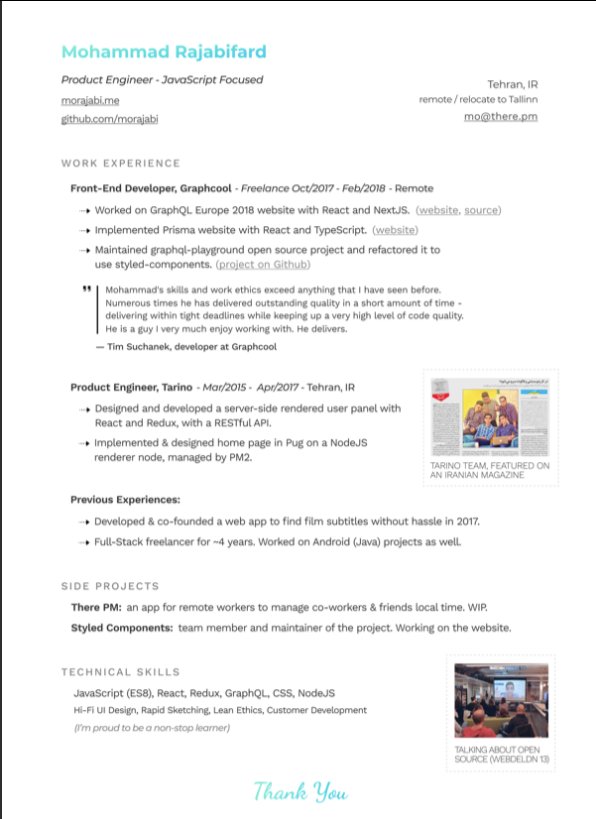
"But I got no work experience..."
Make a open source lib, make a small side project for yourself, do freelance work, ask friends to work with them, no friends? Find friends on Github, and Twitter.
Bonus points:
- Show you care about the company: I used the company's brand font and gradient for in the resume for my name and "Thank You" note.
- Don't list 15 things and libraries you worked with, pick the most related ones to the role you're applying.
-🙅♂️"copy cover letter"
"I got no firends, no work"
One practical way is to reach out to conferences and offer to make their website for free. But make sure to do it good. You'll get:
- a project for portfolio
- new friends
- work experience
- learnt new stuff
- new thing for Twitter bio
If you don't even have the skills yet, why not try your chance for @LambdaSchool? No? @freeCodeCamp. Still not? Pick something from here and learn https://t.co/7NPS1zbLTi
You'll feel very overwhelmed, no escape, just acknowledge it and keep pushing.
- Forget what you don't have, make your strength bold
- Pick one work experience and explain what you did in detail w/ bullet points
- Write it towards the role you apply
- Give social proof
/thread
"But I got no work experience..."
Make a open source lib, make a small side project for yourself, do freelance work, ask friends to work with them, no friends? Find friends on Github, and Twitter.
Bonus points:
- Show you care about the company: I used the company's brand font and gradient for in the resume for my name and "Thank You" note.
- Don't list 15 things and libraries you worked with, pick the most related ones to the role you're applying.
-🙅♂️"copy cover letter"
"I got no firends, no work"
One practical way is to reach out to conferences and offer to make their website for free. But make sure to do it good. You'll get:
- a project for portfolio
- new friends
- work experience
- learnt new stuff
- new thing for Twitter bio
If you don't even have the skills yet, why not try your chance for @LambdaSchool? No? @freeCodeCamp. Still not? Pick something from here and learn https://t.co/7NPS1zbLTi
You'll feel very overwhelmed, no escape, just acknowledge it and keep pushing.