With the Trump administration on the way out, here's a look back at what I wrote about their Iran strategy. When I say the failure of that strategy was easy to foresee, I mean I called it from the beginning (as did others).
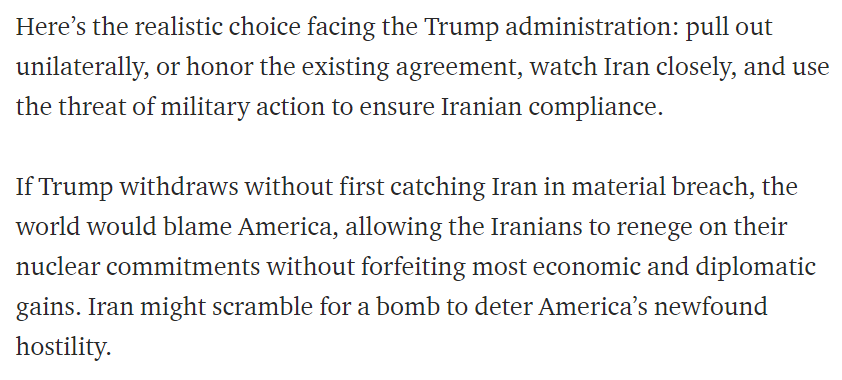
Jan 6, before Trump took office.
https://t.co/sdrJUJoh8C
June 5, 2017: The Saudis and some Israelis want the US to go hard against Iran "in the vain hope Iran will capitulate," but capitulation won't happen so throwing away gains in pursuit of it would be a mistake.
https://t.co/khgXZnRqWS
July 20, 2017: Trump botched the Qatar crisis.
"Trump sees the situation as good guys (Saudis) vs. bad guys (Iran). But — and I can’t believe I have to write this — the Middle East is complicated."
The result: Qatar closer to Iran, Iran stronger in region.
https://t.co/jLJxkga7q4
Oct 5, 2017: The "Madman Theory" won't work on Iran
https://t.co/StayQYRUU6 Oct 8, '17: Scrapping the Iran deal will hurt the Western alliance
https://t.co/bcaMOkOT6m Oct 14, '17: Trump's speech scrapping JCPOA misguidedly ignores Iran's domestic politics
https://t.co/48U06d5Xpx
March 18, 2018: Trump's Iran strategy is failing and that failure will become progressively more obvious, which means he'll come under increasing pressure to Do Something.
(Thankfully US v. Iran military confrontation has remained fairly limited)
https://t.co/hPjbObNURZ
May 8, 2018: The US withdrew from the Iran Deal, but it has no idea how to get a "better deal" because, unlike in 2015, Iran isn't under multilateral pressure. Even if you think Obama was wrong, we can't go back in time and recreate pre-deal conditions.
https://t.co/ltGOTzGzag
Sept 27, 2018: The US scrapping JCPOA without cause, besides letting Iran out of restrictions, is aligning JCPOA proponents against the US.
Bush and Obama built an anti-Iran coalition. Trump flipped that into sympathy for Iran and anger at the US.
https://t.co/d08fAMMvIv
June 19, 2019: To really pressure Iran takes an international coalition. The Trump admin acts like other countries should line up behind the US, and even though they agree on some anti-Iran goals, no one will join because none trust Trump's leadership.
https://t.co/nPzMGW5DAf
Jan 2, 2020: The (non-deadly) attack on the US embassy in Baghdad is very different from the 2012 deadly attack on a US diplomatic facility in Benghazi, and forcing the Baghdad attack into the partisan frame of "Benghazi" is a mistake.
https://t.co/widYhbeJn9
Jan 4, 2020: US killing Iranian general Qassem Soleimani won't lead to outright war, but will likely lead to Iran gaining more political influence in Iraq at America's expense.
(Looking at it a year later, that's exactly what happened).
https://t.co/ZjMtkXOzDt
After Jan 2020, I focused on COVID and the election, and didn't write a full article on US-Iran (though I tweeted about it a bunch).
Looking back, I nailed it every step of the way. So did others.
This failure was easy to see coming. Trump was warned. He did it anyway.
(END)