

🚨Thread: What is the Trump Card?
1. This my personal opinion based on my military experience, analysis of indicators, open source information & common sense. I’m not talking about the card in my wallet.
Let’s get into it.

More from Trump

Long thread: Because I couldn’t find anything comprehensive, I’m just going to post everything I’ve seen in the news/Twitter about Trump’s activities related to the Jan 6th insurrection. I think the timing & context of his actions/inactions will matter a lot for a senate trial.
12/12: The earlier DC protest over the electoral college vote during clearly inspired Jan 6th. On Dec 12th, he tweeted: “Wow! Thousands of people forming in Washington (D.C.) for Stop the Steal. Didn’t know about this, but I’ll be seeing them! #MAGA.”
12/19: Trump announces the Jan. 6th event by tweeting, “Big protest in D.C. on January 6th. Be there, will be wild!” Immediately, insurrectionists begin to discuss the “Wild Protest.” Just 2 days later, this UK political analyst predicts the violence
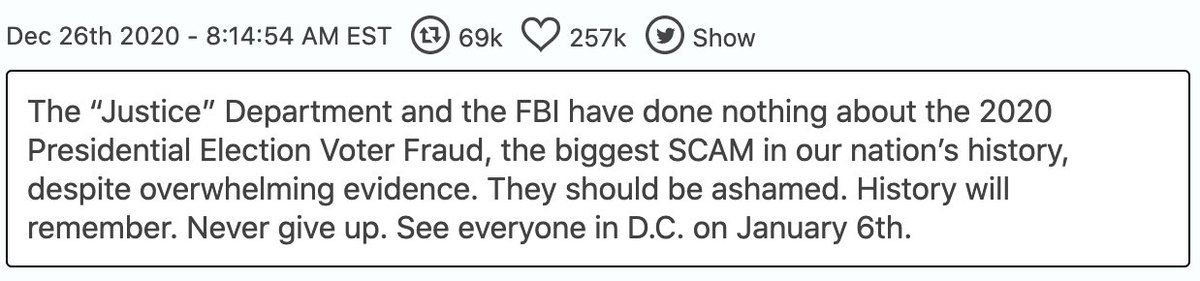
12/26-27: Trump announces his participation on Twitter. On Dec. 29, the FBI sends out a nationwide bulletin warning legislatures about attacks https://t.co/Lgl4yk5aO1
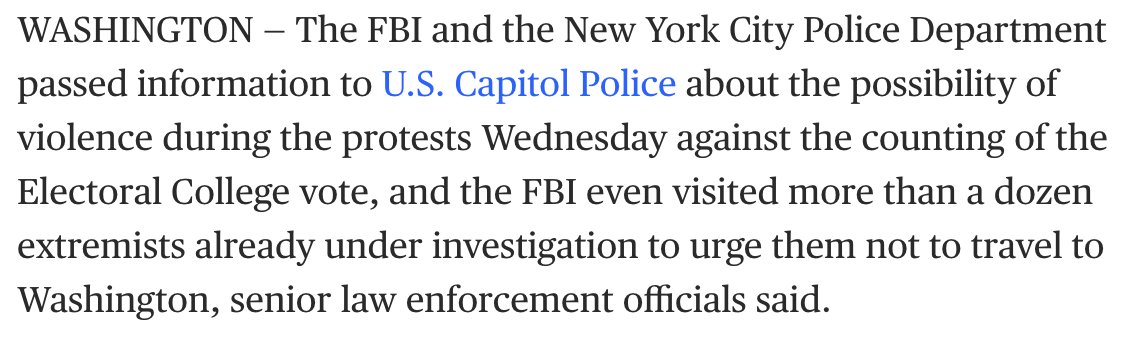
1/1: Trump tweets the time of his protest. Then he retweets “The calvary is coming” on Jan. 6!” Sounds like a war? About this time, the FBI begins visiting right wing extremists to tell them not to go--does the FBI tell the president? https://t.co/3OxnB2AHdr
12/12: The earlier DC protest over the electoral college vote during clearly inspired Jan 6th. On Dec 12th, he tweeted: “Wow! Thousands of people forming in Washington (D.C.) for Stop the Steal. Didn’t know about this, but I’ll be seeing them! #MAGA.”
Jumping in for @DCist/@wamu885 this evening. The scene rn coming up 17th Street from BLM Plaza. pic.twitter.com/Fn9aukjEPW
— Matt Blitz (@WhyBlitz) December 12, 2020
12/19: Trump announces the Jan. 6th event by tweeting, “Big protest in D.C. on January 6th. Be there, will be wild!” Immediately, insurrectionists begin to discuss the “Wild Protest.” Just 2 days later, this UK political analyst predicts the violence
On January 6, armed Trumpist militias will be rallying in DC, at Trump's orders. It's highly likely that they'll try to storm the Capitol after it certifies Joe Biden's win. I don't think this has sunk in yet.
— Arieh Kovler (@ariehkovler) December 21, 2020
12/26-27: Trump announces his participation on Twitter. On Dec. 29, the FBI sends out a nationwide bulletin warning legislatures about attacks https://t.co/Lgl4yk5aO1
1/1: Trump tweets the time of his protest. Then he retweets “The calvary is coming” on Jan. 6!” Sounds like a war? About this time, the FBI begins visiting right wing extremists to tell them not to go--does the FBI tell the president? https://t.co/3OxnB2AHdr




You May Also Like




1/ Some initial thoughts on personal moats:
Like company moats, your personal moat should be a competitive advantage that is not only durable—it should also compound over time.
Characteristics of a personal moat below:
2/ Like a company moat, you want to build career capital while you sleep.
As Andrew Chen noted:
3/ You don’t want to build a competitive advantage that is fleeting or that will get commoditized
Things that might get commoditized over time (some longer than
4/ Before the arrival of recorded music, what used to be scarce was the actual music itself — required an in-person artist.
After recorded music, the music itself became abundant and what became scarce was curation, distribution, and self space.
5/ Similarly, in careers, what used to be (more) scarce were things like ideas, money, and exclusive relationships.
In the internet economy, what has become scarce are things like specific knowledge, rare & valuable skills, and great reputations.
Like company moats, your personal moat should be a competitive advantage that is not only durable—it should also compound over time.
Characteristics of a personal moat below:
I'm increasingly interested in the idea of "personal moats" in the context of careers.
— Erik Torenberg (@eriktorenberg) November 22, 2018
Moats should be:
- Hard to learn and hard to do (but perhaps easier for you)
- Skills that are rare and valuable
- Legible
- Compounding over time
- Unique to your own talents & interests https://t.co/bB3k1YcH5b
2/ Like a company moat, you want to build career capital while you sleep.
As Andrew Chen noted:
People talk about \u201cpassive income\u201d a lot but not about \u201cpassive social capital\u201d or \u201cpassive networking\u201d or \u201cpassive knowledge gaining\u201d but that\u2019s what you can architect if you have a thing and it grows over time without intensive constant effort to sustain it
— Andrew Chen (@andrewchen) November 22, 2018
3/ You don’t want to build a competitive advantage that is fleeting or that will get commoditized
Things that might get commoditized over time (some longer than
Things that look like moats but likely aren\u2019t or may fade:
— Erik Torenberg (@eriktorenberg) November 22, 2018
- Proprietary networks
- Being something other than one of the best at any tournament style-game
- Many "awards"
- Twitter followers or general reach without "respect"
- Anything that depends on information asymmetry https://t.co/abjxesVIh9
4/ Before the arrival of recorded music, what used to be scarce was the actual music itself — required an in-person artist.
After recorded music, the music itself became abundant and what became scarce was curation, distribution, and self space.
5/ Similarly, in careers, what used to be (more) scarce were things like ideas, money, and exclusive relationships.
In the internet economy, what has become scarce are things like specific knowledge, rare & valuable skills, and great reputations.