Today we’re going to talk statistics and semantics. I’m going to do so via the medium of one of Twitter’s favourite stats 1.7% (aka “intersex is as common as red heads.”). The statistic comes from Fausto-Sterling’s work, which you can see a review of
https://t.co/fze95pGwN2
Do intersex women have penises? I\u2019m seeing this thrown around a lot, so let\u2019s address it. Firstly, as ever, let\u2019s all remember that intersex =/= trans, and he conflation is harmful and ignorant. Now let\u2019s get on with some science\u2026
— Mrkhtake2 (@mrkhtake2) August 25, 2018


More from Tech




I could create an entire twitter feed of things Facebook has tried to cover up since 2015. Where do you want to start, Mark and Sheryl? https://t.co/1trgupQEH9
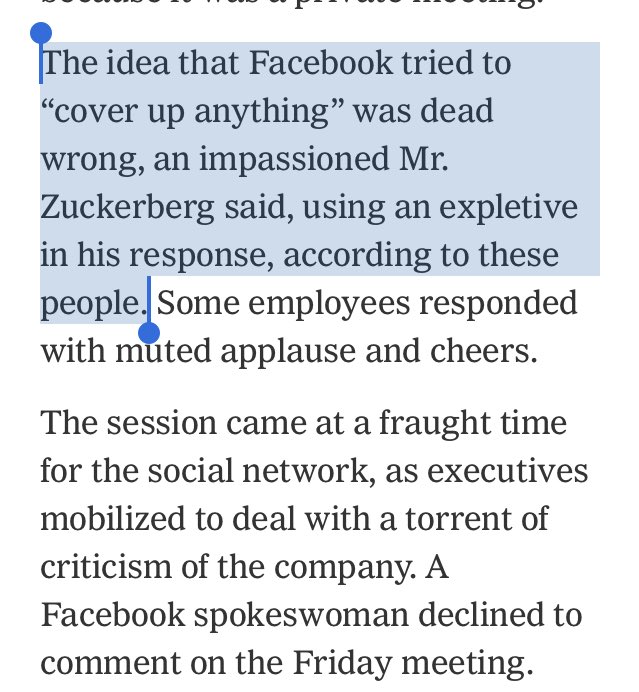
Ok, here. Just one of the 236 mentions of Facebook in the under read but incredibly important interim report from Parliament. ht @CommonsCMS https://t.co/gfhHCrOLeU
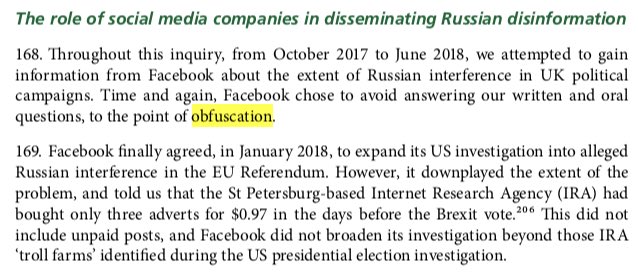
Let’s do another, this one to Senate Intel. Question: “Were you or CEO Mark Zuckerberg aware of the hiring of Joseph Chancellor?"
Answer "Facebook has over 30,000 employees. Senior management does not participate in day-today hiring decisions."
Or to @CommonsCMS: Question: "When did Mark Zuckerberg know about Cambridge Analytica?"
Answer: "He did not become aware of allegations CA may not have deleted data about FB users obtained through Dr. Kogan's app until March of 2018, when
these issues were raised in the media."

If you prefer visuals, watch this short clip after @IanCLucas rightly expresses concern about a Facebook exec failing to disclose info.
Ok, here. Just one of the 236 mentions of Facebook in the under read but incredibly important interim report from Parliament. ht @CommonsCMS https://t.co/gfhHCrOLeU
Let’s do another, this one to Senate Intel. Question: “Were you or CEO Mark Zuckerberg aware of the hiring of Joseph Chancellor?"
Answer "Facebook has over 30,000 employees. Senior management does not participate in day-today hiring decisions."
Or to @CommonsCMS: Question: "When did Mark Zuckerberg know about Cambridge Analytica?"
Answer: "He did not become aware of allegations CA may not have deleted data about FB users obtained through Dr. Kogan's app until March of 2018, when
these issues were raised in the media."
If you prefer visuals, watch this short clip after @IanCLucas rightly expresses concern about a Facebook exec failing to disclose info.
A company as powerful as @facebook should be subject to proper scrutiny. Mike Schroepfer, its CTO, told us that the buck stops with Mark Zuckerberg on the Cambridge Analytica scandal, which is why he should come and answer our questions @DamianCollins @IanCLucas pic.twitter.com/0H4VMhtIFu
— Digital, Culture, Media and Sport Committee (@CommonsCMS) May 23, 2018




THREAD: How is it possible to train a well-performing, advanced Computer Vision model 𝗼𝗻 𝘁𝗵𝗲 𝗖𝗣𝗨? 🤔
At the heart of this lies the most important technique in modern deep learning - transfer learning.
Let's analyze how it
2/ For starters, let's look at what a neural network (NN for short) does.
An NN is like a stack of pancakes, with computation flowing up when we make predictions.
How does it all work?
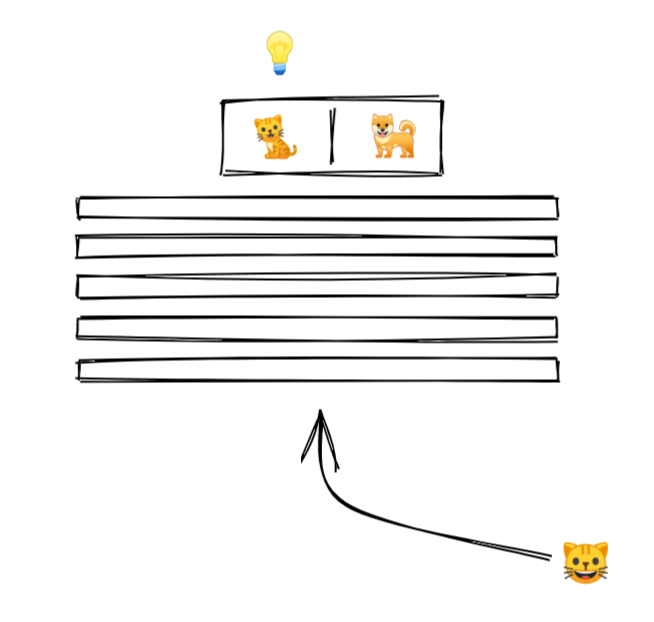
3/ We show an image to our model.
An image is a collection of pixels. Each pixel is just a bunch of numbers describing its color.
Here is what it might look like for a black and white image
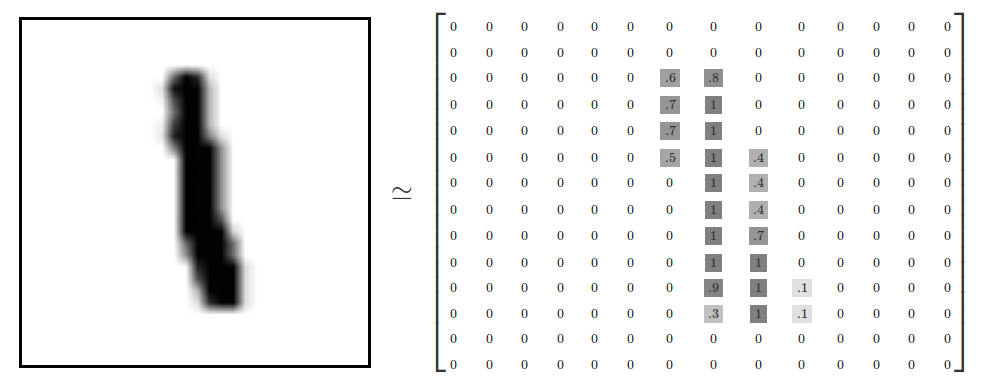
4/ The picture goes into the layer at the bottom.
Each layer performs computation on the image, transforming it and passing it upwards.
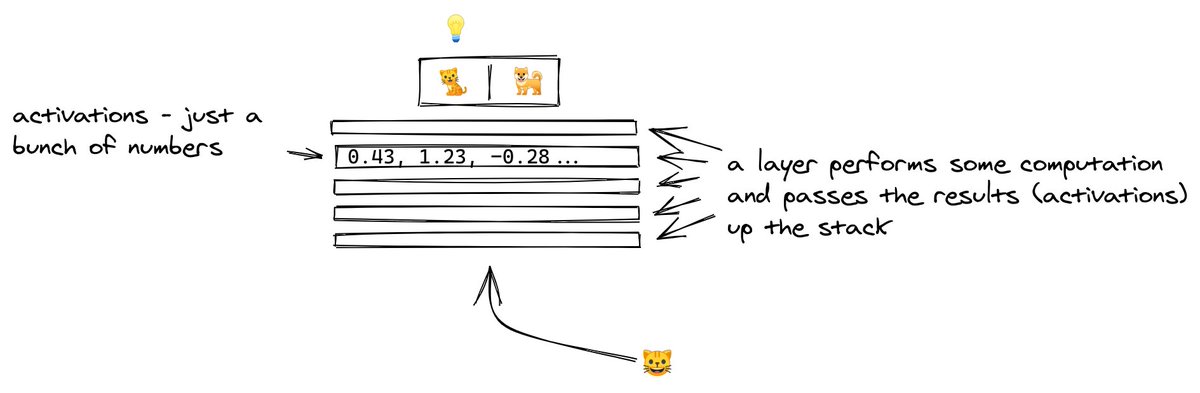
5/ By the time the image reaches the uppermost layer, it has been transformed to the point that it now consists of two numbers only.
The outputs of a layer are called activations, and the outputs of the last layer have a special meaning... they are the predictions!
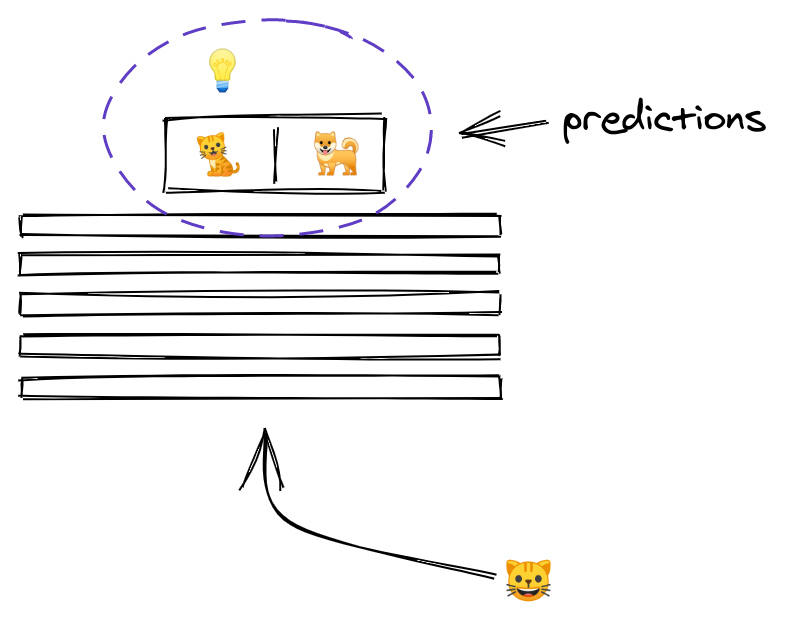
At the heart of this lies the most important technique in modern deep learning - transfer learning.
Let's analyze how it
THREAD: Can you start learning cutting-edge deep learning without specialized hardware? \U0001f916
— Radek Osmulski (@radekosmulski) February 11, 2021
In this thread, we will train an advanced Computer Vision model on a challenging dataset. \U0001f415\U0001f408 Training completes in 25 minutes on my 3yrs old Ryzen 5 CPU.
Let me show you how...
2/ For starters, let's look at what a neural network (NN for short) does.
An NN is like a stack of pancakes, with computation flowing up when we make predictions.
How does it all work?
3/ We show an image to our model.
An image is a collection of pixels. Each pixel is just a bunch of numbers describing its color.
Here is what it might look like for a black and white image
4/ The picture goes into the layer at the bottom.
Each layer performs computation on the image, transforming it and passing it upwards.
5/ By the time the image reaches the uppermost layer, it has been transformed to the point that it now consists of two numbers only.
The outputs of a layer are called activations, and the outputs of the last layer have a special meaning... they are the predictions!

You May Also Like


These 10 threads will teach you more than reading 100 books
Five billionaires share their top lessons on startups, life and entrepreneurship (1/10)
10 competitive advantages that will trump talent (2/10)
Some harsh truths you probably don’t want to hear (3/10)
10 significant lies you’re told about the world (4/10)
Five billionaires share their top lessons on startups, life and entrepreneurship (1/10)
I interviewed 5 billionaires this week
— GREG ISENBERG (@gregisenberg) January 23, 2021
I asked them to share their lessons learned on startups, life and entrepreneurship:
Here's what they told me:
10 competitive advantages that will trump talent (2/10)
To outperform, you need serious competitive advantages.
— Sahil Bloom (@SahilBloom) March 20, 2021
But contrary to what you have been told, most of them don't require talent.
10 competitive advantages that you can start developing today:
Some harsh truths you probably don’t want to hear (3/10)
I\u2019ve gotten a lot of bad advice in my career and I see even more of it here on Twitter.
— Nick Huber (@sweatystartup) January 3, 2021
Time for a stiff drink and some truth you probably dont want to hear.
\U0001f447\U0001f447
10 significant lies you’re told about the world (4/10)
THREAD: 10 significant lies you're told about the world.
— Julian Shapiro (@Julian) January 9, 2021
On startups, writing, and your career: