
Materials I studied for hundreds of hours before I became consistently profitable as a day trader - a thread:

https://t.co/VrdX0GViIb
More from Ta

25k webinar Done in a tweet
A sweet and simple BNF Setup i use
Alligator Setup
Retweet so that everyone can get benefited.
Check Full thread for full strategy.
1. You have to use 2 charts simultaneously , first chart of bank nifty spot 15 min time frame , candle used heikin ashi
Second chart 15 min bnf future normal candle.
2. Indicator used is alligator , in the indicator you have to only use the jaw of indicator.
3. Whenever spot and future candle closes simultaneously below the jaw line , short at the low of the candle which closed below the jawline.
4. Whenever spot and future candle closes simultaneously above the jaw line , buy at the high of the candle which closes above the jawline.
5. Target and Stoploss - Ideal target which i personally take is 100 points.
Stoploss also 100 points.
On trending days you can trail and take 200/300/400 points also.
I have personally made maximum 624 points in bank nifty in a single trade.
6. Precautions - never trade on sideways days.
7. Never trade on gap up or gapdown of more than 100 points .
I have made a detailed video on the same.
Link https://t.co/XMolGUKZPF
Thankyou for reading.
A sweet and simple BNF Setup i use
Alligator Setup
Retweet so that everyone can get benefited.
Check Full thread for full strategy.
1. You have to use 2 charts simultaneously , first chart of bank nifty spot 15 min time frame , candle used heikin ashi
Second chart 15 min bnf future normal candle.
2. Indicator used is alligator , in the indicator you have to only use the jaw of indicator.
3. Whenever spot and future candle closes simultaneously below the jaw line , short at the low of the candle which closed below the jawline.
4. Whenever spot and future candle closes simultaneously above the jaw line , buy at the high of the candle which closes above the jawline.
5. Target and Stoploss - Ideal target which i personally take is 100 points.
Stoploss also 100 points.
On trending days you can trail and take 200/300/400 points also.
I have personally made maximum 624 points in bank nifty in a single trade.
6. Precautions - never trade on sideways days.
7. Never trade on gap up or gapdown of more than 100 points .
I have made a detailed video on the same.
Link https://t.co/XMolGUKZPF
Thankyou for reading.

"How to Determine Market Trend Using CPR"
Read the writeup & most importantly understand the chart with comments
It solves the problem which traders face "what's the trend?"
If someone liked it, may send a box of chocolates, I won't mind 🍫 😄 https://t.co/BQ9bwjxBU4
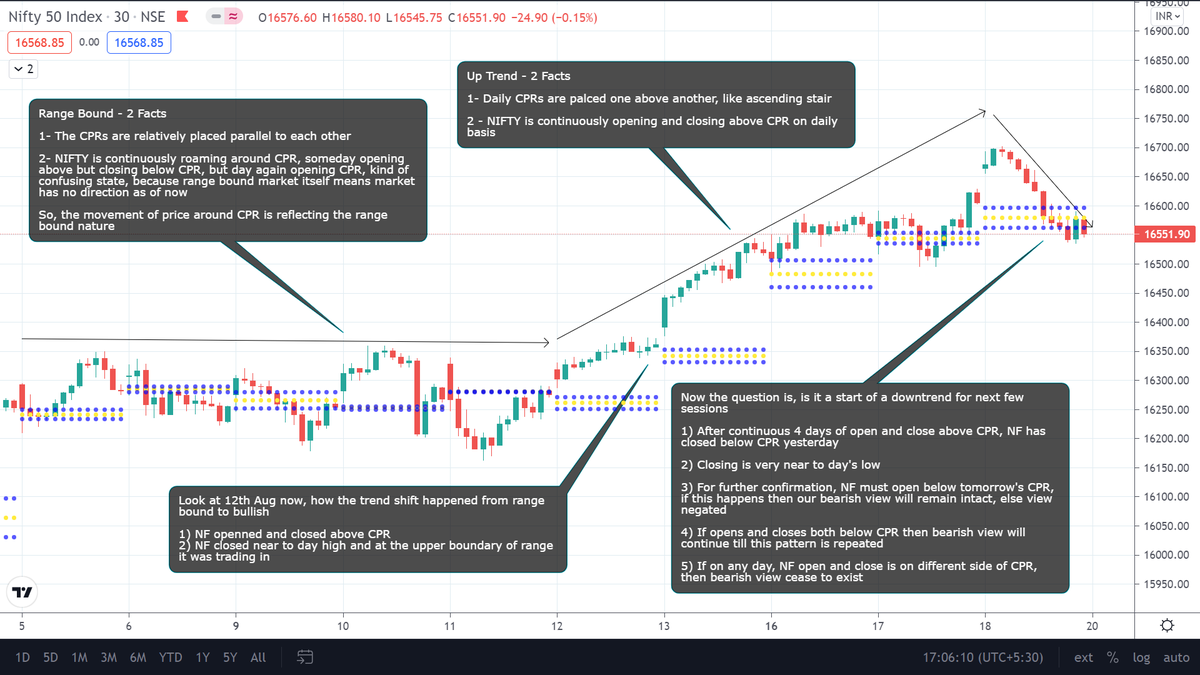
Read the writeup & most importantly understand the chart with comments
It solves the problem which traders face "what's the trend?"
If someone liked it, may send a box of chocolates, I won't mind 🍫 😄 https://t.co/BQ9bwjxBU4
SGX in -320 Pts
— Sarah (@TheCosmicTrader) August 19, 2021
Look at CPR of NF basis open & close, something unusual happened yesterday which didn't happen in last few trading sessions
If you can see above in chart, you will realize CPR is not an indicator, it is market sentiment
It's time for a short webinar






You May Also Like





So the cryptocurrency industry has basically two products, one which is relatively benign and doesn't have product market fit, and one which is malignant and does. The industry has a weird superposition of understanding this fact and (strategically?) not understanding it.
The benign product is sovereign programmable money, which is historically a niche interest of folks with a relatively clustered set of beliefs about the state, the literary merit of Snow Crash, and the utility of gold to the modern economy.
This product has narrow appeal and, accordingly, is worth about as much as everything else on a 486 sitting in someone's basement is worth.
The other product is investment scams, which have approximately the best product market fit of anything produced by humans. In no age, in no country, in no city, at no level of sophistication do people consistently say "Actually I would prefer not to get money for nothing."
This product needs the exchanges like they need oxygen, because the value of it is directly tied to having payment rails to move real currency into the ecosystem and some jurisdictional and regulatory legerdemain to stay one step ahead of the banhammer.
If everyone was holding bitcoin on the old x86 in their parents basement, we would be finding a price bottom. The problem is the risk is all pooled at a few brokerages and a network of rotten exchanges with counter party risk that makes AIG circa 2008 look like a good credit.
— Greg Wester (@gwestr) November 25, 2018
The benign product is sovereign programmable money, which is historically a niche interest of folks with a relatively clustered set of beliefs about the state, the literary merit of Snow Crash, and the utility of gold to the modern economy.
This product has narrow appeal and, accordingly, is worth about as much as everything else on a 486 sitting in someone's basement is worth.
The other product is investment scams, which have approximately the best product market fit of anything produced by humans. In no age, in no country, in no city, at no level of sophistication do people consistently say "Actually I would prefer not to get money for nothing."
This product needs the exchanges like they need oxygen, because the value of it is directly tied to having payment rails to move real currency into the ecosystem and some jurisdictional and regulatory legerdemain to stay one step ahead of the banhammer.


