
Stream never modifies the source data, it processes it and gives us the result without modifying the original data.
Java: Beginner Guide to Stream API
a thread...
Stream never modifies the source data, it processes it and gives us the result without modifying the original data.
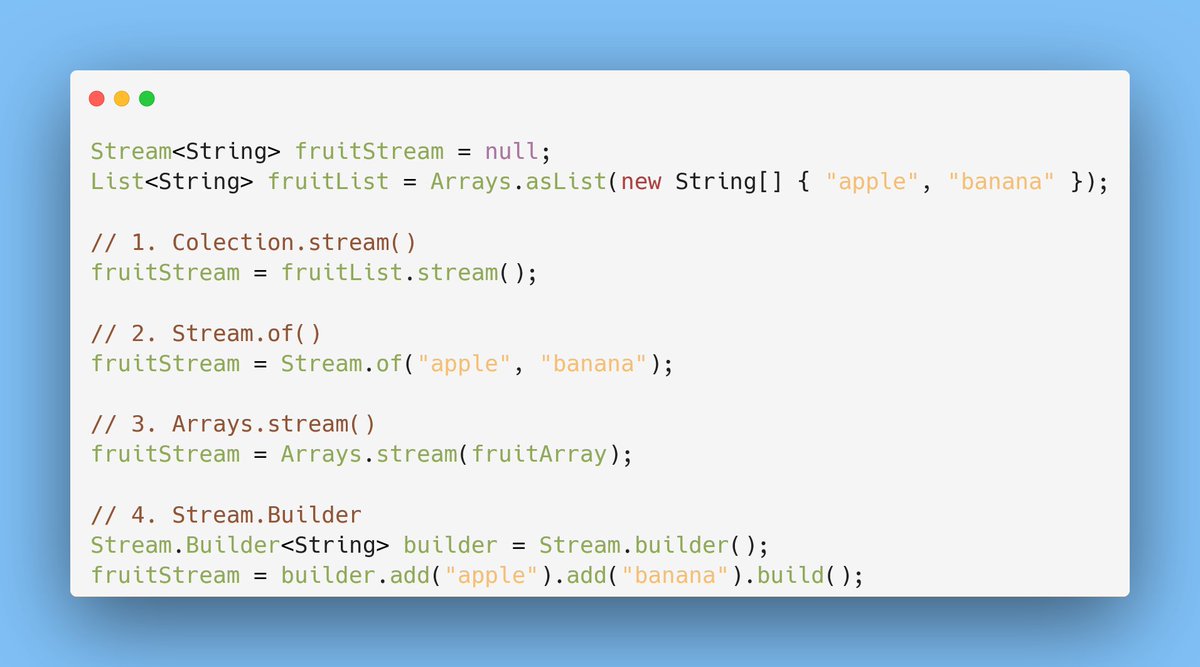
1. Collection. stream()
2. Stream.of(T... values)
3. Arrays. stream()
4. Stream.builder()
Eg:️
1. Intermediate Operations(IO)
2. Terminal Operations(TO)
Here's what the stream pipeline looks like:
Source -> Intermediate Operations -> Terminal Operations
It returns another stream object, after this, we can either call another IO or TO.
Few methods in Stream API for Intermediate operations:
1. filter()
2. map()
3. sorted()
and many more...
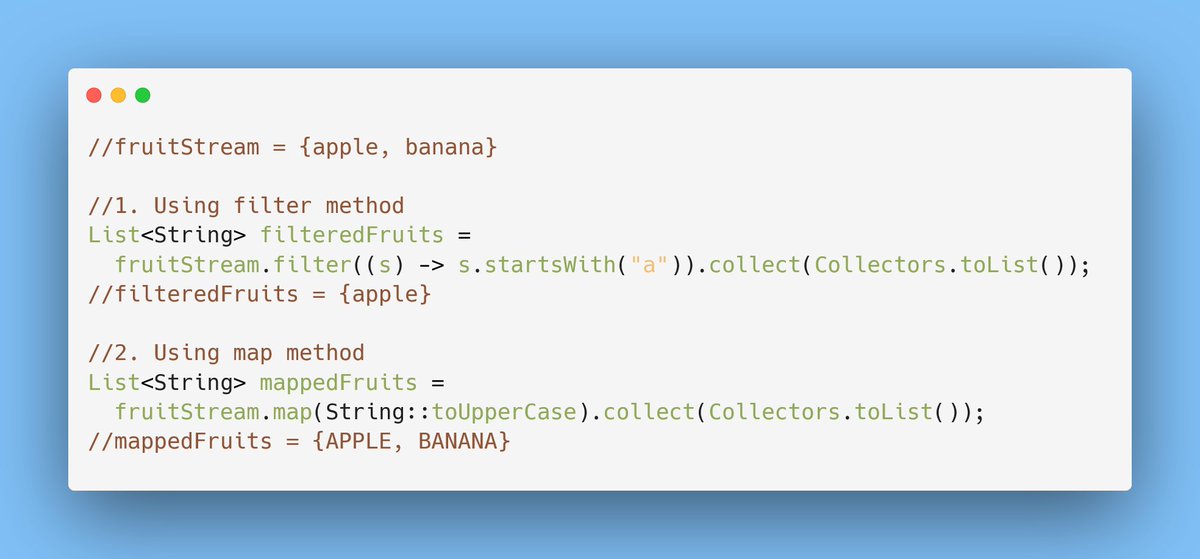
filter() - filters out the data based on any boolean condition - below we're filtering elements starting with the letter a.
map() - performs some given operation on the whole data set - below we're converting every element to upper case.
It's the last operation done on stream that's why it's called terminal.
This operation returns the final result.
Few methods in Stream API for Terminal operations:
1. collect()
2. count()
3. forEach()
and many more...
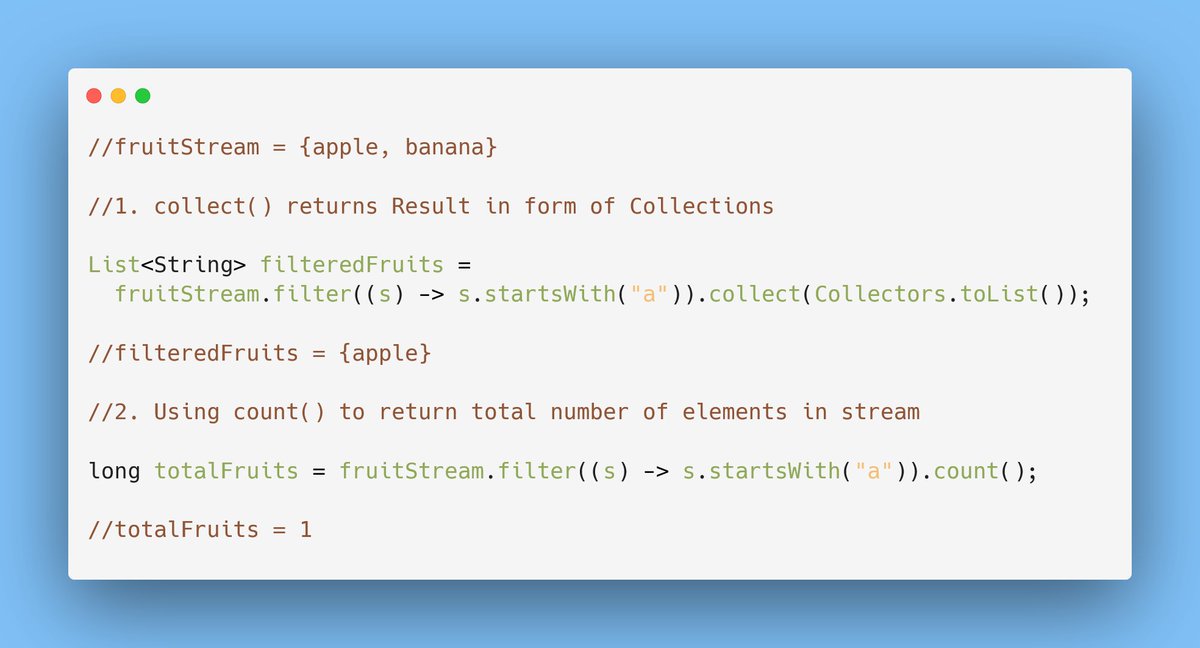
collect() - collects the elements in the given collection as shown below in the first case it is returning data in the form of a list.
count() - counts the no of the element in the stream and returns in the form of long.

More from Vikas Rajput



Learn Core Java, in 30 days as an Absolute Beginner
a roadmap...
Core Java can be Overwhelming, in the beginning!
Let's see what are those topics you should cover and what you can skip in Core Java.
1. Theoretical Concepts (2 days)
- Features of Java
- JVM, JRE & JDK
- Memory areas in Java
- Basics of how Garbage Collection Works.
2. OOP Concepts (3 days)
- Objects and Classes
- Inheritance
- Polymorphism
- Encapsulation
This topic forms the basis of your Java learning. Spent enough time on this topic and understanding it using real-world examples and some
3. Primitives data types, Operators & Arrays (3 days)
- Various primitives/non-primitives data types, operators
- What is their use, How to use them
- Various sizes of data types
- Arrays, practice a few of its problems
- 2D/3D arrays and their use cases, practice a few problems
a roadmap...
Core Java can be Overwhelming, in the beginning!
Let's see what are those topics you should cover and what you can skip in Core Java.
1. Theoretical Concepts (2 days)
- Features of Java
- JVM, JRE & JDK
- Memory areas in Java
- Basics of how Garbage Collection Works.
2. OOP Concepts (3 days)
- Objects and Classes
- Inheritance
- Polymorphism
- Encapsulation
This topic forms the basis of your Java learning. Spent enough time on this topic and understanding it using real-world examples and some
OOPs Concept in Java
— Vikas Rajput (@vikasrajputin) April 4, 2022
a thread...
3. Primitives data types, Operators & Arrays (3 days)
- Various primitives/non-primitives data types, operators
- What is their use, How to use them
- Various sizes of data types
- Arrays, practice a few of its problems
- 2D/3D arrays and their use cases, practice a few problems
You May Also Like







Oh my Goodness!!!
I might have a panic attack due to excitement!!
Read this thread to the end...I just had an epiphany and my mind is blown. Actually, more than blown. More like OBLITERATED! This is the thing! This is the thing that will blow the entire thing out of the water!
Has this man been concealing his true identity?
Is this man a supposed 'dead' Seal Team Six soldier?
Witness protection to be kept safe until the right moment when all will be revealed?!
Who ELSE is alive that may have faked their death/gone into witness protection?

Were "golden tickets" inside the envelopes??

Are these "golden tickets" going to lead to their ultimate undoing?
Review crumbs on the board re: 'gold'.

#SEALTeam6 Trump re-tweeted this.

I might have a panic attack due to excitement!!
Read this thread to the end...I just had an epiphany and my mind is blown. Actually, more than blown. More like OBLITERATED! This is the thing! This is the thing that will blow the entire thing out of the water!
Tik Tok pic.twitter.com/8X3oMxvncP
— Scotty Mar10 (@Allenma15086871) December 29, 2020
Has this man been concealing his true identity?
Is this man a supposed 'dead' Seal Team Six soldier?
Witness protection to be kept safe until the right moment when all will be revealed?!
Who ELSE is alive that may have faked their death/gone into witness protection?
Were "golden tickets" inside the envelopes??
Are these "golden tickets" going to lead to their ultimate undoing?
Review crumbs on the board re: 'gold'.
#SEALTeam6 Trump re-tweeted this.