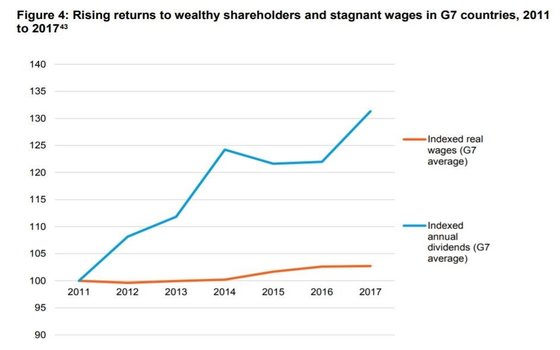
The Chartwells/Compass free school meals package scandal is a teachable moment about capitalism. 1/ Why do so many families need free school meals? Because real wages have stagnated while profits soared...

2/ Why packages and not vouchers? Because the big outsourcers like Compass *lobbied the government* against vouchers, claiming they could use their scale to provide cheaper food...
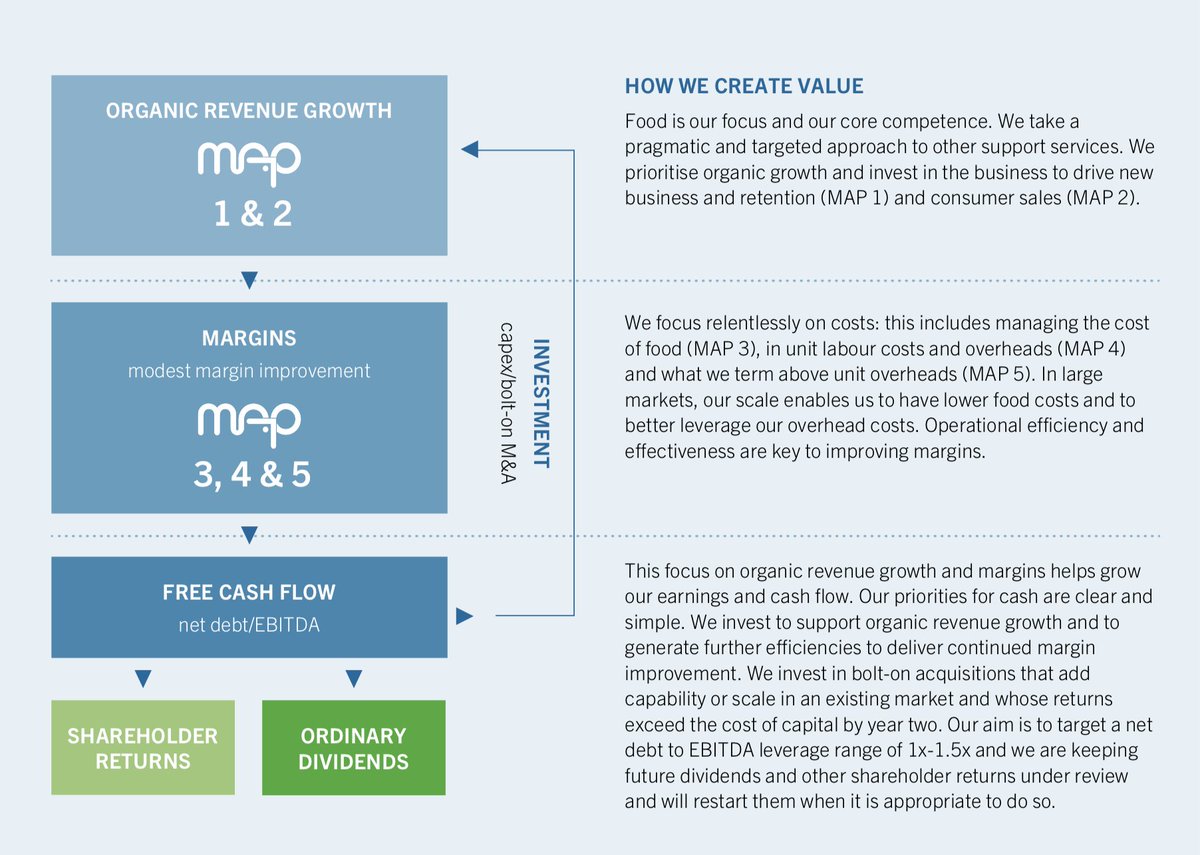
3/ Here's the business model in a single graphic. Buy food as cheap as possible. Achieve growth by replacing/acquiring smaller, higher-quality providers, hire the cheapest possible labour...("we focus relentlessly on costs")... but it's not done to make huge bottom line profits
4/ If you look at a normal year, Compass and other big outsourcers make relatively meagre profits... they grow, and drive dividends, by acquisition - not by innovation... (except in ways to cut costs)...
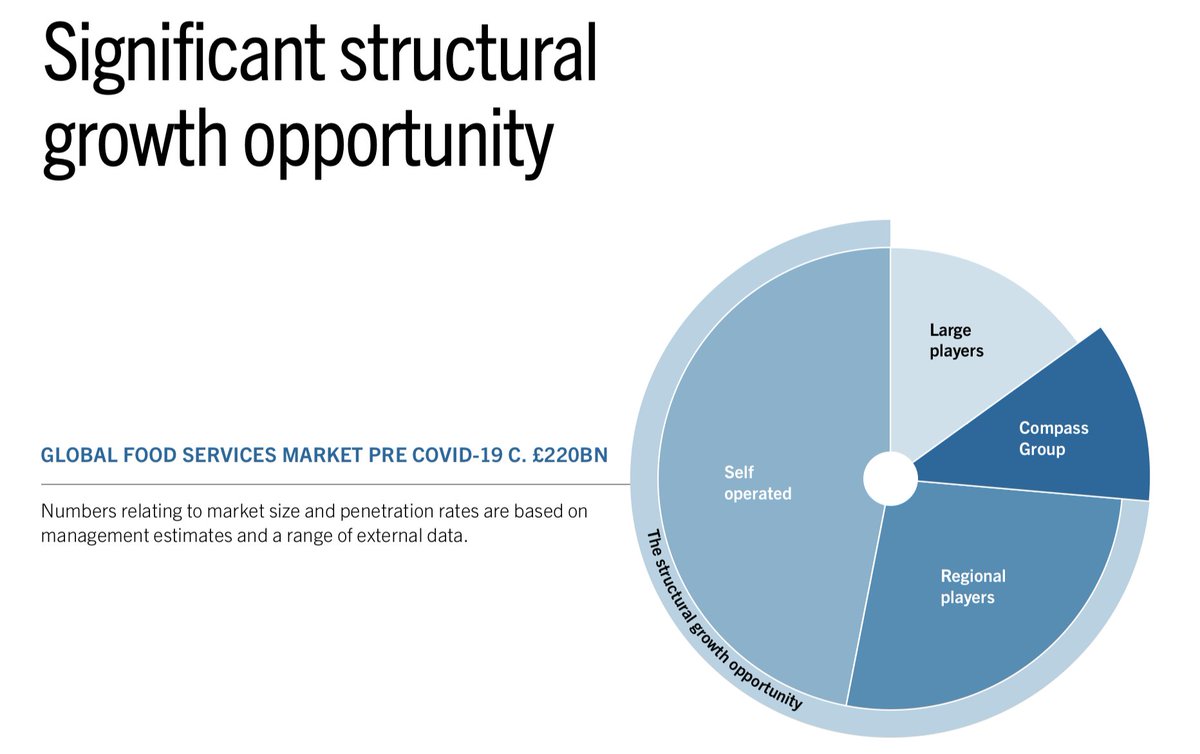
5/ Businesses like this were created by the state. They're not the product of the market, or consumer choice, but of regulation. They survive on wafer thin margins because that's how the govt structured the market...
6/ So it's not corruption - except in the moral sense - that leeches most of the value of the food away from the poor families who have to live on it... it's "operating costs"... the CSR department, the glossy annual report, the lobbying, exec salaries etc...
7/ How do you turn £30 worth of food into seven quid's worth? It's capitalism. It's an institution called a corporation. It's the state that regulates to eviscerate small, well-run businesses and replace them with faceless outsourcers... it's called neoliberalism... but wait...
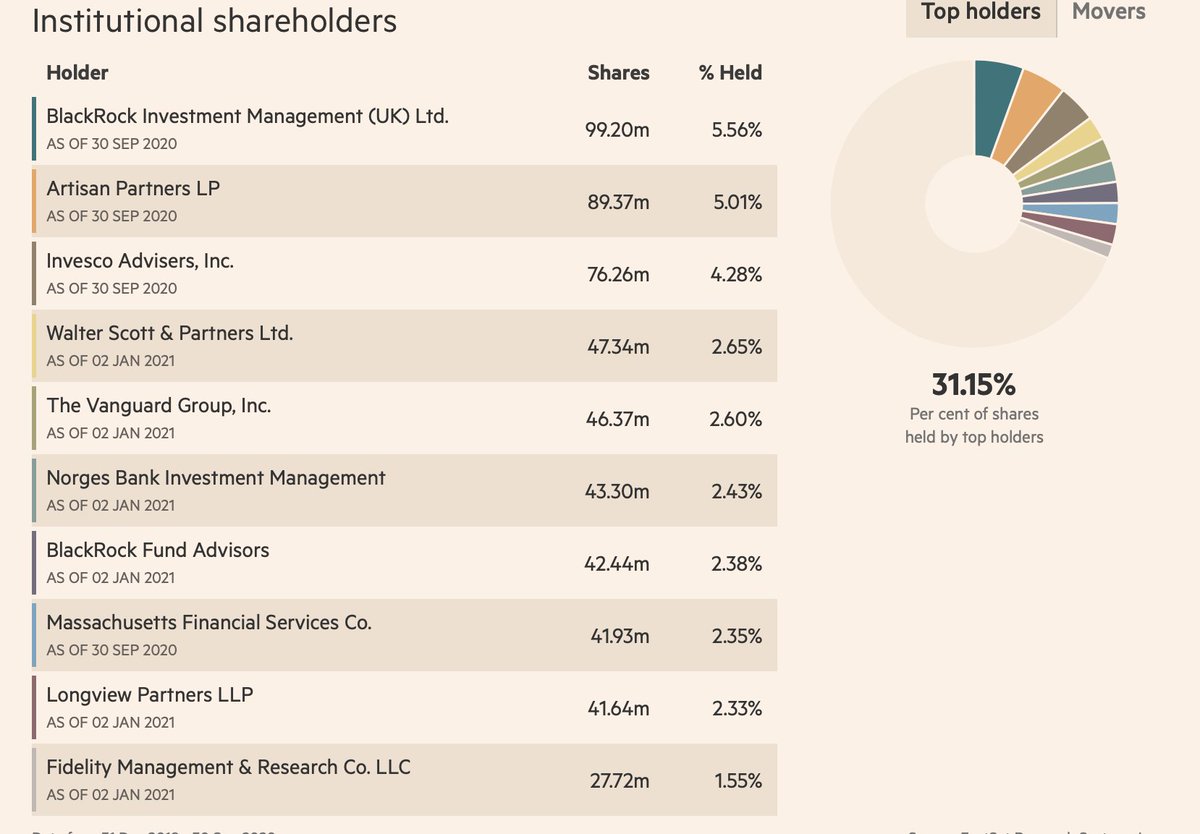
8/ Who owns Compass? The global middle class and the super-rich, through these lovely bespoke, boutique (add other adjectives) investment managers... it's to them that the £1.6bn a year operating profit flows (in a good year)...
9/ The managers and execs of these firms are trapped in the same system as the victims of the gross rip-offs at the bottom (though they have a better deal) ... it's the system and its design that incentivises cost-cutting, and a race to the bottom...
10./ What if we designed school meals provision on human scale? Do we have a model? I do - in my memory! Good, locally produced food, so good people look forward to it...
11/ Free school meals should be a universal basic service. Produced and sourced locally, with decent wages and the best quality produce, with a fair deal for the farmer and nothing to the middleman, aka the capitalist...
12/ They would cost more to produce. But the efficiencies and scale could be even bigger - despite the fragmented nature of many co-ops and SMEs providing: because the state would foster co-operation, not competition...
13/ Capitalism makes us look at that rip-off box of veg, beans and bananas and say: if only they'd delivered value for money. I want value for people, not value for money.

More from Society

The Nashville Operation - A Battle in the War

A thread exploring the Nashville bombing in the context of the 2020 Digital War (via SolarWinds) against the United States perpetrated by our enemies, likely China, Iran and/or Russia.


SolarWinds Hack

A digital "Pearl Harbor" moment for the United States, whoever was responsible had access to the keys to the kingdom for months during 2020, including sensitive military infrastructure. This is war!

SunGard + SolarWinds

SolarWinds software company is owned by same company that owns SunGard, which essentially provides data center services. A secure place to host internet servers with redundant power and "big pipe" data connections.

https://t.co/U3P3SrrkM1


SunGard Data Center

In Nashville, around the corner from their "big pipe" connection, AT&T. Like any data center, highly secure. Only authorized personnel can enter, and even fewer can access the actual server rooms. Backup generators are available in case of power failure.


If the SunGard hardware was being used to "host" critical command and control software related to SolarWinds, the US powers would be very interested in gaining special access keys that are stored on the hard-drives of specific servers.
Patriotism is an interesting concept in that it’s excepted to mean something positive to all of us and certainly seen as a morally marketable trait that can fit into any definition you want for it.+


Tolstoy, found it both stupid and immoral. It is stupid because every patriot holds his own country to be the best, which obviously negates all other countries.+

It is immoral because it enjoins us to promote our country’s interests at the expense of all other countries, employing any means, including war. It is thus at odds with the most basic rule of morality, which tells us not to do to others what we would not want them to do to us+

My sincere belief is that patriotism of a personal nature, which does not impede on personal and physical liberties of any other, is not only welcome but perhaps somewhat needed.

But isn’t adherence to a more humane code of life much better than nationalistic patriotism?+

Göring said, “people can always be brought to the bidding of the leaders. That is easy. All you have to do is tell them they are being attacked, and denounce the peacemakers for lack of patriotism and exposing the country to danger. It works the same in any country.”+

You May Also Like

Recently, the @CNIL issued a decision regarding the GDPR compliance of an unknown French adtech company named "Vectaury". It may seem like small fry, but the decision has potential wide-ranging impacts for Google, the IAB framework, and today's adtech. It's thread time! 👇

It's all in French, but if you're up for it you can read:
• Their blog post (lacks the most interesting details):
https://t.co/PHkDcOT1hy
• Their high-level legal decision: https://t.co/hwpiEvjodt
• The full notification: https://t.co/QQB7rfynha

I've read it so you needn't!

Vectaury was collecting geolocation data in order to create profiles (eg. people who often go to this or that type of shop) so as to power ad targeting. They operate through embedded SDKs and ad bidding, making them invisible to users.

The @CNIL notes that profiling based off of geolocation presents particular risks since it reveals people's movements and habits. As risky, the processing requires consent — this will be the heart of their assessment.

Interesting point: they justify the decision in part because of how many people COULD be targeted in this way (rather than how many have — though they note that too). Because it's on a phone, and many have phones, it is considered large-scale processing no matter what.