Bear with me here for a moment.
There are acceptable "censorships" and censorships which you should stand up against - because sooner or later the latter will bite you in the ass too.
It also applies to fringe portals; Breitbart has a full authority to censor me if I go nuts and decide to comment there.
You may not like their motivation, but you might like the outcome. I can tell you outright that if you're in that group - you need to rethink your position.
They are *still* only market entities and not essential service.
People smarter than me warned against Apple App Store ban on sexual content since the day 0 of App Store. And they are right.
Similarly, people complaining about Apple and Google banning Parler are equally right.
But that's not the point.
Apps which don't distribute porn, which have not positioned themselves in any way as political radicals platform; apps which are simply in a way of app stores monopoly over platforms.
Courts also fuck up, but there are ways to mend that.
More from Society


I’ll address every nonsense argument and lie used to defend the suicidal gender ideology Thats in vogue today:
3:45 - “So what if you don’t have gametes?”
It’s called a birth defect. You’re still male or female.
~5:00 *nonsense trying to say the sexes of seahorses could be swapped coz male carry the eggs*
male doesn’t produce eggs, he produces the sperm. He’s still the male. If I impregnated a chick then carried the amniotic sac in a backpack ‘til the baby was done I’ll still be male🤦♂️
5:10 - we could say there’s 4 sexes of fruit fly cause there’s 3 producers of different sized sperm
No. They’re still producing sperm. They’re males. This is idiotic. Is this whole video like this? (Probably. 99% likely. Abandon hope.)
~6:10 - hermaphroditism and sequential hermaphroditism exists therefore....
No. Some animals being hermaphrodites, which is meaningless w/o the existence of binary sex to contrast it to, still doesn’t make gender ideology or transgenderism valid.
Intersex ≠ transgenderism 🙄
6:20 - bilateral gynandromorphism is a disorder in some species (not in humans). Has nothing to do w/ “gender” or transgenderism.
Ova-testes in humans are also a disorder, usually found in those w/ the karyotype disorders that you ppl also try to appropriate (extra X’s/Y’s).
3:45 - “So what if you don’t have gametes?”
It’s called a birth defect. You’re still male or female.
*one horrible doctor does a horrible thing* "oh I guess gender is horrible" miss me with that transphobic nonsense
— Goob \u26a1 (@Goob999) February 17, 2021
Here's a video to even disprove your take on sex (not gender) and the binary:https://t.co/bpmqqJWoJX
~5:00 *nonsense trying to say the sexes of seahorses could be swapped coz male carry the eggs*
male doesn’t produce eggs, he produces the sperm. He’s still the male. If I impregnated a chick then carried the amniotic sac in a backpack ‘til the baby was done I’ll still be male🤦♂️
5:10 - we could say there’s 4 sexes of fruit fly cause there’s 3 producers of different sized sperm
No. They’re still producing sperm. They’re males. This is idiotic. Is this whole video like this? (Probably. 99% likely. Abandon hope.)
~6:10 - hermaphroditism and sequential hermaphroditism exists therefore....
No. Some animals being hermaphrodites, which is meaningless w/o the existence of binary sex to contrast it to, still doesn’t make gender ideology or transgenderism valid.
Intersex ≠ transgenderism 🙄
6:20 - bilateral gynandromorphism is a disorder in some species (not in humans). Has nothing to do w/ “gender” or transgenderism.
Ova-testes in humans are also a disorder, usually found in those w/ the karyotype disorders that you ppl also try to appropriate (extra X’s/Y’s).

I've seen many news articles cite that "the UK variant could be the dominant strain by March". This is emphasized by @CDCDirector.
While this will likely to be the case, this should not be an automatic cause for concern. Cases could still remain contained.
Here's how: 🧵
One of @CDCgov's own models has tracked the true decline in cases quite accurately thus far.
Their projection shows that the B.1.1.7 variant will become the dominant variant in March. But interestingly... there's no fourth wave. Cases simply level out:
https://t.co/tDce0MwO61
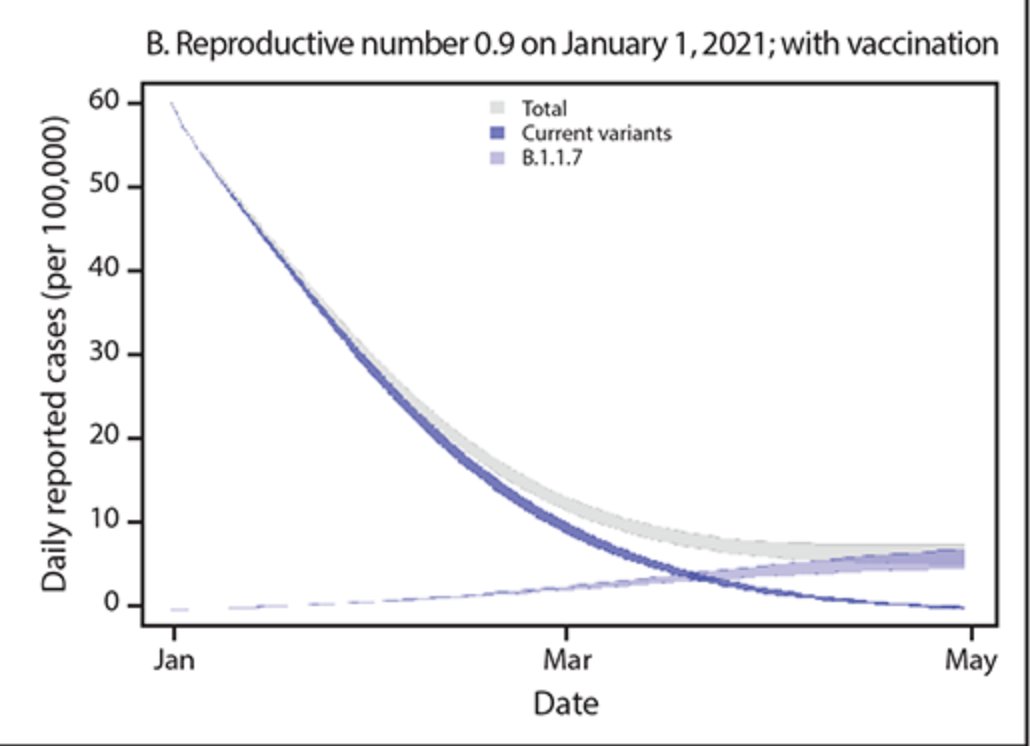
Just because a variant becomes the dominant strain does not automatically mean we will see a repeat of Fall 2020.
Let's look at UK and South Africa, where cases have been falling for the past month, in unison with the US (albeit with tougher restrictions):
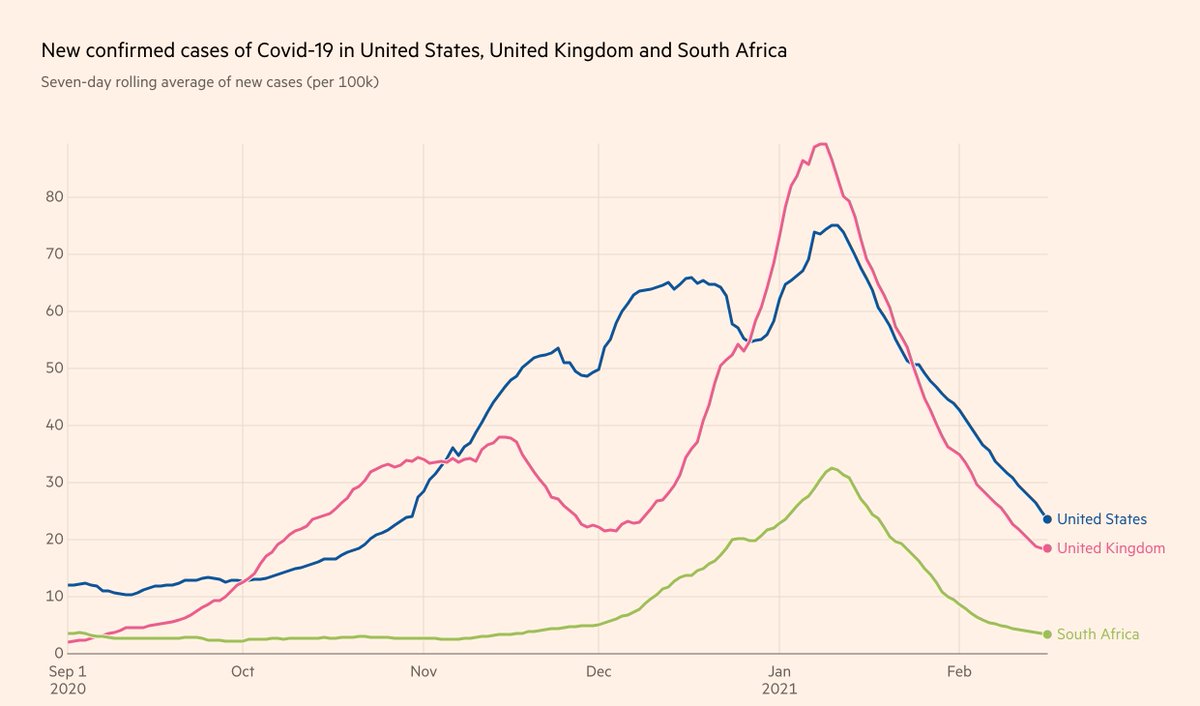
Furthermore, the claim that the "variant is doubling every 10 days" is false. It's the *proportion of the variant* that is doubling every 10 days.
If overall prevalence drops during the studied time period, the true doubling time of the variant is actually much longer 10 days.
Simple example:
Day 0: 10 variant / 100 cases -> 10% variant
Day 10: 15 variant / 75 cases -> 20% variant
Day 20: 20 variant / 50 cases -> 40% variant
1) Proportion of variant doubles every 10 days
2) Doubling time of variant is actually 20 days
3) Total cases still drop by 50%
While this will likely to be the case, this should not be an automatic cause for concern. Cases could still remain contained.
Here's how: 🧵
One of @CDCgov's own models has tracked the true decline in cases quite accurately thus far.
Their projection shows that the B.1.1.7 variant will become the dominant variant in March. But interestingly... there's no fourth wave. Cases simply level out:
https://t.co/tDce0MwO61
Just because a variant becomes the dominant strain does not automatically mean we will see a repeat of Fall 2020.
Let's look at UK and South Africa, where cases have been falling for the past month, in unison with the US (albeit with tougher restrictions):
Furthermore, the claim that the "variant is doubling every 10 days" is false. It's the *proportion of the variant* that is doubling every 10 days.
If overall prevalence drops during the studied time period, the true doubling time of the variant is actually much longer 10 days.
Simple example:
Day 0: 10 variant / 100 cases -> 10% variant
Day 10: 15 variant / 75 cases -> 20% variant
Day 20: 20 variant / 50 cases -> 40% variant
1) Proportion of variant doubles every 10 days
2) Doubling time of variant is actually 20 days
3) Total cases still drop by 50%