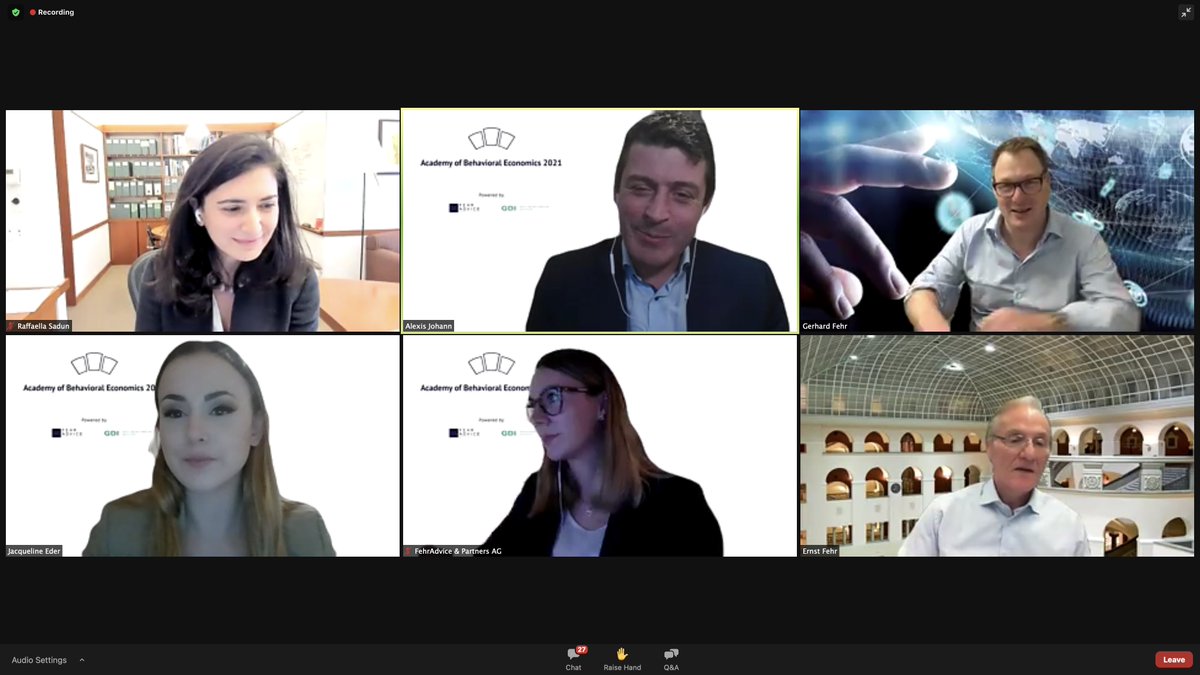
🧵 We're riding shotgun tonight. Here's a little thread on remote leadership with your's truly Ernst Fehr (@econ_uzh), @raffasadun and @Gerhard_Fehr. https://t.co/FcO1CFyRZk
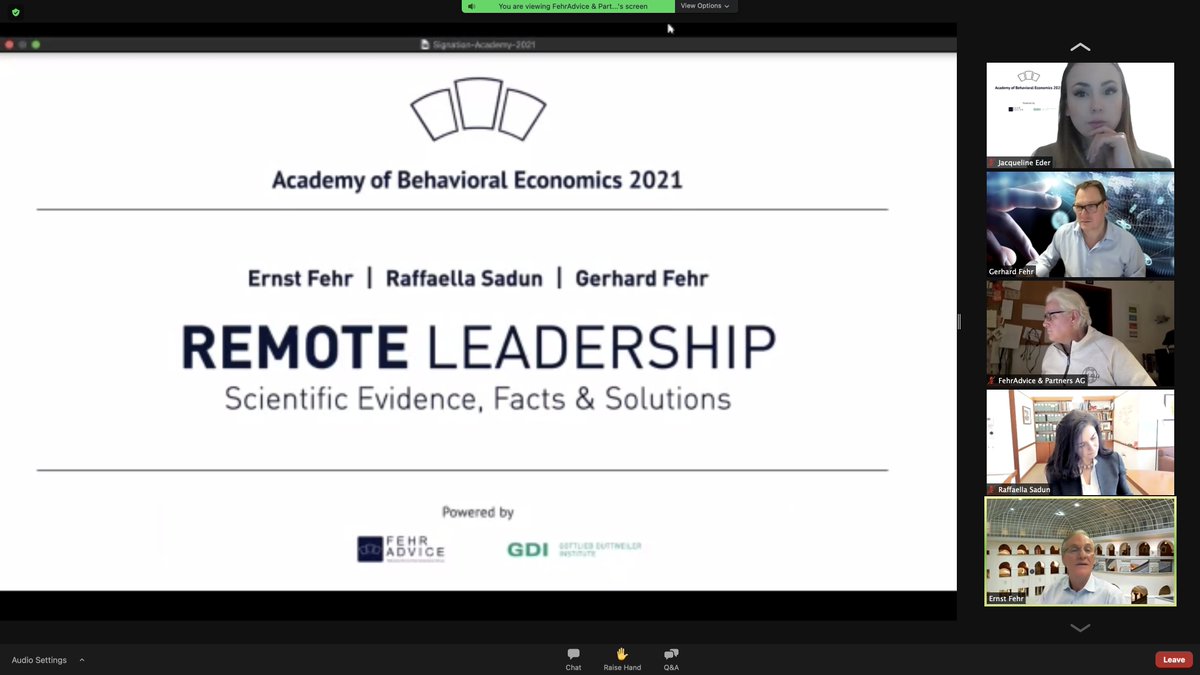
Ernst Fehr is talking about evidence and challenges of work at home arrangements.
Key question: Do we have the technological capacities to work at home? And is it a trend or a sustainable transformation?

Ernst Fehr @econ_uzh #EconomicsForSociety
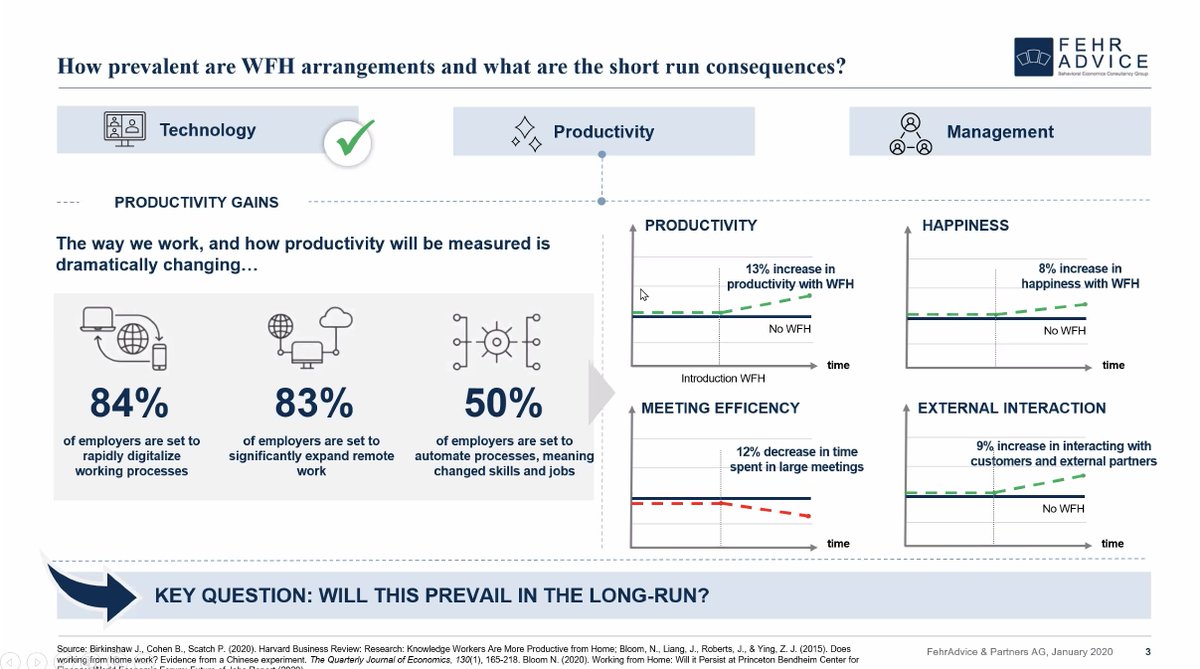
Will this prevail in the long-run?

Ernst Fehr @econ_uzh #EconomicsForSociety
The problem of sustaining cooperation in the long-run: How do we prevent the deterioration of collaboration?

Ernst Fehr @econ_uzh #EconomicsForSociety
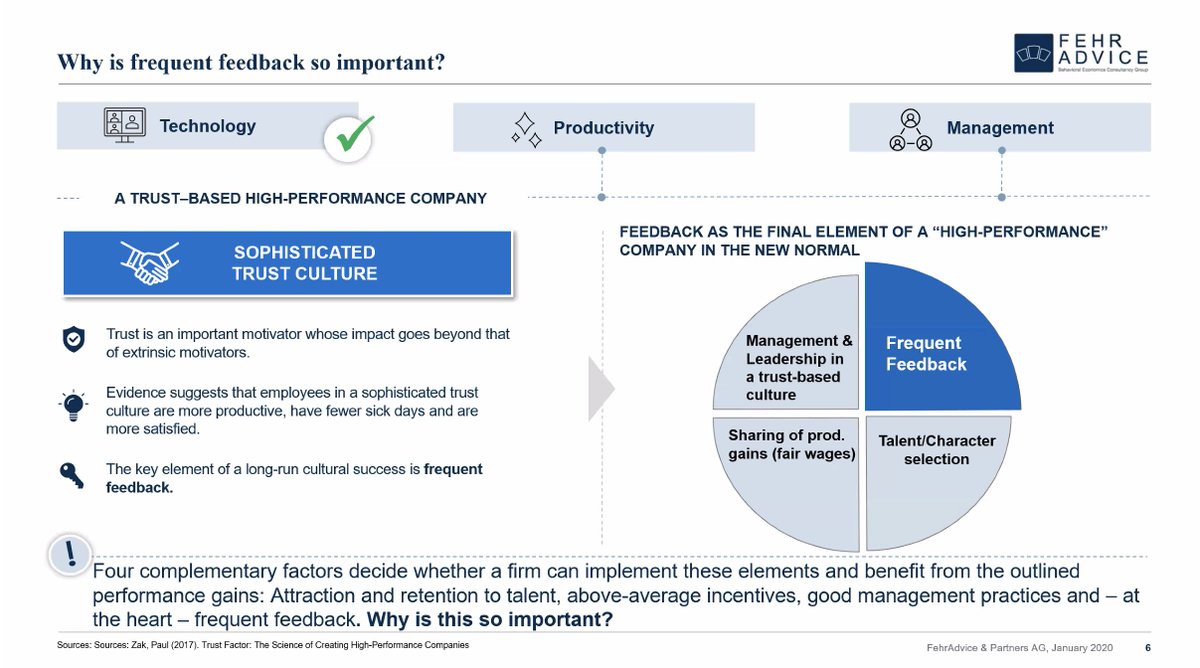
Evidence suggests to focus on a sophisticated trust-based culture where one improves employees' performance via a range of different factors.

Ernst Fehr @econ_uzh #EconomicsForSociety
Why is frequent feedback so important? A trust culture with feedback induces and sustains high levels of cooperation.

Ernst Fehr @econ_uzh #EconomicsForSociety
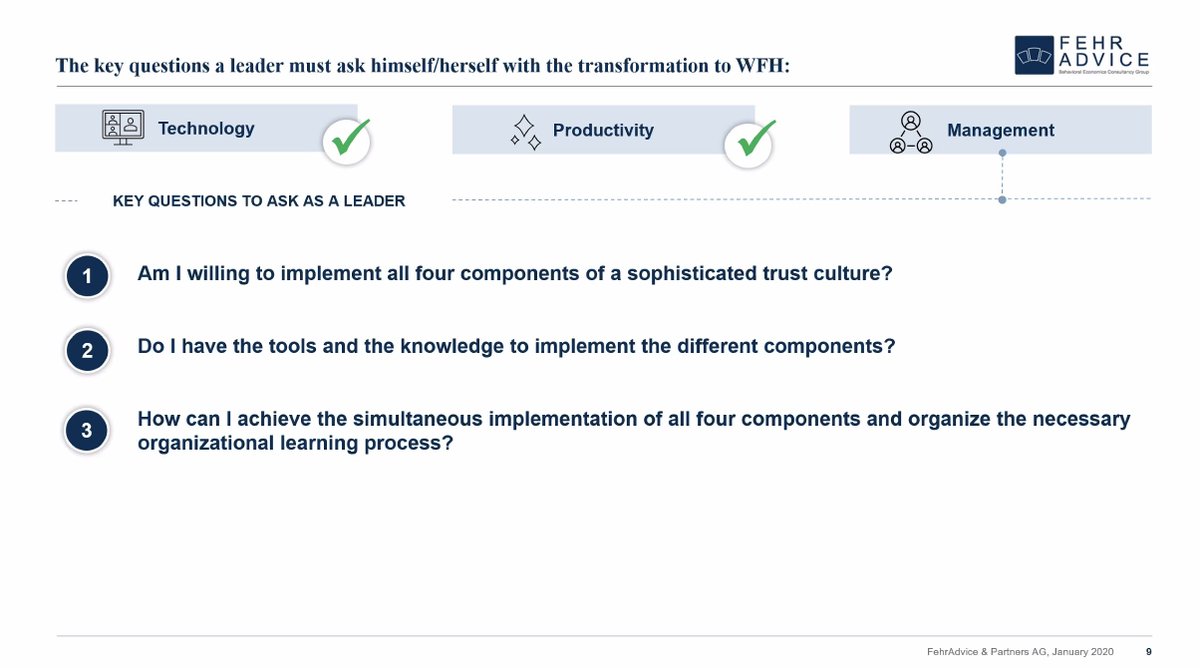
Here are three key questions you have to ask yourselves as leaders.

Ernst Fehr @econ_uzh #EconomicsForSociety
One more remark: There are fields and industries where productivity gains cannot be realised.

Ernst Fehr @econ_uzh #EconomicsForSociety
Up next, @raffasadun from @HarvardHBS. Initial question: is #WFH hear to stay?
#WFH is not just a change from WHERE we work, but a change in HOW we work.

@raffasadun @HarvardHBS
The real challenges of #WFH turned out to be burnout and meeting fatigue.

@raffasadun @HarvardHBS
#WFH is not a technological problem, but an organisational issue.

@raffasadun @HarvardHBS
Leaders play a critical role in shaping transition towards and effective and sustainable #WFH. Three main areas of reflection:

1. Think systematically
2. Set up a learning process
3. Structured delegation

@raffasadun @HarvardHBS
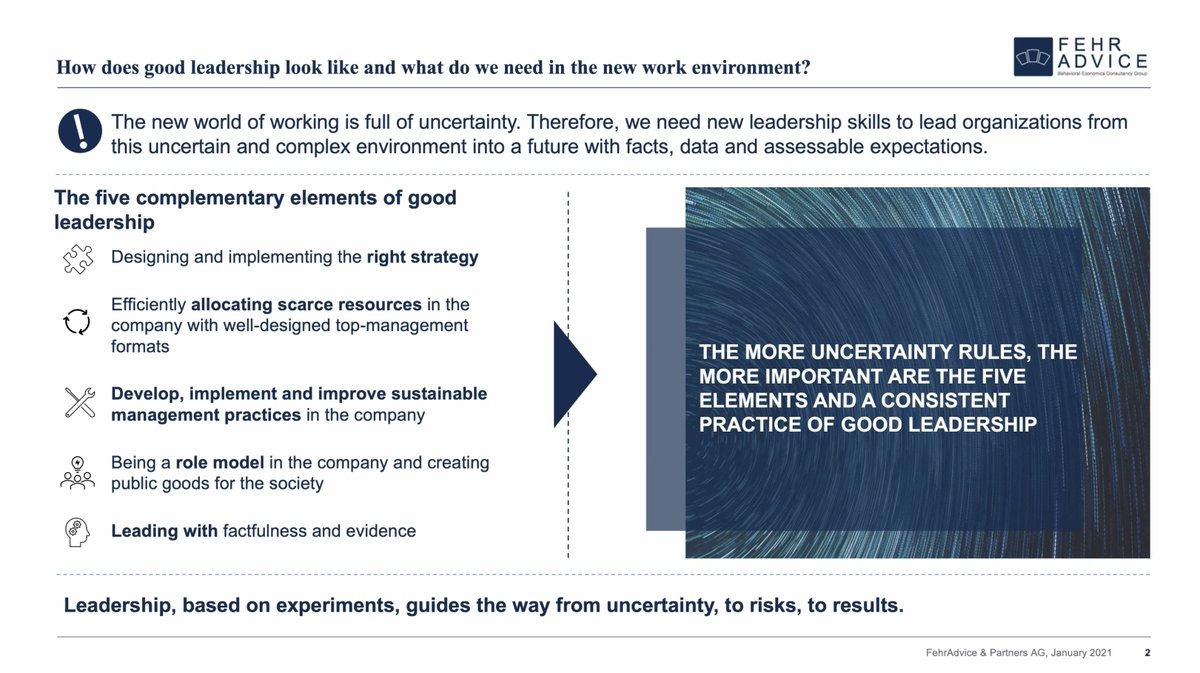
Last but not least, @Gerhard_Fehr of @FehrAdvice on hybrid leadership and that it's a matter of choice (- and technology sometimes 😄)
The new world of working is full of uncertainty. Leadership, based on experiments, guides the way from uncertainty, to risks, to results.

@Gerhard_Fehr @FehrAdvice
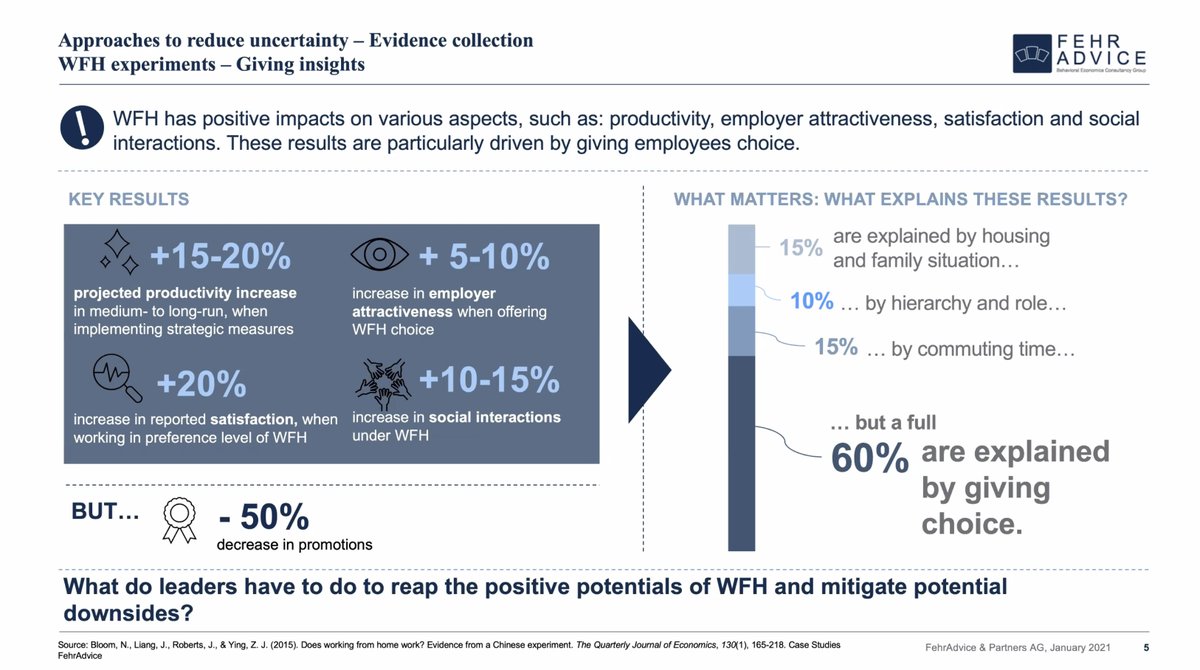
Implement systematic experiments to access the underlying potential. Gathering the data provides the insights safeguarding the way towards the new work environment.

@Gerhard_Fehr @FehrAdvice
#WFH: Give choice to the people to match their preferences with the needs of the company.

@Gerhard_Fehr @FehrAdvice
Key principles: commitment, feedback, transparency, planning. Bring into practices by: daily rituals, weekly task and goal setting, bundle meetings.

@Gerhard_Fehr @FehrAdvice
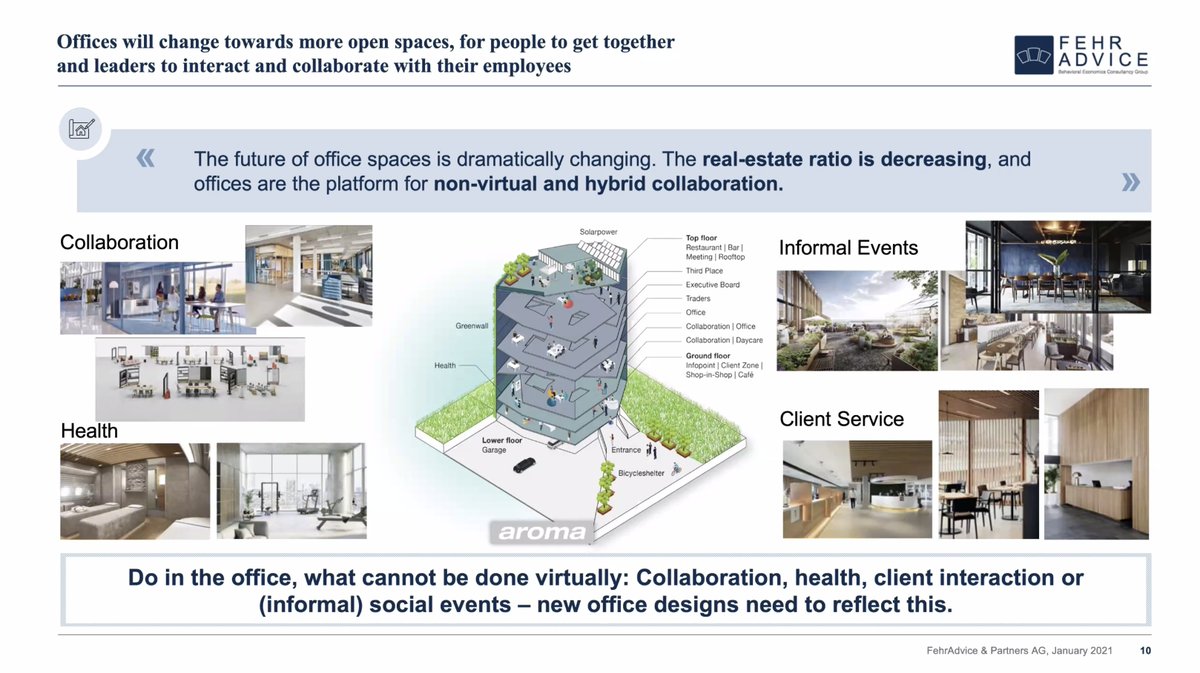
«Do in the office, what cannot be done virtually»

@Gerhard_Fehr @FehrAdvice
Trust has several aspects. It's a personality issue. Most people are well intentioned. Companies select based on character. They want to have trustworthy people. That 's the whole reason we have incentives.

Ernst Fehr @econ_uzh
Collective feedback is a great trust enhancer.

Ernst Fehr @econ_uzh
You need to constantly invest in culture for it to sustain.

@raffasadun @HarvardHBS
It's a wrap. Thank you!
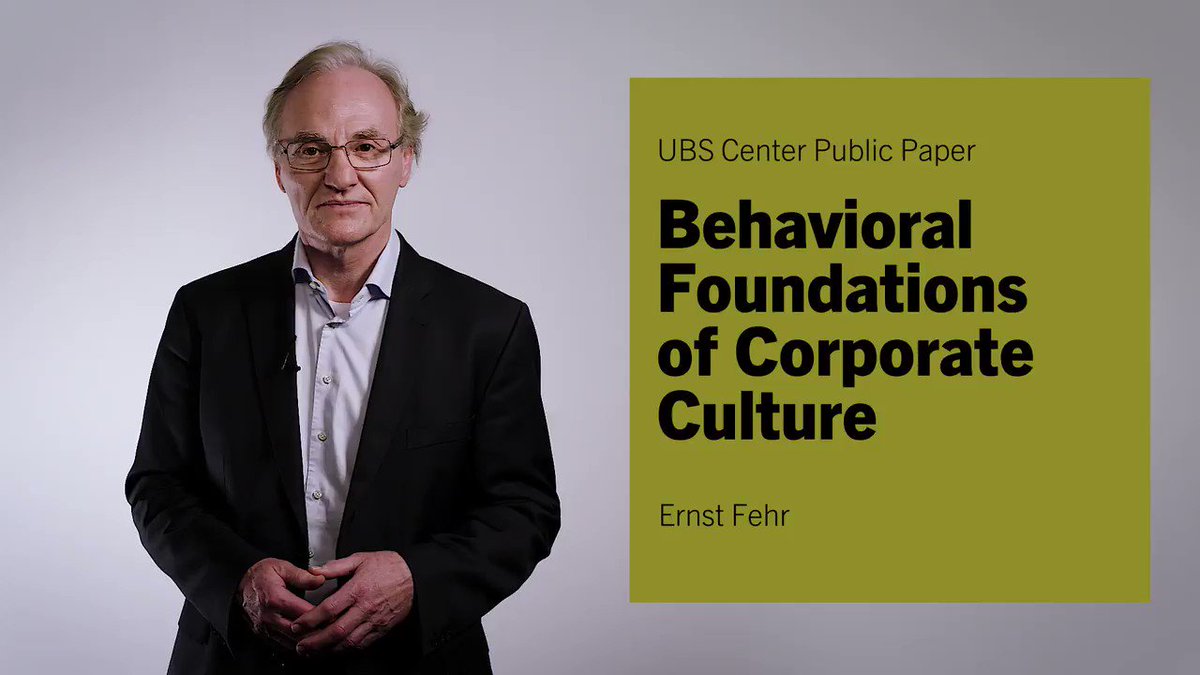
If you are interested in the behavioral foundations of corporate culture, we recommend our UBS Center Public Paper by Ernst Fehr. Now available in English and German → https://t.co/M1Hz3vuPtN
#EconomicsForSociety

More from Society

I've seen many news articles cite that "the UK variant could be the dominant strain by March". This is emphasized by @CDCDirector.

While this will likely to be the case, this should not be an automatic cause for concern. Cases could still remain contained.

Here's how: 🧵

One of @CDCgov's own models has tracked the true decline in cases quite accurately thus far.

Their projection shows that the B.1.1.7 variant will become the dominant variant in March. But interestingly... there's no fourth wave. Cases simply level out:

https://t.co/tDce0MwO61


Just because a variant becomes the dominant strain does not automatically mean we will see a repeat of Fall 2020.

Let's look at UK and South Africa, where cases have been falling for the past month, in unison with the US (albeit with tougher restrictions):


Furthermore, the claim that the "variant is doubling every 10 days" is false. It's the *proportion of the variant* that is doubling every 10 days.

If overall prevalence drops during the studied time period, the true doubling time of the variant is actually much longer 10 days.

Simple example:

Day 0: 10 variant / 100 cases -> 10% variant
Day 10: 15 variant / 75 cases -> 20% variant
Day 20: 20 variant / 50 cases -> 40% variant

1) Proportion of variant doubles every 10 days
2) Doubling time of variant is actually 20 days
3) Total cases still drop by 50%

You May Also Like