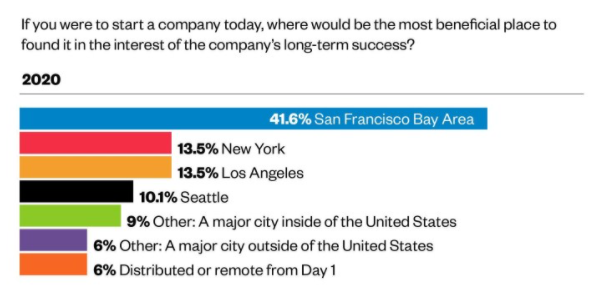
2/We're all familiar with the trend of tech companies and other knowledge industries (finance, biotech, etc.) piling into a few tech hubs, raising rents and house prices.
Now some think the advent of Zoom, Slack, etc. might reverse this trend.
https://t.co/nQVCJrKvrB
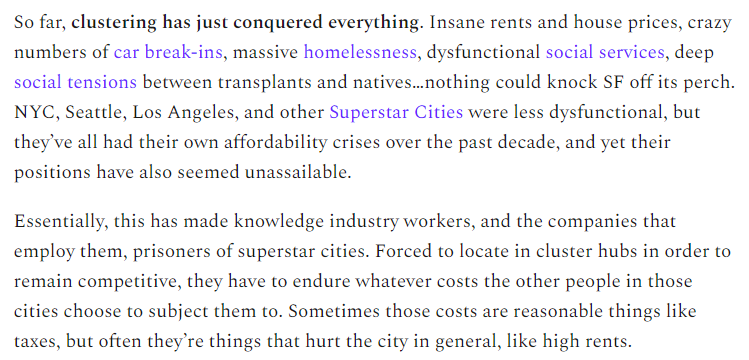
3/But escaping the superstar cities is going to be tough.
The forces keeping tech companies in places like SF are so strong that these regions have essentially become prisons for these companies.
4/In order to escape the prison of the superstar cities, tech companies and other knowledge industries will have to overcome the Four Jailers of Industrial Clustering:
1. In-person office productivity
2. Thick market effects
3. Knowledge spillovers
4. City life amenities
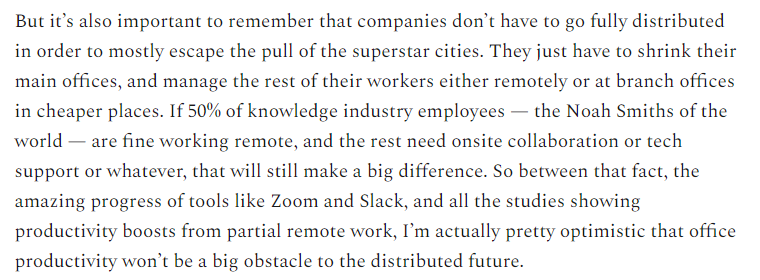
5/I'm actually pretty optimistic that companies can find ways to make remote work productive.
Studies show that working from home *some* of the time actually tends to raise productivity.
https://t.co/HK9DW99qAl
6/Does that mean people can work productively away from the office ALL of the time?
It's not clear yet. But remember, in order to shift out of top cities, tech companies only need to shift PART of their workforce to 100% remote.
That seems very doable.
7/Then there's the "thick market" effect.
Lose your engineering job in SF, and it's easy to find another nearby.
Lose your engineering job in Tulsa and you're in trouble.
Same goes for companies who need to find new employees.
8/To beat the thick market effect, companies and workers will need to learn to do 100% remote job search and hiring. They'll need to get comfortable working closely with people they've never been in a room with.
That seems like a difficult but doable shift.
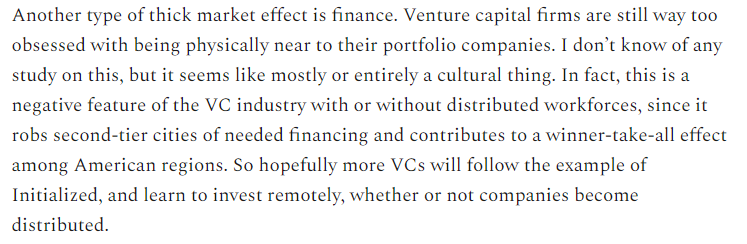
9/VCs will also have to get used to investing in companies remotely.
In fact, this was a shift that needed to happen long ago, because VCs' cultural preference for in-person investing means that a lot of cities unfairly lose out.
10/But remote work, hiring, job search, and investing are all things that are possible as technology improves.
Companies will look for solutions, and they will find solutions.
But a harder challenge will be replacing the good things about cities that companies DON'T generate.
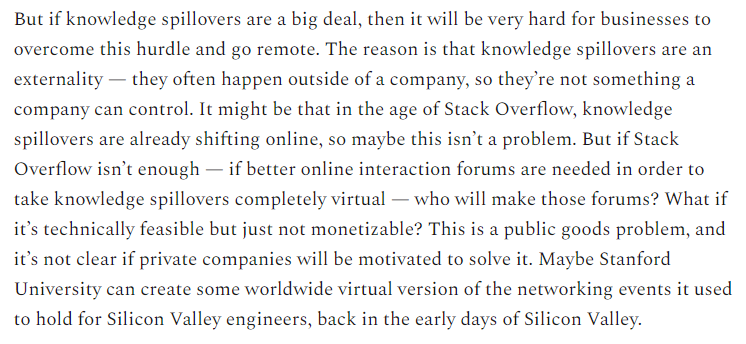
11/One of those good effects of cities is knowledge spillovers.
Many economists believe that when knowledge workers (like engineers) live in close proximity, they exchange ideas that boost their productivity.
https://t.co/hROA2pMOsw
12/No one company is responsible for knowledge spillovers. They happen outside the company.
So companies can't really replace this benefit of cities.
Maybe the internet will naturally replace knowledge spillovers. Maybe Stack Overflow is all we really need.
...Maybe??
13/Maybe universities, or industry associations, or other actors can try to recreate virtual spaces where engineers can mix, mingle, and share ideas? Just spitballing here.
Anyway, this going to be a taller order than switching companies over to Zoom/Slack.
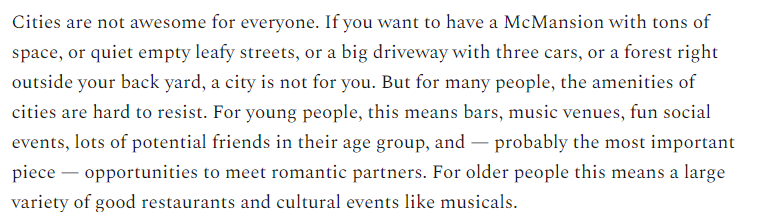
14/Now we come to the fourth benefit of cities, and the most difficult to replace.
Cities are great places to meet people and do fun stuff.
15/Here's an important but subtle point:
If distributed remote work means that tech workers just move to DIFFERENT SUPERSTAR CITIES, you haven't really changed anything!
16/To really distribute the workforce, you need more than for San Franciscans to work in Tokyo and New Yorkers to work in LA.
You need to get knowledge workers to work in Tulsa, Oklahoma and Cleveland, Ohio.
17/One function of cities -- dating -- actually seems somewhat easy to replace, since it's basically just a 1-to-1 matching process.
But social discovery -- meeting whole groups of friends online -- is a problem that no social media company seems to have solved yet.
18/And restaurants will be even harder. I can't even think of how cities like Tulsa will be able to achieve the variety and quality of dining options of cities like Los Angeles.
Maybe there is a way, but it'll take some creative supply chaining and matching!!
19/Anyway, so there you have it. To escape the prison that cities like San Francisco have become, knowledge industries will need to UNBUNDLE THE CITY completely, for the first time in human history.
It's a tall order. We'll see if they can do it!
(end)
https://t.co/3XYIftJAHd
20/Oh and if you like stuff like this, make sure to sign up for my free email list, so you can get my newsletter delivered directly to your inbox! :-)
https://t.co/FGppA1M8W6