RISHI ASHTAVAKRA(DEVAL)

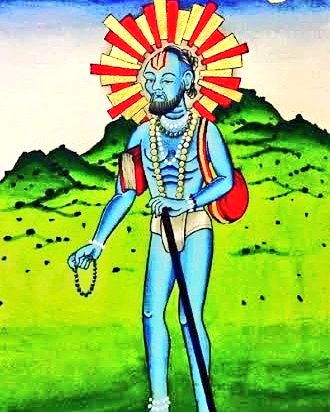
Those who are well versed in our ancient scriptures must definitely have come across the name of Ashtavakra Muni. Who was he and what is the story behind his body getting crooked from all sides.

Muni Asit was the son of Pracheta Rishi.

He was childless and this caused a lot of worry to him. But an Akashvani assured him that he should go to Shivji to get all his
worries nullified.

So he along with his wife go to Shivji and after paying him obeisance start singing Shivji's praises.
He describes Shiv as the one who is beyond any other thing, whose glory has no words to describe. After this the couple stands with folded hands in front of Rudradev. The strotras sung in praise of Shiv possess magical qualities even today.
Shiv gets satisfied by them soon and is ready to grant a boon.

Shiva told him that, he very well knew what the Muni desired. He then gives him the "Sansaar Vijay' mantra and asks him to keep reciting it. The Isht devi would come at an appropriate time and fulfill his wish.
Asit Muni kept reciting this mantra for hundred years. The Devi appeared and granted him the boon of a son as a Shivansh. A son was born and was named as Deval. He grew upto be a great scholar well versed and a handsome young man. Asit Muni got him married to Ratnamalavati.
He lived with his family for some years. But one fine day he left his sleeping wife and left for Gandhmaadan Parvat for tapasya. On discovering that Deval had left she was distraught with sorrow and ultimately died. Her son performed the last rites.
#MuniDeval continued with his tapasya. He had won over his vices. He performed Tap for one thousand years.

Once Apsara #Rambha requested for a meeting with the Rishi which was promptly rejected.
He told her the summary of Vedas in a few words that if any man who has left his wife and accepts another woman, he is considered to be as good as dead. He would loose his fame, reputation and age. So if residing on Prithvi one fails to spread his fame, that life is wasted.
A tapasvi does not desire material things. And he was now lustfree and old. He asks her to go elsewhere.

Hearing this Rambha is angry but again she puts forth her wish to him. Again he rejects her. So an angry Rambha curses him and says that all his body parts would get crooked.
He would become dark complexioned and ugly and would be criticised in all the loks.

On realizing the transformation of his body into a ugly one he is so distraught that he is ready to jump into a Agnikund.
It is that time Shri Krishna appears before him and soothes and pacifies him. Since his eight main body parts were now crooked, Hari names him Ashtavakra. Shrikrishna tells him to go to Malay Parvat and pray in their caves.
So the Rishi, who now has forsaken food, performs tapasya for sixty thousand years and at an appropriate time he would be one with Parmatma.

That appropriate time was when Krishna is sitting with Radha and narrating stories during Maharaas, that Ashtavakra Muni comes there
and after paying his respects to Shrikrishna he falls dead on Hari's feet. His last rites are performed by Krishna himself with tear ladden eyes. His Atma is taken to Vaikunth on a divine Vimaan by the Parshaads.

#PuranPositivity

SOURCE - Brahma Vaivartva Puran
I have posted the same content in other SM channel's too, Do follow me there.

Instagram link👇
https://t.co/IVDV5RtdTs

Facebook link👇
https://t.co/JEEO5rULWO

More from Anshul Pandey

Rig Ved 1.40.2

Here marudgans are requested to help the yajmans at the time of war. Our actual war is with ignorance. We will become truly powerful and able bodied only after defeating ignorance. The yajmans request marudgans to make them effective rather than

1/9


make them lacking in something. Let their nature and effectiveness be divine. Let their Praan and Pragya { knowledge} become capable. Mind will be enriched only when it is satisfied. Unsatisfied and sad mind cannot carry out the work of Paramarth.

2/9

Only quiet and reclusive mind can think of Paramarth. Those who are unattached can only experience constant mind(स्थिर बुद्धि). The one with determined insight only can know their true self. This is what we wish Parmatma to grant us.

3/9

त्वामिद्धि स॑हसस्पुत्र॒ मर्त्य॑ उपब्रू॒ते धने॑ हि॒ते ।
सु॒वीर्यं॑ मरुत॒ आ स्वश्व्यं॒ दधी॑त॒ यो व॑ आच॒के ॥

Translation:

सहस्त्रपुत्र - Oh the protector of many Waters!

मर्त्य: - Human.

हिते - Formidable for enemies.

धने - For wealth.

त्वाम - Yours.

इत - This.

4/9

उप ब्रूते - Near.

हि - Is there.

मरुतः - Marudgan.

यः - Which.

व: - Yours.

आचके - To praise.

स्वश्यव्यम - With beautiful horses.

सुवीर्यम - With best valour.

आ दधित - To wear on all sides.

Explanation: Oh the doers of all courageous works! The men call out to you

5/9
BHAI DOOJ / KARTIK DWIITYA RITUALS AS PER PADMA PURAN!


https://t.co/Nk49jADuXS


https://t.co/CqYE2aVHCI


Instagram link👇
https://t.co/UmeHgDSP0a

Facebook page link👇
https://t.co/LFtkDQeBvI

Happy Bhai Dooj to all!

#InspiredBySwamiAnjaninandanDass

Just in case if you have not subscribed to my youtube channel, please do subscribe, I have already posted 9 Videos till now on different subjects, Specially Mythbusters topics. Do watch them and give your feedback in comments

More from Religion

MDZS is laden with buddhist references. As a South Asian person, and history buff, it is so interesting to see how Buddhism, which originated from India, migrated, flourished & changed in the context of China. Here's some research (🙏🏼 @starkjeon for CN insight + citations)

1. LWJ’s sword Bichen ‘is likely an abbreviation for the term 躲避红尘 (duǒ bì hóng chén), which can be translated as such: 躲避: shunning or hiding away from 红尘 (worldly affairs; which is a buddhist teaching.) (
https://t.co/zF65W3roJe) (abbrev. TWX)

2. Sandu (三 毒), Jiang Cheng’s sword, refers to the three poisons (triviṣa) in Buddhism; desire (kāma-taṇhā), delusion (bhava-taṇhā) and hatred (vibhava-taṇhā).

These 3 poisons represent the roots of craving (tanha) and are the cause of Dukkha (suffering, pain) and thus result in rebirth.

Interesting that MXTX used this name for one of the characters who suffers, arguably, the worst of these three emotions.

3. The Qian kun purse “乾坤袋 (qián kūn dài) – can be called “Heaven and Earth” Pouch. In Buddhism, Maitreya (मैत्रेय) owns this to store items. It was believed that there was a mythical space inside the bag that could absorb the world.” (TWX)

You May Also Like