None of the attributes like discipline, persistence, consistency or hard work are going to do you any good if you are all over the place and haven't first defined your style and committed to mastering it at the expense of being a mediocre jack-of-all trades. #avoidstyledrift.
The word is sacrifice. You are not going to be the best at day trading, swing, value and growth investing. It will be amazing if you can master just one. And you only need one. So pick one and sacrifice the rest! There is no other way unless you want to suck at a bunch of things. https://t.co/QVI68eaNHQ
— Mark Minervini (@markminervini) April 14, 2021
More from Mark Minervini

More from Markminervinilearnings

What is the single unavoidable thing you must do to be the best or great at one thing? One word?
— Mark Minervini (@markminervini) April 14, 2021

20 Powerful tweets to learn from @markminervini
A 🧵thread...
Jesse Livermore
Some important quotes by Jesse Livermore... pic.twitter.com/UklL86oTvb
— Mark Minervini (@markminervini) June 16, 2021
Never let a loss exceed 8% changed his trading game for the
The big turning point in my trading came when I made a decision and vowed to NEVER EVER let a loss exceed 8%. During the next 5 years I averaged 220% per year for a total compounded return of 33,500%. It's been 28 years since and I have never broken that discipline not even once!
— Mark Minervini (@markminervini) April 26, 2021
Key early decisions to make for your trading
A few key decisions early in my trading career and my financial life completely changed for the better in just a few years.
— Mark Minervini (@markminervini) June 13, 2021
1. No big losses
2. No averaging down
3. No chasing extended stocks
4. No giving back decent profits
5. Always get odds on my money
Never listen to
Only losers discourage dreamers. Only those who never achieved big things discourage those attempting to achieve big things. Only those who think small discourage those who think big. Never believe discourages. The have no credibility! Believe winners. Believe in YOU! \U0001f447 pic.twitter.com/JdAhRy3lRJ
— Mark Minervini (@markminervini) June 14, 2021

You May Also Like




I'll begin with the ancient history ... and it goes way back. Because modern humans - and before that, the ancestors of humans - almost certainly originated in Ethiopia. 🇪🇹 (sub-thread):
The famous \u201cLucy\u201d, an early ancestor of modern humans (Australopithecus) that lived 3.2 million years ago, and was discovered in 1974 in Ethiopia, displayed in the national museum in Addis Ababa \U0001f1ea\U0001f1f9 pic.twitter.com/N3oWqk1SW2
— Patrick Chovanec (@prchovanec) November 9, 2018
The first likely historical reference to Ethiopia is ancient Egyptian records of trade expeditions to the "Land of Punt" in search of gold, ebony, ivory, incense, and wild animals, starting in c 2500 BC 🇪🇹

Ethiopians themselves believe that the Queen of Sheba, who visited Israel's King Solomon in the Bible (c 950 BC), came from Ethiopia (not Yemen, as others believe). Here she is meeting Solomon in a stain-glassed window in Addis Ababa's Holy Trinity Church. 🇪🇹
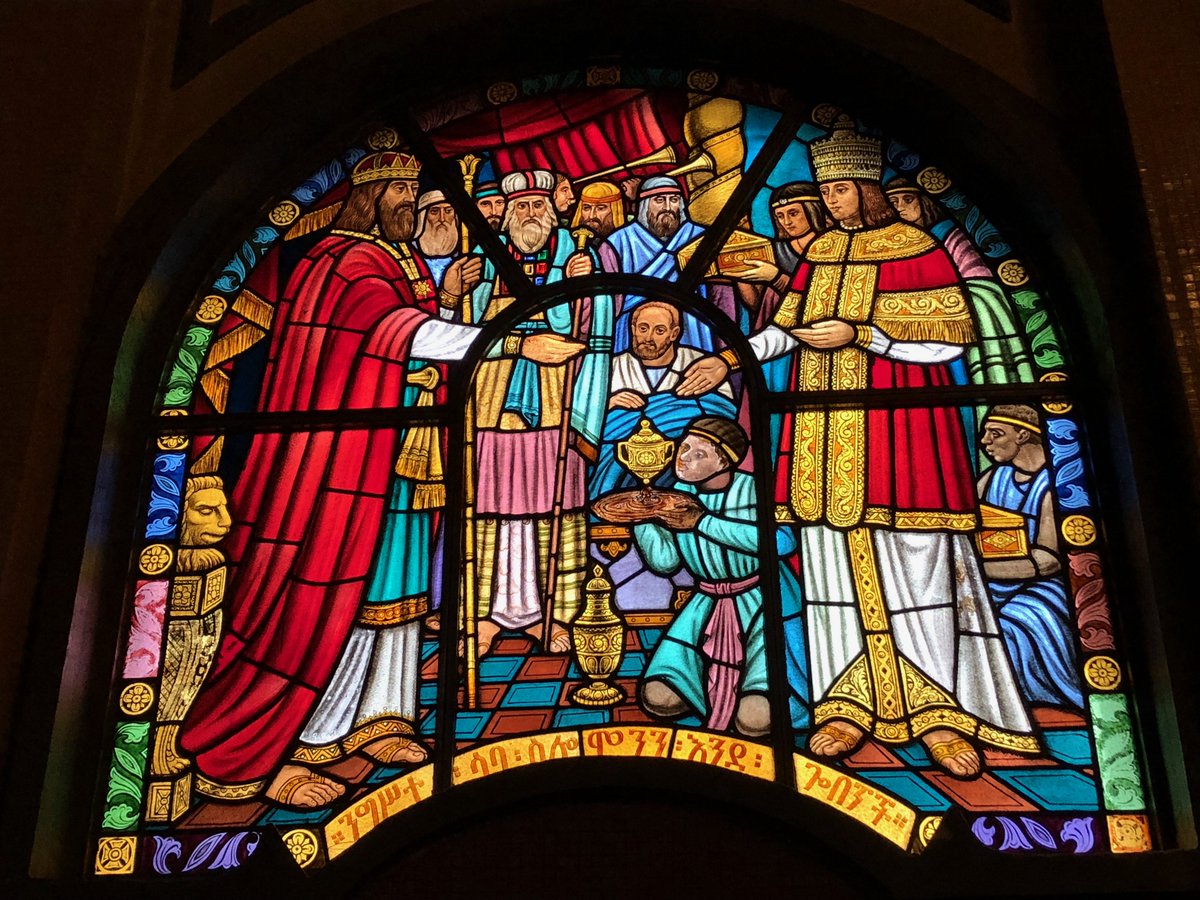
References to the Queen of Sheba are everywhere in Ethiopia. The national airline's frequent flier miles are even called "ShebaMiles". 🇪🇹