Since "at 22" is trending and I coincidentally changed my profile picture to this on facebook yesterday, here I am at 22 back in 1984 and in my final year at university. 1/14
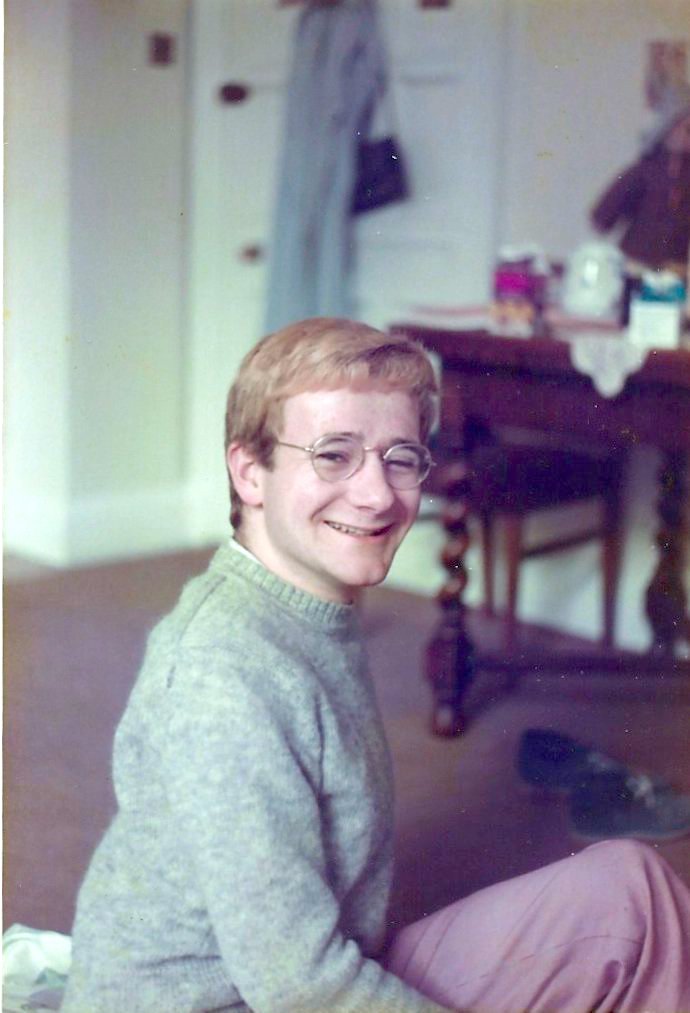
Earlier in the year I'd dyed my hair pink and yellow as a rag week stunt, and then all pink so as it wasn't quite so crazy. In a way, dying my hair like this may have helped determine the course of my whole subsequent life. 2/14
A few weeks later, with the hair dye still very much showing, I landed a job at a small software company based in a farmhouse near #Peterborough. I turned down an interview for a job with a big company, Ferranti, because I'd become aware of its links to the defence industry. 3/14
My mother thought I was making a big mistake, passing up the chance to work for a famous and long-established blue-chip company, and choosing a company that would probably go under quickly. 4/14
The software company often struggled. Sometimes when we got our pay cheques we were asked not to pay them in just yet, until those who were married and had kids had got their pay cheques cleared, in case some of the cheques bounced. 5/14
But the company survived, and some software I had designed and written became a key component of its product. 6/14
By the early 1990s the company had grown and moved into an office in Huntingdon. Meanwhile Ferranti was in big trouble after taking over a profitable US defence company, whose profits turned out to come from clandestine arms deals. 7/14
By 1993 Ferranti was bankrupt, but I was still working for the software company, helped through the early 90s recession by venture capital, which meant I could still pay the mortgage on the house I'd bought in Peterborough. 8/14
Periodically the company structure or name would change for one reason or another, but somehow my job survived, and my software ended up being used in countries around the world, giving me lots of opportunities to travel. 9/14
Though the original company is now long gone, the software I wrote is still in use, and helps me make a living, even though it's no longer a big part of my day to day life. I'm still living in the same house in Peterborough, now happily married. 10/14
I didn't explain the part the hair dye played in all this. It was probably some time in the mid 90s when I found out. I'm not sure when or where, but over a beer, maybe abroad on a business trip, and definitely from my boss, the founder of the farmhouse software business. 11/14
He told me that he'd given me the job at least partly because he thought my dyed hair would mean nobody else would give me a chance, so maybe he should. He also told me that at first he thought he might have made a mistake. 12/14
It had taken a couple of years for me really to find my feet as a programmer. But it turned out that it was my software that had helped to keep the company afloat and get the venture capitalists interested. 13/14
So really that hair dye didn't just change my life, but his too, and, in a smaller way perhaps, the lives of everyone else who worked for the company, and the software developers in other companies who used our software. No wonder I like chaos theory. 😀14/14

More from Life

1/ Some initial thoughts on personal moats:

Like company moats, your personal moat should be a competitive advantage that is not only durable—it should also compound over time.

Characteristics of a personal moat below:


2/ Like a company moat, you want to build career capital while you sleep.

As Andrew Chen noted:


3/ You don’t want to build a competitive advantage that is fleeting or that will get commoditized

Things that might get commoditized over time (some longer than


4/ Before the arrival of recorded music, what used to be scarce was the actual music itself — required an in-person artist.

After recorded music, the music itself became abundant and what became scarce was curation, distribution, and self space.

5/ Similarly, in careers, what used to be (more) scarce were things like ideas, money, and exclusive relationships.

In the internet economy, what has become scarce are things like specific knowledge, rare & valuable skills, and great reputations.
1/“What would need to be true for you to….X”

Why is this the most powerful question you can ask when attempting to reach an agreement with another human being or organization?

A thread, co-written by @deanmbrody:


2/ First, “X” could be lots of things. Examples: What would need to be true for you to

- “Feel it's in our best interest for me to be CMO"
- “Feel that we’re in a good place as a company”
- “Feel that we’re on the same page”
- “Feel that we both got what we wanted from this deal

3/ Normally, we aren’t that direct. Example from startup/VC land:

Founders leave VC meetings thinking that every VC will invest, but they rarely do.

Worse over, the founders don’t know what they need to do in order to be fundable.

4/ So why should you ask the magic Q?

To get clarity.

You want to know where you stand, and what it takes to get what you want in a way that also gets them what they want.

It also holds them (mentally) accountable once the thing they need becomes true.

5/ Staying in the context of soliciting investors, the question is “what would need to be true for you to want to invest (or partner with us on this journey, etc)?”

Multiple responses to this question are likely to deliver a positive result.

You May Also Like