
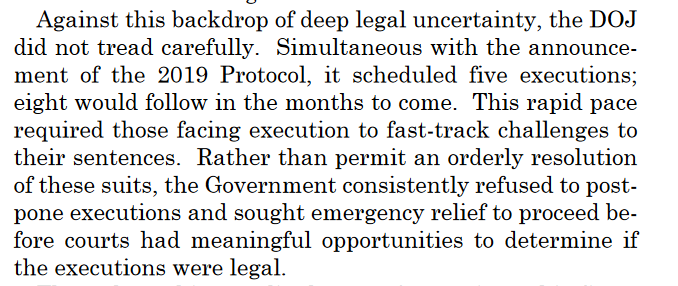
Tonight we have dissents from both Sotomayor and Breyer in the last instance of the Supreme Court waving the matador's cape for Trump's machinery of death without so much as a word of reasoned justification
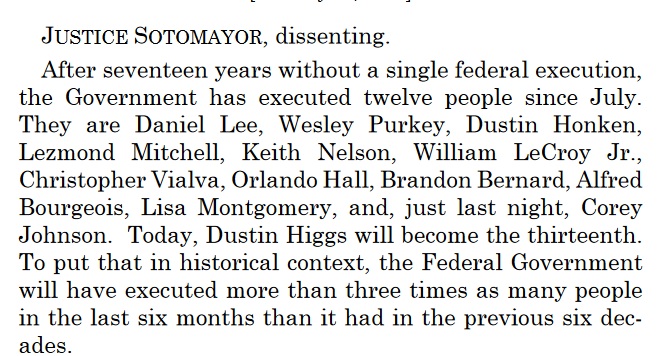

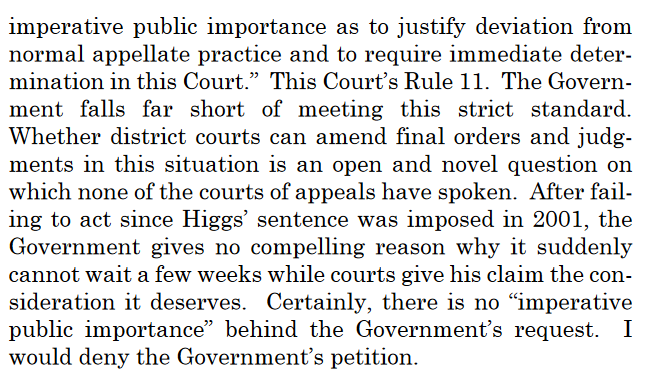
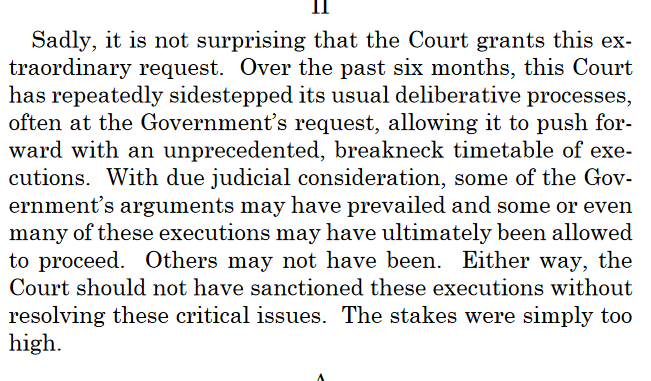
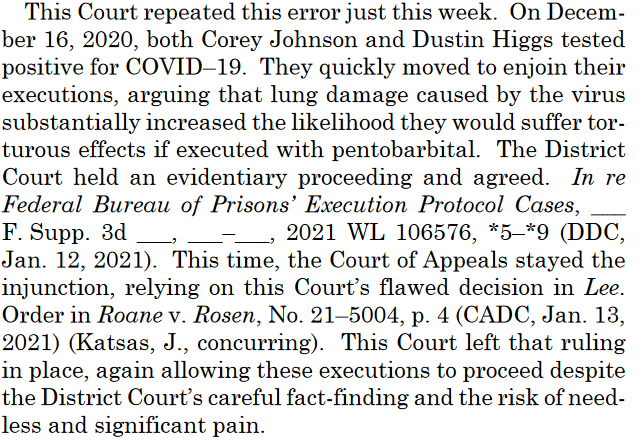
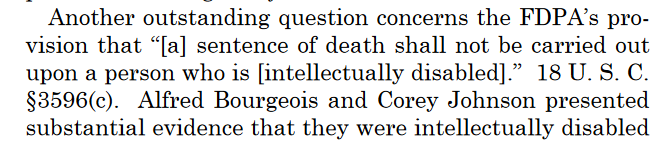
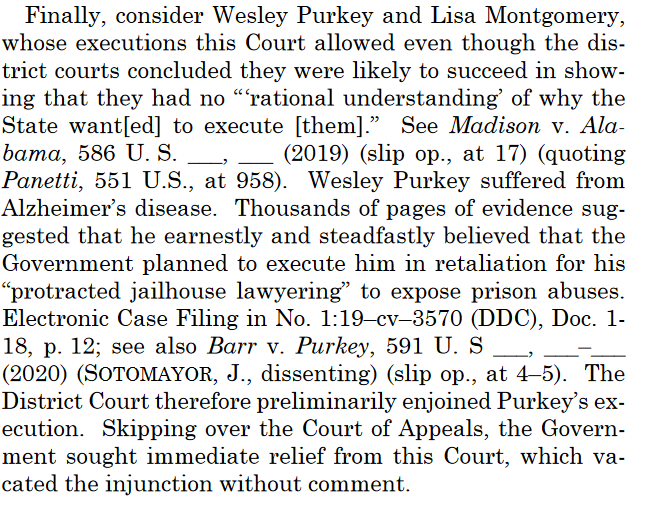
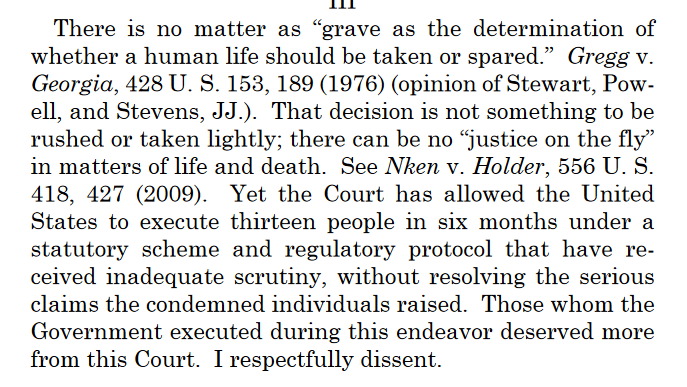
This is my story about the case. Higgs was not the triggerman in the murder of Tamika Black, Tanji Jackson and Mishann Chinn\u2014the government concedes this. The man who was the shooter later said the prosecution\u2019s theory was \u201cbullshit.\u201d https://t.co/Za8lcSB3zN
— Liliana Segura (@LilianaSegura) January 16, 2021
Dustin Higgs was pronounced dead at 1:23 a.m. Saturday, Jan. 16 at FCC-TH. His final words, \u201cFirst, I\u2019d like to state I am an innocent man.\u201d He named the three victims, then said, \u201cI am not responsible for their deaths and I did not order the murders.\u201d
— TribStarLisa (@TribStarLisa) January 16, 2021
More from Law

Pretty much every professional field EXCEPT police have clear, rigorous, transparent consequences for unethical behavior, negligence and malpractice.
The idea that we can "disbar" lawyers but not police is absolute foolishness.
All the factors that make disbarment a necessary tool for lawyers apply to cops... except that cops don't need to be qualified in the first place.
It is a rank absurdity of the criminal justice system that one needs to be educated and certified with a degree in order to argue on behalf of someone's life in court, but to have no qualifications necessary to detain, assault, or prematurely end that same life.
There are countless circumstances in which a lawyer's unethical behavior will result in them not only losing their job but never being able to practice it again.
But corrupt and murderous cops can be rehired indefinitely.
A lawyer's entire career can be ended forever if they were found to have knowingly put someone on a stand to lie.
Police officers however are allowed to lie in court on the stand under oath.
So much that lawyers aren't penalized for putting cops on the stand to lie.
And as a former EMT let me tell you, you will find dropout cops in training classes that just want power over people - difference is our system has CONSEQUENCES for negligence and malpractice. We get the same chuds every now and then but they still have to help or else.
— Love Potion No. Nines (@NineJackals) January 29, 2021
The idea that we can "disbar" lawyers but not police is absolute foolishness.
All the factors that make disbarment a necessary tool for lawyers apply to cops... except that cops don't need to be qualified in the first place.
It is a rank absurdity of the criminal justice system that one needs to be educated and certified with a degree in order to argue on behalf of someone's life in court, but to have no qualifications necessary to detain, assault, or prematurely end that same life.
There are countless circumstances in which a lawyer's unethical behavior will result in them not only losing their job but never being able to practice it again.
But corrupt and murderous cops can be rehired indefinitely.
A lawyer's entire career can be ended forever if they were found to have knowingly put someone on a stand to lie.
Police officers however are allowed to lie in court on the stand under oath.
So much that lawyers aren't penalized for putting cops on the stand to lie.


You May Also Like





H was always unseen in S2NL :)
Those who exited at 1500 needed money. They can always come back near 969. Those who exited at 230 also needed money. They can come back near 95.
Those who sold L @ 660 can always come back at 360. Those who sold S last week can be back @ 301
Those who exited at 1500 needed money. They can always come back near 969. Those who exited at 230 also needed money. They can come back near 95.
Those who sold L @ 660 can always come back at 360. Those who sold S last week can be back @ 301
Sir, Log yahan.. 13 days patience nhi rakh sakte aur aap 2013 ki baat kar rahe ho. Even Aap Ready made portfolio banakar bhi de do to bhi wo 1 month me hi EXIT kar denge \U0001f602
— BhavinKhengarSuratGujarat (@IntradayWithBRK) September 19, 2021
Neuland 2700 se 1500 & Sequent 330 to 230 kya huwa.. 99% retailers/investors twitter par charcha n EXIT\U0001f602


"I really want to break into Product Management"
make products.
"If only someone would tell me how I can get a startup to notice me."
Make Products.
"I guess it's impossible and I'll never break into the industry."
MAKE PRODUCTS.
Courtesy of @edbrisson's wonderful thread on breaking into comics – https://t.co/TgNblNSCBj – here is why the same applies to Product Management, too.
There is no better way of learning the craft of product, or proving your potential to employers, than just doing it.
You do not need anybody's permission. We don't have diplomas, nor doctorates. We can barely agree on a single standard of what a Product Manager is supposed to do.
But – there is at least one blindingly obvious industry consensus – a Product Manager makes Products.
And they don't need to be kept at the exact right temperature, given endless resource, or carefully protected in order to do this.
They find their own way.
make products.
"If only someone would tell me how I can get a startup to notice me."
Make Products.
"I guess it's impossible and I'll never break into the industry."
MAKE PRODUCTS.
Courtesy of @edbrisson's wonderful thread on breaking into comics – https://t.co/TgNblNSCBj – here is why the same applies to Product Management, too.
"I really want to break into comics"
— Ed Brisson (@edbrisson) December 4, 2018
make comics.
"If only someone would tell me how I can get an editor to notice me."
Make Comics.
"I guess it's impossible and I'll never break into the industry."
MAKE COMICS.
There is no better way of learning the craft of product, or proving your potential to employers, than just doing it.
You do not need anybody's permission. We don't have diplomas, nor doctorates. We can barely agree on a single standard of what a Product Manager is supposed to do.
But – there is at least one blindingly obvious industry consensus – a Product Manager makes Products.
And they don't need to be kept at the exact right temperature, given endless resource, or carefully protected in order to do this.
They find their own way.
