To answer these questions, we need to take a step back and ask a bigger question first:
What motivates us?
What drives us to do anything at all?
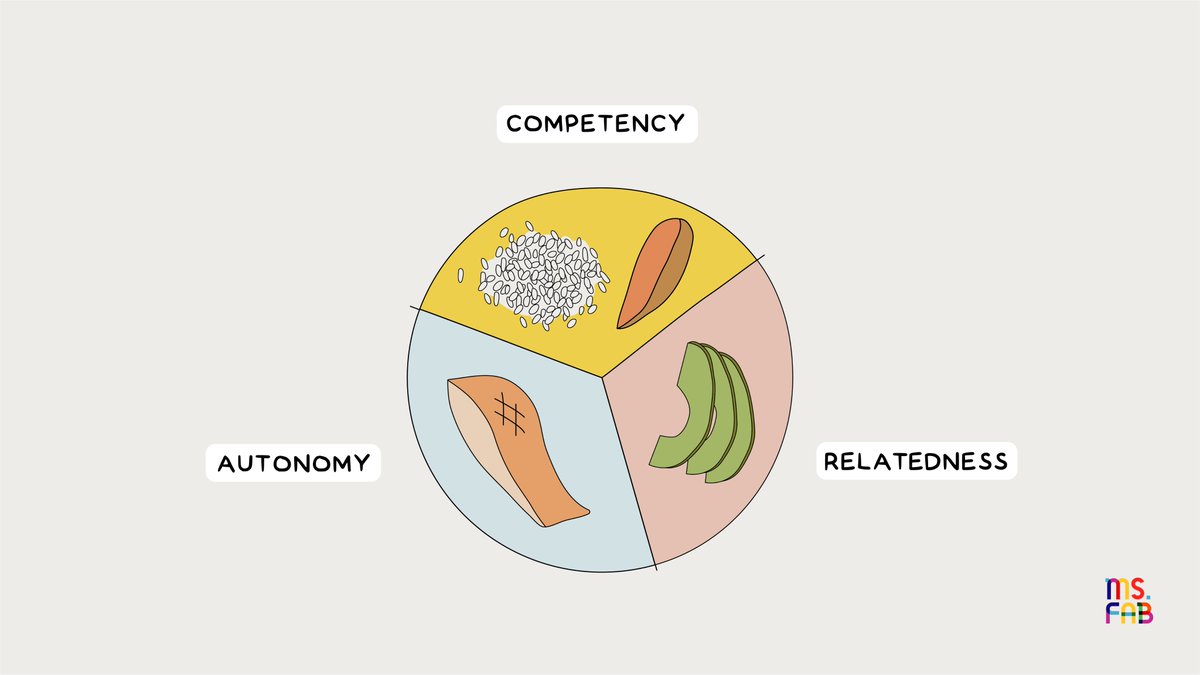
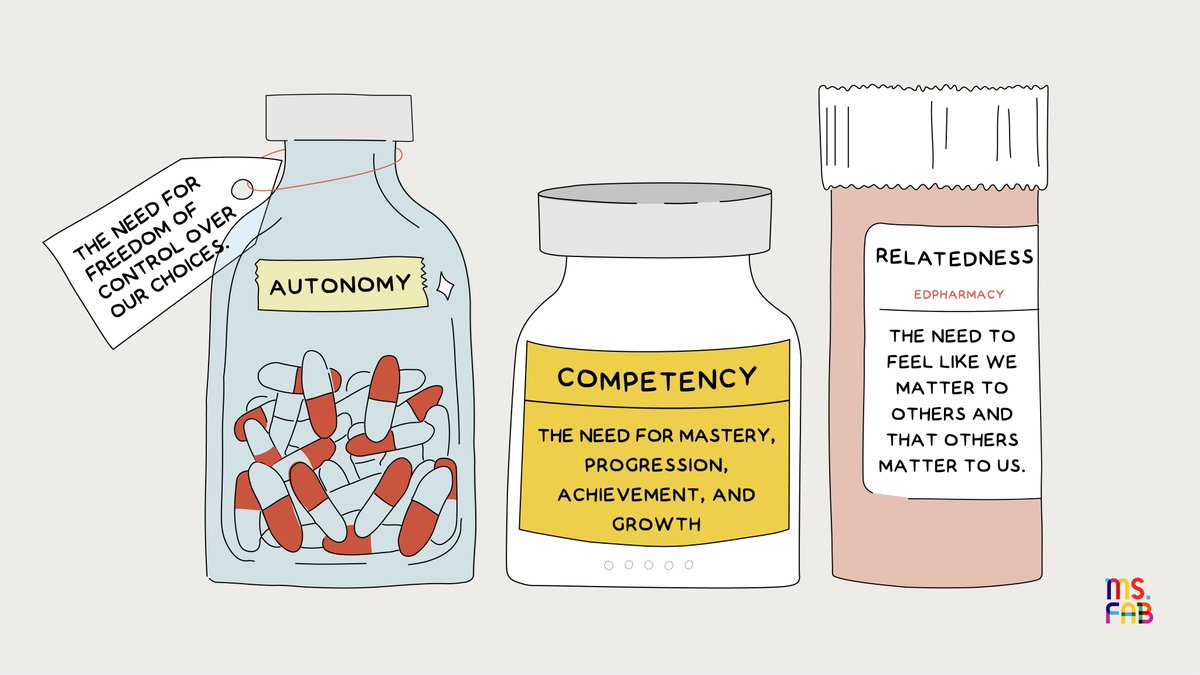
Self-determination theory explains that humans are motivated by three things:
• autonomy
• competency
• relatedness
We crave these experiences just like our bodies crave protein, carbs, and fats.
Read more here:
https://t.co/KhcP9iDlsI
If we don’t eat right, our bodies break down.
In the same way, if we don’t feed our psyches with autonomy, competency, and relatedness, our mental health suffers.
Unfortunately, many kids don't get enough of these essential experiences.
As
@nireyal says in his book, Indistractable:
“School, where kids spend most of their waking hours, is in many ways the antithesis of a place where kids feel competence, autonomy, and relatedness.”
This problem raises an interesting question:
Are kids searching for supplements online because they can’t find autonomy, competency, and relatedness in their offline world?
Let’s unpack this idea further by looking at the daily life of a kid in school.
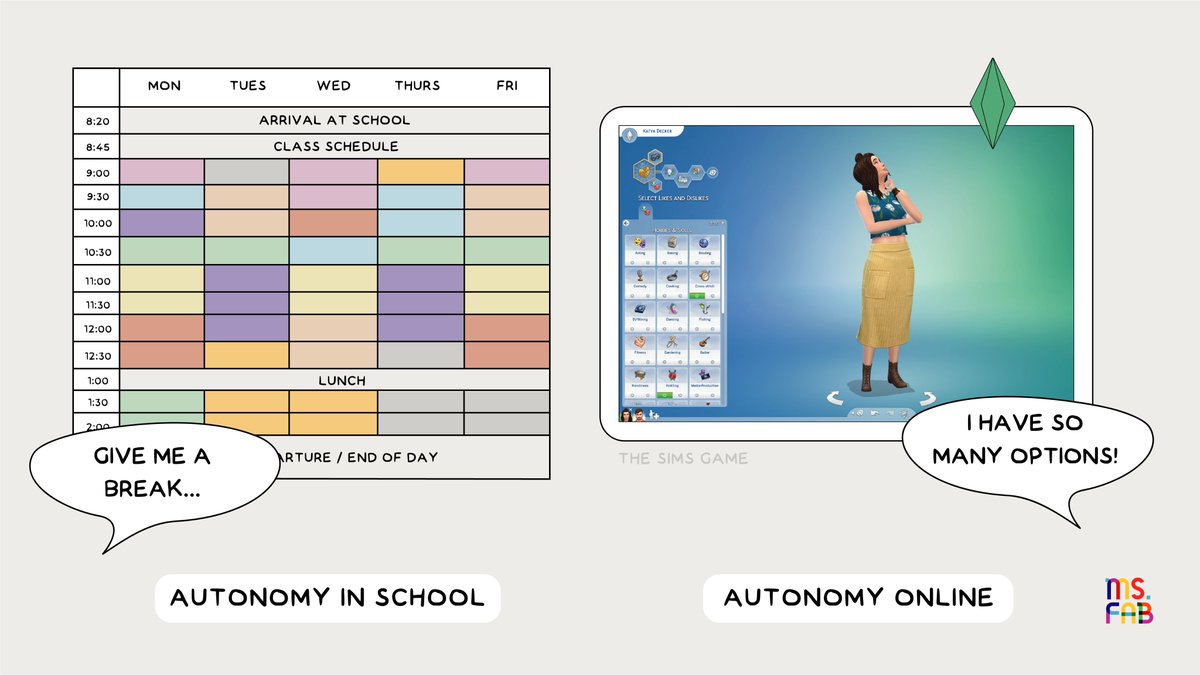
*AUTONOMY*
In school, everything is planned with strict rules. Kids are told what to do, what to think, & even what to wear!
One survey found that the average kid has to follow twice as many restrictions as an incarcerated felon 😳
https://t.co/LmZCLPRoaY
By contrast, kids have tons of autonomy online.
They can make choices (like what and who to play with), dive deep into what interests them, and make decisions of their own (like what their avatar should look like).
They experience a lot less adult control and surveillance.
*COMPETENCY*
Kids are so different. We can’t expect them to learn the same way or force them into one box.
The recent obsession with metrics, standards, and one-size-fits-all curriculums makes it hard for kids like this to experience competency in school.
On the internet, kids can learn anything they want!
They get to teach themselves new subjects, which gives them confidence in their abilities to learn on their own.
Many turn to video games, which are specifically designed to give a sense of competency and achievement.
*RELATEDNESS*
Parents send their kids to school so they can make friends and develop social skills.
Unfortunately, kids don't have as much time to socialize as they used to in schools.
Packed schedules and extensive curriculums leave little room for them to play and connect.
On the other hand, the internet is perfect for finding “your people.”
It's like a huge playground, where people can connect over their shared interests.
Kids can build friendships through free play, spending hours together diving into games and working on projects they choose.
No wonder kids spend so much time online!
But what about when screen time goes from an important outlet to an unhealthy obsession?
Here are 7 ideas to help kids navigate screen time:
1. Discuss the pros/cons of tech
It’s easy to lay down rules without giving any good reasons, but that’s a quick way to frustrate kids.
Instead, talk about the costs and benefits of tech. Help them see the issues so they can make good choices even when you're not around.
2. Show you understand their struggle
Say things like, “It must be hard to be told what to do all day. I bet it feels good to choose what you want to do when you play Minecraft."
When kids feel understood, they're more receptive to new ideas & can plan better ways to spend time
3. Acknowledge you face similar challenges
Say things like, “I’ve noticed I waste a lot of time on Instagram in the morning. When I wake up, I’m going to read a book instead of immediately grabbing my phone.”
Model the proper use of technology. Vulnerability builds trust.
4. Address screen time in an autonomy-supported way
Instead of adding more rules, create boundaries together in a collaborative way.
Spend time with them online and learn to value what *they* value before you start encouraging them to limit screen time.
5. Provide opportunities for real-world fulfillment
Give kids the chance to enjoy agency, competency, & relatedness offline as well as online.
Limit adult-led activities. Give them lots of free time, let them explore many hobbies, and organize plenty of playdates with friends.
6. Encourage more creation and less consumption
When your kids are online, encourage them to learn, socialize, and create.
Aim for less Coco Mellon and more Endless Reader; fewer cat videos and more time learning to code; less time watching Tiktoks & more time creating them.
7. Offer a better “yes”
Make sure that when you do ask your kids to say “No” to their screens, they’re saying “Yes!” to something even better.
Make family time so fulfilling and engaging, your kids won’t miss their phones.
“Knowing what’s really driving their overuse of technology is the first step to helping kids build resilience instead of escaping discomfort through distraction."
@nireyal Once kids feel understood, they can start making better choices around how to spend their time.
I explore ideas like this in Fab Fridays, my newsletter on childhood education with a twist + new ways to learn.
Subscribe below! 🤸🏼
https://t.co/SrOmbm4qkL