Just like photography has become much easier to create in the last 100 years, liquid NFTs will surely bring down price points of tokenized digital content but will also open expansive new markets.
1/The next major problem set in #DeFi is #NFTLiquidity.
It has become very clear that, like fungibles, nonfungibles are their own financial asset class.
One path to see this is to envision the future of NFTs as “liquid
Just like photography has become much easier to create in the last 100 years, liquid NFTs will surely bring down price points of tokenized digital content but will also open expansive new markets.
👉🏻 In particular, because of tokenization, *the NFT liquidity problem reduces to the NFT price discovery problem.*
This is a core mechanism that today is underutilized in the market, and one that — we will soon see — applies to all illiquid assets.
And the fundamental problem with each of these mechanisms is capital efficiency: in each mechanism, participants need to spend *at least* $N to value something at $N.
But one super cool approach uses peer prediction oracles created by @nick_emmons and @UpshotHQ. https://t.co/HleEMPpgcq
It\u2019s no secret that pricing NFTs is really difficult, so we built an NFT appraisal product powered by peer prediction.https://t.co/uWFZq4aeGs
— Upshot (@UpshotHQ) December 23, 2020
Prices can then be reported on-chain through @UpshotHQ’s mechanism.
More from Internet


Many conversations happening on #WhatsApp (WA) groups about new #WhatsAppPrivacyPolicy .
This thread has arguments to help ditch WA & move to @signalapp:
https://t.co/En4fe9VxUN
Share, use, copy-paste, modify with understanding as you deem fit on any platform in whole or part
1/n
Note: No affiliations, conflict of interest
Info presented with NO bias, prejudice, malice or indemnity.
Open to corrections: individual tweets may be deleted, tweets added to thread or corrected as replies.
Points that are unclear or uncertain are marked with "(?)".
2/n
CONTENT OF WA MESSAGES SHALL REMAIN ENCRYPTED END TO END.
BUT, there's data: contacts, group affiliations, co-affiliations, locations (live?), frequency of contacts, *tags* generated when we send or forward a message or file to contacts or groups, links, clicks on links, etc.
3/n
It is unclear whether this data is anonymized.
NOTHING in latest policy *prevents* the collection, retention, sharing or sale by FaceBook (FB: owner of WA) of this data in part or whole whether with identifying information or anonymized.
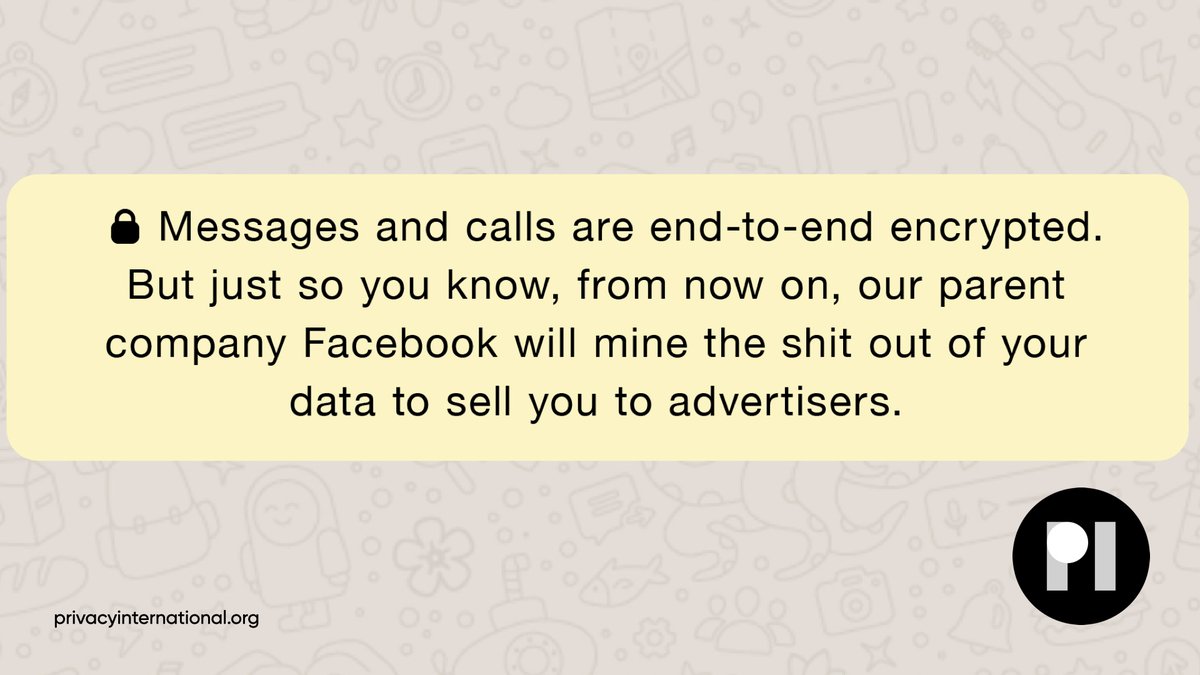
Meme source:
https://t.co/nMDTUlb0rl
4/n
Companies need to make money & generate profits:
To create software, install & maintain infrastructure.
Google, FB, Insta, Amazon etc sell data created from our content & data generated from our interactions (searches, clicks, purchases etc).
This makes many uncomfortable.
5/n
This thread has arguments to help ditch WA & move to @signalapp:
https://t.co/En4fe9VxUN
Share, use, copy-paste, modify with understanding as you deem fit on any platform in whole or part
1/n
Note: No affiliations, conflict of interest
Info presented with NO bias, prejudice, malice or indemnity.
Open to corrections: individual tweets may be deleted, tweets added to thread or corrected as replies.
Points that are unclear or uncertain are marked with "(?)".
2/n
CONTENT OF WA MESSAGES SHALL REMAIN ENCRYPTED END TO END.
BUT, there's data: contacts, group affiliations, co-affiliations, locations (live?), frequency of contacts, *tags* generated when we send or forward a message or file to contacts or groups, links, clicks on links, etc.
3/n
It is unclear whether this data is anonymized.
NOTHING in latest policy *prevents* the collection, retention, sharing or sale by FaceBook (FB: owner of WA) of this data in part or whole whether with identifying information or anonymized.
Meme source:
https://t.co/nMDTUlb0rl
4/n
Now that #WhatsApp have updated their terms, forcing users to share their data with #Facebook, here's our suggested update to that notification you see at the top of your chats.#WhatsappNewPolicy #WhatsappPrivacy pic.twitter.com/FjxFGBm6Q8
— Privacy International (@privacyint) January 7, 2021
Companies need to make money & generate profits:
To create software, install & maintain infrastructure.
Google, FB, Insta, Amazon etc sell data created from our content & data generated from our interactions (searches, clicks, purchases etc).
This makes many uncomfortable.
5/n

There are lots of problems with ad-tech:
* being spied on all the time means that the people of the 21st century are less able to be their authentic selves;
* any data that is collected and retained will eventually breach, creating untold harms;
1/

* data-collection enables for discriminatory business practices ("digital redlining");
* the huge, tangled hairball of adtech companies siphons lots (maybe even most) of the money that should go creators and media orgs; and
2/
* anti-adblock demands browsers and devices that thwart their owners' wishes, a capability that can be exploited for even more nefarious purposes;
That's all terrible, but it's also IRONIC, since it appears that, in addition to everything else, ad-tech is a fraud, a bezzle.
3/
Bezzle was John Kenneth Galbraith's term for "the magic interval when a confidence trickster knows he has the money he has appropriated but the victim does not yet understand that he has lost it." That is, a rotten log that has yet to be turned over.
4/
Bezzles unwind slowly, then all at once. We've had some important peeks under ad-tech's rotten log, and they're increasing in both intensity and velocity. If you follow @Chronotope, you've had a front-row seat to the
* being spied on all the time means that the people of the 21st century are less able to be their authentic selves;
* any data that is collected and retained will eventually breach, creating untold harms;
1/
* data-collection enables for discriminatory business practices ("digital redlining");
* the huge, tangled hairball of adtech companies siphons lots (maybe even most) of the money that should go creators and media orgs; and
2/
* anti-adblock demands browsers and devices that thwart their owners' wishes, a capability that can be exploited for even more nefarious purposes;
That's all terrible, but it's also IRONIC, since it appears that, in addition to everything else, ad-tech is a fraud, a bezzle.
3/
Bezzle was John Kenneth Galbraith's term for "the magic interval when a confidence trickster knows he has the money he has appropriated but the victim does not yet understand that he has lost it." That is, a rotten log that has yet to be turned over.
4/
Bezzles unwind slowly, then all at once. We've had some important peeks under ad-tech's rotten log, and they're increasing in both intensity and velocity. If you follow @Chronotope, you've had a front-row seat to the
The numbers are all fking fake, the metrics are bullshit, the agencies responsible for enforcing good practices are knowing bullshiters enforcing and profiting off all the fake numbers and none of the models make sense at scale of actual human users. https://t.co/sfmdrxGBNJ pic.twitter.com/thvicDEL29
— Aram Zucker-Scharff (@Chronotope) December 26, 2018