#Kanishka I was, the greatest, and certainly the most famous, of the #Kushan kings.
He is known, from the combined testimony of the literary, epigraphic, and numismatic sources, to have ruled over an extensive dominion extending from Bihar in the east to #Khorasan
@atalbrave https://t.co/o9dOqR8bDg
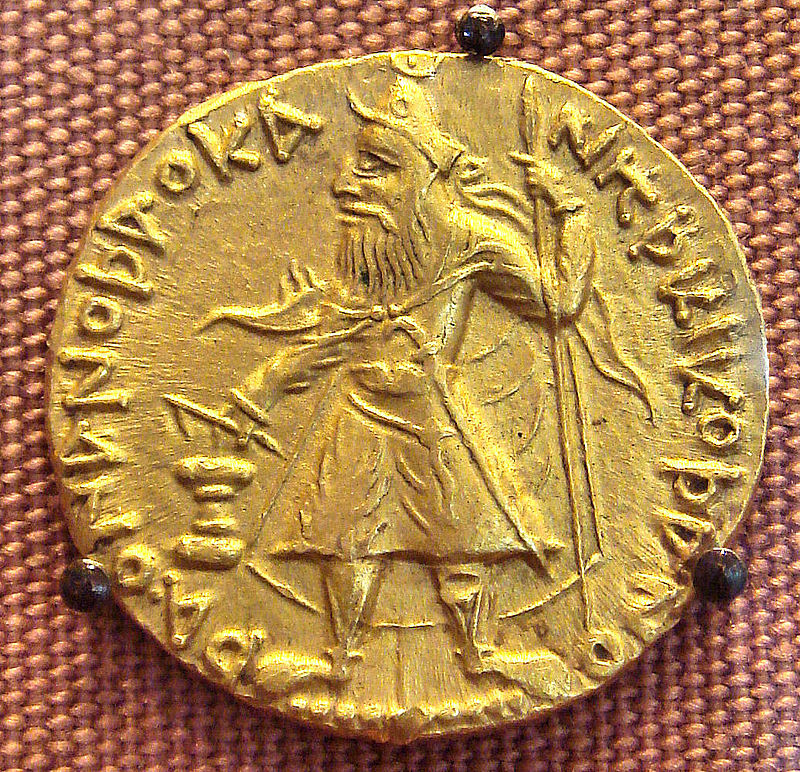
Now, #Kanishka, sometimes known as the great, the most celebrated of #Kushans, the founder of his own era, the great conqueror, the \u2018inventor\u2019 of #Bactrian writing. This will be a language & coin galore. #Afghanistan 1/ kr pic.twitter.com/Ji30OIIZiI
— Afghan Historians (@AfghanHistorian) August 10, 2019
#Kosam inscription dated year 2,
#Sarnath inscription dated year 3,
#Mathur¹ inscription dated year 4,
#Suivihar inscription dated year 11, and
#Manikiala inscription dated year 18.
#AFG
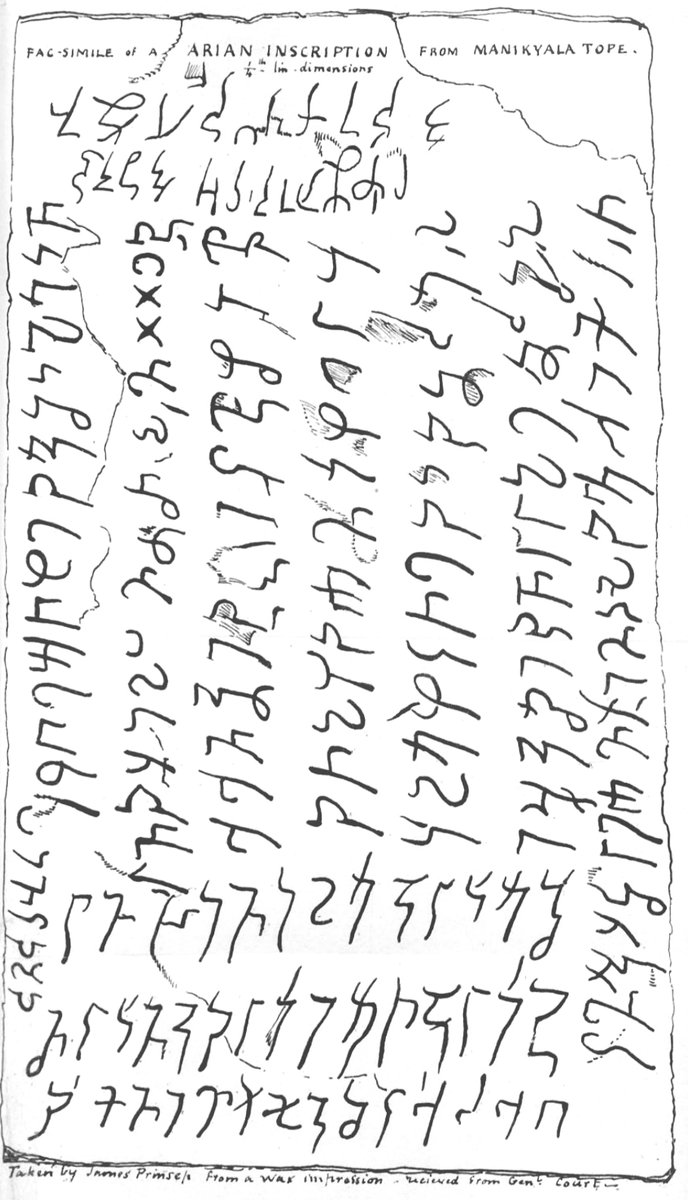
He carved out a principality for himself somewhere in #UttarPradesh, sometime after the death of V’ima #Kadphises.
However, the recently discovered #Rabatak inscription #SurkhKotal shows that he was, in fact, the son and successor of V’ima Kadphises.
Kanishka I attained several military successes in the east.
When he returned to his capital, #Purushapura (#Peshawar) from #Magadha, he carried away with him, the begging bowl of the #Buddha, a magical cock, and the Buddhist scholar, #Aoevaghosha.

According to the Rajataraógiòî of Kalhaòa, #Kanishka I conquered #Kashmir.

The OErîdharmapiþaka refers to his expedition against the #Parthians, in which he is reported to have achieved success.

These successes of the #Kushan ruler towards the north made the Chinese wary of his intentions.
According to a legend, Kanishka lamented this failure about the time of his death.
Kanishka I appear to be a devout #Buddhist, who, as per the testimony of #Hiuen-tsang and #Alberuni,
In this Council, #Vasumitra acted as the president, and Pnroeva, as vice-president.
The Council prepared the Vibhashaoeastra commentary on the #Tripiþaka.
@atalbrave
More from History




You May Also Like

Department List of UCAS-China PROFESSORs for ANSO, CSC and UCAS (fully or partial) Scholarship Acceptance
1) UCAS School of physical sciences Professor
https://t.co/9X8OheIvRw
2) UCAS School of mathematical sciences Professor
3) UCAS School of nuclear sciences and technology
https://t.co/nQH8JnewcJ
4) UCAS School of astronomy and space sciences
https://t.co/7Ikc6CuKHZ
5) UCAS School of engineering
6) Geotechnical Engineering Teaching and Research Office
https://t.co/jBCJW7UKlQ
7) Multi-scale Mechanics Teaching and Research Section
https://t.co/eqfQnX1LEQ
😎 Microgravity Science Teaching and Research
9) High temperature gas dynamics teaching and research section
https://t.co/tVIdKgTPl3
10) Department of Biomechanics and Medical Engineering
https://t.co/ubW4xhZY2R
11) Ocean Engineering Teaching and Research
12) Department of Dynamics and Advanced Manufacturing
https://t.co/42BKXEugGv
13) Refrigeration and Cryogenic Engineering Teaching and Research Office
https://t.co/pZdUXFTvw3
14) Power Machinery and Engineering Teaching and Research
1) UCAS School of physical sciences Professor
https://t.co/9X8OheIvRw
2) UCAS School of mathematical sciences Professor
3) UCAS School of nuclear sciences and technology
https://t.co/nQH8JnewcJ
4) UCAS School of astronomy and space sciences
https://t.co/7Ikc6CuKHZ
5) UCAS School of engineering
6) Geotechnical Engineering Teaching and Research Office
https://t.co/jBCJW7UKlQ
7) Multi-scale Mechanics Teaching and Research Section
https://t.co/eqfQnX1LEQ
😎 Microgravity Science Teaching and Research
9) High temperature gas dynamics teaching and research section
https://t.co/tVIdKgTPl3
10) Department of Biomechanics and Medical Engineering
https://t.co/ubW4xhZY2R
11) Ocean Engineering Teaching and Research
12) Department of Dynamics and Advanced Manufacturing
https://t.co/42BKXEugGv
13) Refrigeration and Cryogenic Engineering Teaching and Research Office
https://t.co/pZdUXFTvw3
14) Power Machinery and Engineering Teaching and Research