The Government is making the same mistakes as it did in the first wave. Except with knowledge.

A thread.

The Government's strategy at the beginning of the pandemic was to 'cocoon' the vulnerable (e.g. those in care homes). This was a 'herd immunity' strategy. This interview is from March.

https://t.co/UHDUTzDNkz
This strategy failed. It is impossible to 'cocoon' the vulnerable, as Covid is passed from younger people to older, more vulnerable people.

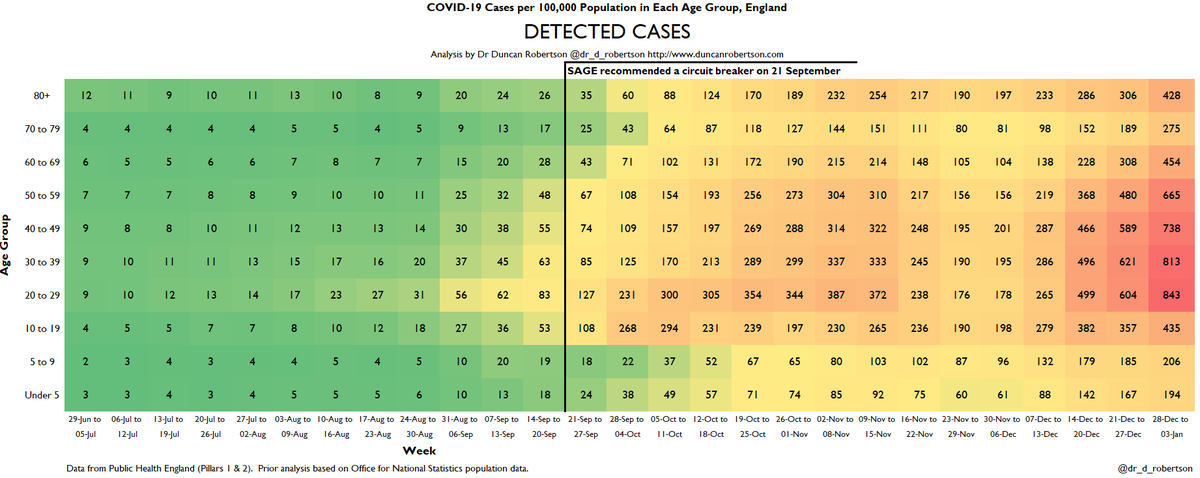
We can see this playing out through heatmaps. e.g. these heatmaps from the second wave.

https://t.co/EiYNLEIhQ3
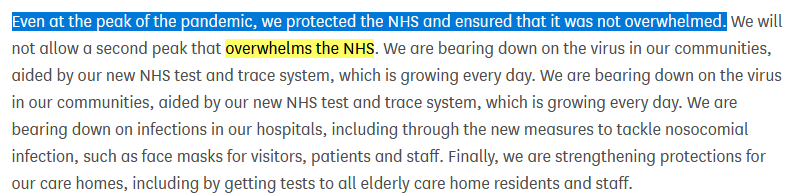
The Government then decided to change its strategy to 'preventing a second wave that overwhelms the NHS'. This was announced on 8 June in Parliament.

This is not the same as 'preventing a second wave'.

https://t.co/DPWiJbCKRm
The Academy of Medical Scientists published a report on 14 July 'Preparing for a Challenging Winter' commissioned by the Chief Scientific Adviser that set out what needed to be done in order to prevent a catastrophe over the winter period.

https://t.co/T4HGsQJ5M8
Around this time, the Great Barrington Declaration was published. This changed the rhetoric from 'herd immunity' to 'focused protection'.

This was and remains non-mainstream from a scientific point of view, but was popular amongst a group of commentators

https://t.co/X7EiNhMh1T
Cases were increasing rapidly, and SAGE (the Scientific Advisory Group for Emergencies) called for a 'circuit breaker'.

https://t.co/M3Mh8UVdxh
At the same time, a focused protection-supporting group of scientists were invited to Downing Street to present the alternate view. Politically, this enabled this headline to be written.

https://t.co/GDxBEx6Yiu
Cases grew. Another tier system was introduced to attempt to control the virus.

https://t.co/prKsIKqNh9
In a fantastic acheivement of science, the Pfizer/BioNTech vaccine was approved on 3 December https://t.co/BZwQ3ykzrz.

Since then, the Oxford/AstraZeneca and Moderna vaccines have been approved.
A new variant was discovered with increased transmissibility. This caused a 'lockdown' as the NHS was now in crisis mode and there was 'a material risk of the NHS in several areas being overwhelmed'. The Government's second strategy is failing.

https://t.co/3eTVHXtbkm
However, this 'lockdown' is not stringent. Many more people are allowed to send their children to school allowing the virus to mix in children and their parents.

https://t.co/mjdbnwHqC2
The Prime Minister made a strange comment on 6 January. The word 'cocoon' was back. Remember that from March?

https://t.co/MzC6O5psQs
Matt Hancock has now given an interview setting out the Government's new, third, strategy

https://t.co/n2SKYx8WFN
The strategy is about 'manageable risk'. Risk to those that may die or live with the effects of catching Covid, or risk to the Government?
We are now back to vaccinating the vulnerable - focused protection if you will.
It appears that the Government has adopted a hybrid strategy - vaccination for the 'vulnerable', and herd immunity or focused protection for those that are not. There is no discussion of vaccinating children and the under-50s.

It is clear that many more lives will be lost.

More from Government

Caveat: This article is sourced from @Daily_Express !!!

"End of Sturgeon?"

Frankly, an appropriate response from @NicolaSturgeon might be to quote the infamous Mark Twain response to an erroneous 'obituary' known to all...

"The reports of my demise are greatly exaggerated."

https://t.co/Ce1xVVISR2

More accurately, the media have quoted:

"Ms Sturgeon said she had a “real job to do” and was focused on guiding Scotland through the Covid-19 pandemic."

It's very reassuring to hear that @scotgov and @ScotGovFM have prioritised safeguarding lives and Scotland, above all else.

"I’ll leave others to play games or politics. I have got a real job to do and people can decide themselves whether I am doing it well or not, but I am absolutely 100 per cent focused on leading this country through a pandemic."

💯% 😀👍

Making her priorities crystal clear!

“That’s what I’ve done since this time last year and it’s what I’m going to continue to do for absolutely as long as necessary.”

And again, making it absolutely crystal clear!

You May Also Like

I’m torn on how to approach the idea of luck. I’m the first to admit that I am one of the luckiest people on the planet. To be born into a prosperous American family in 1960 with smart parents is to start life on third base. The odds against my very existence are astronomical.


I’ve always felt that the luckiest people I know had a talent for recognizing circumstances, not of their own making, that were conducive to a favorable outcome and their ability to quickly take advantage of them.

In other words, dumb luck was just that, it required no awareness on the person’s part, whereas “smart” luck involved awareness followed by action before the circumstances changed.

So, was I “lucky” to be born when I was—nothing I had any control over—and that I came of age just as huge databases and computers were advancing to the point where I could use those tools to write “What Works on Wall Street?” Absolutely.

Was I lucky to start my stock market investments near the peak of interest rates which allowed me to spend the majority of my adult life in a falling rate environment? Yup.
First thread of the year because I have time during MCO. As requested, a thread on the gods and spirits of Malay folk religion. Some are indigenous, some are of Indian origin, some have Islamic


Before I begin, it might be worth explaining the Malay conception of the spirit world. At its deepest level, Malay religious belief is animist. All living beings and even certain objects are said to have a soul. Natural phenomena are either controlled by or personified as spirits

Although these beings had to be respected, not all of them were powerful enough to be considered gods. Offerings would be made to the spirits that had greater influence on human life. Spells and incantations would invoke their


Two known examples of such elemental spirits that had god-like status are Raja Angin (king of the wind) and Mambang Tali Arus (spirit of river currents). There were undoubtedly many more which have been lost to time

Contact with ancient India brought the influence of Hinduism and Buddhism to SEA. What we now call Hinduism similarly developed in India out of native animism and the more formal Vedic tradition. This can be seen in the multitude of sacred animals and location-specific Hindu gods