And it's time for me to make good.
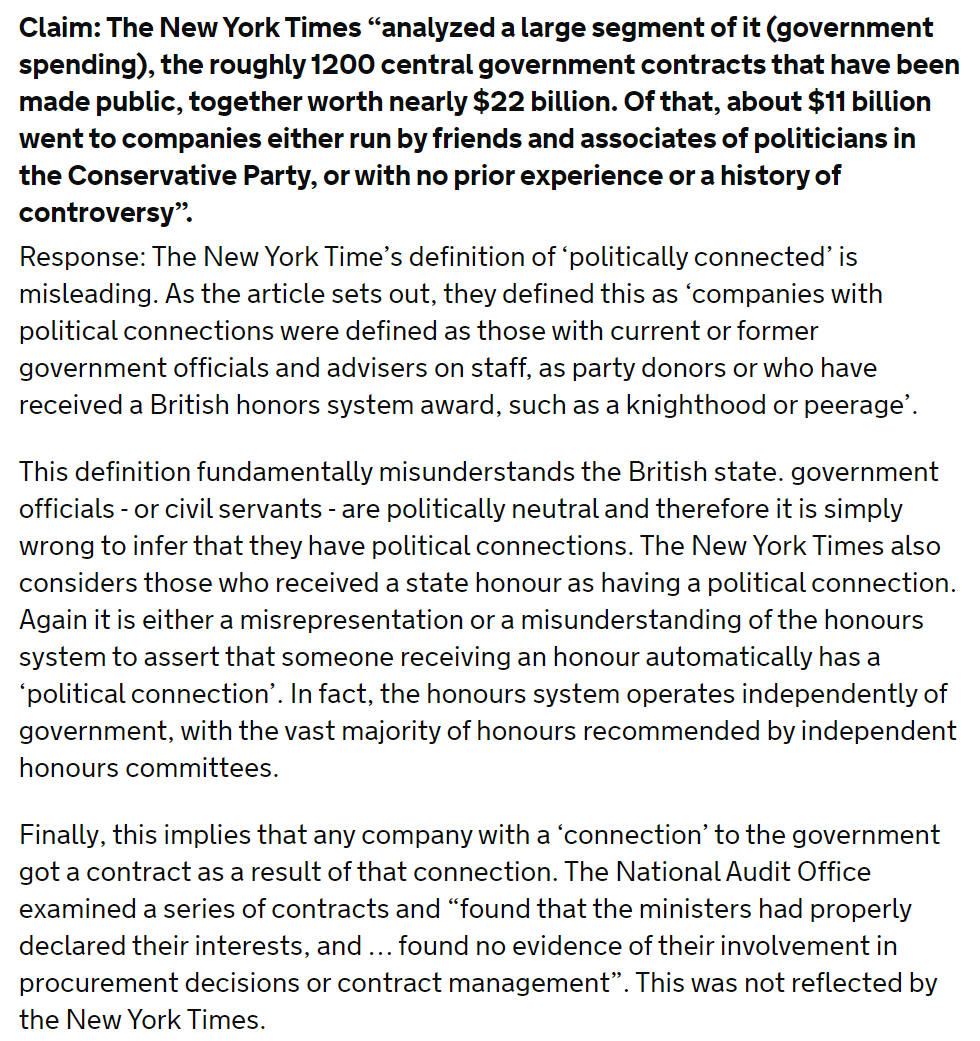
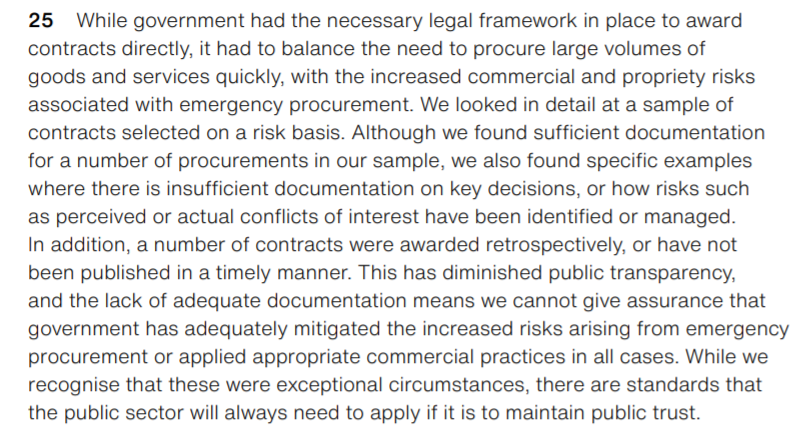
So, just before Christmas, Government what it called a "response" to this New York Times account of cronyism in pandemic spending.
And it's time for me to make good.

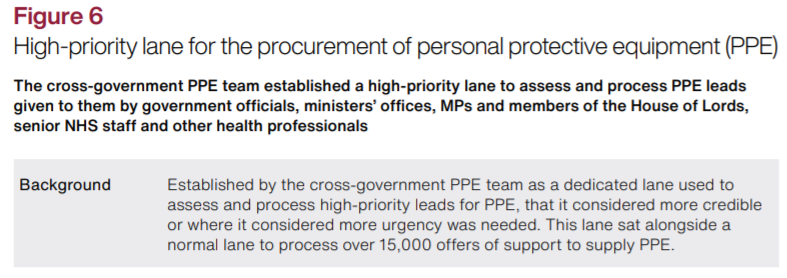
(1) Government cannot say the NYT got it wrong. (2) the NAO found the VIP lane (later renamed the high-priority lane) "sat alongside" the normal lane. And I have shown elsewhere VIP contracts were handled by different teams all the way through.

More from Jo Maugham
We need to talk about the 'expert' witness statement evidence led by Ms Bell in her successful case before the Tavistock. THREAD
You can see who gave evidence in her support from these extracts from the Tavistock's Skeleton Argument.
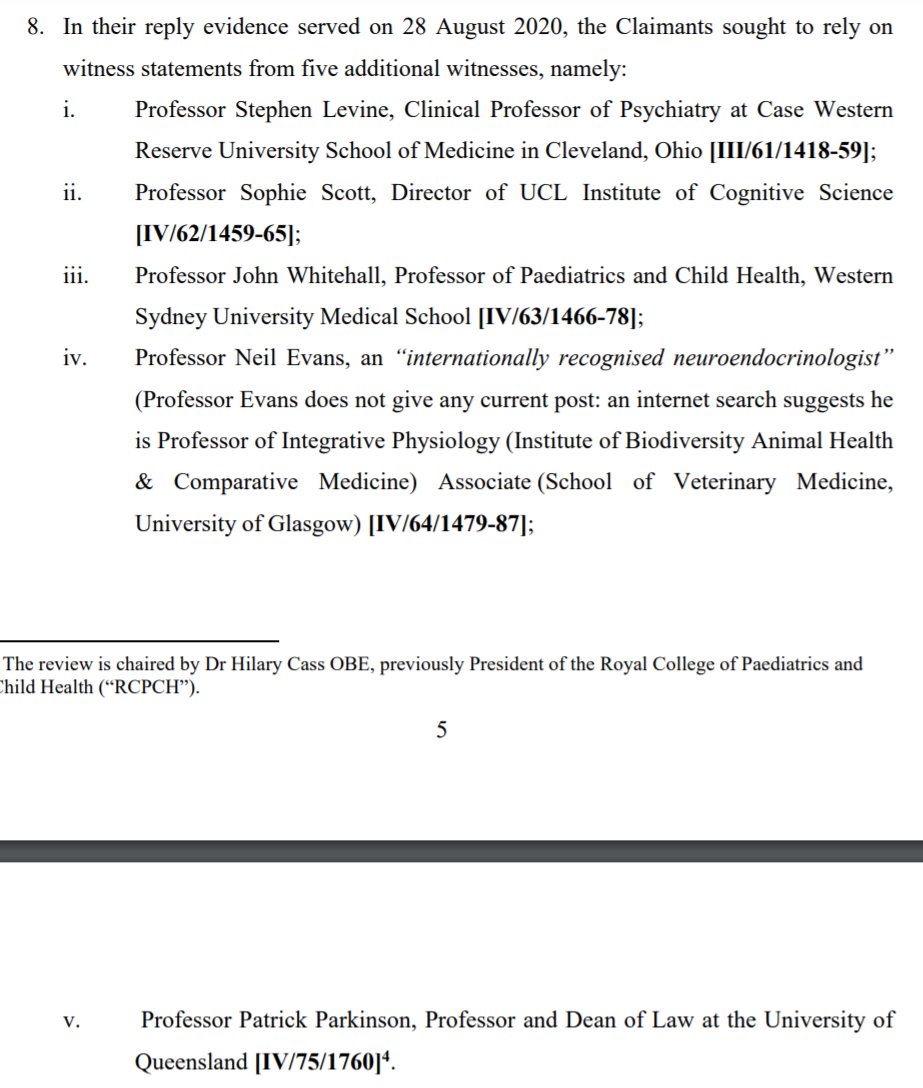
Helpful for you to bear in mind that her solicitor was a man called Paul Conrathe, who has a long association with the religious right in the US (I have talked about him a number of times but this is as good a starting point as any).
I am not going to address here other criticisms that might be made of the form in which that evidence was given or the timing of its service before the court. I am just going to address, in alphabetical order, the individuals whose evidence Mr Conrathe led on Ms Bell's behalf.
The first witness, alphabetically, was Associate Professor of Sociology at the University of Oxford, Michael Biggs.
Mr Biggs was exposed for posting transphobic statements online under a fake twitter handle: @MrHenryWimbush according to this report.
You can see who gave evidence in her support from these extracts from the Tavistock's Skeleton Argument.
Helpful for you to bear in mind that her solicitor was a man called Paul Conrathe, who has a long association with the religious right in the US (I have talked about him a number of times but this is as good a starting point as any).
In this thread, I noted the lawyer acting against the Tavistock, Paul Conrathe, is using very similar arguments (those under 18 cannot consent at all; or cannot lawfully consent without x conditions) as he has run/is running in a number of cases challenging abortion rights. https://t.co/gJk4c9bUED
— Jo Maugham (@JolyonMaugham) June 21, 2020
I am not going to address here other criticisms that might be made of the form in which that evidence was given or the timing of its service before the court. I am just going to address, in alphabetical order, the individuals whose evidence Mr Conrathe led on Ms Bell's behalf.
The first witness, alphabetically, was Associate Professor of Sociology at the University of Oxford, Michael Biggs.
Mr Biggs was exposed for posting transphobic statements online under a fake twitter handle: @MrHenryWimbush according to this report.

If you want to know what happens to populations living in austerity who trade with the US on WTO terms, take a look at Tonga. THREAD
I visited Tonga in 1981 and it was, like so many other Pacific Island nations, slowly adjusting to Westernisation. The people ate mostly fish and vegetables. /1
Now it has rates of Type 2 diabetes of up to 40%, life expectancy has fallen by 10 years and well over half the population is obese. So what happened? (stats https://t.co/1XQHdqL8o8) /2
What happened was that the US discovered that Tonga was a great dumping ground for a cheap and locally unsaleable product known as a Turkey 'tail', essentially a gland of 40-45% fat. /3
They were fatty and, because cheap, attractive to a poor population. By 2007, in another Pacific Island nation, Samoa, 20 kilos per person were being sold every year. But it banned them for public health reasons. https://t.co/2f1N8tuMp6 /4
I visited Tonga in 1981 and it was, like so many other Pacific Island nations, slowly adjusting to Westernisation. The people ate mostly fish and vegetables. /1
Now it has rates of Type 2 diabetes of up to 40%, life expectancy has fallen by 10 years and well over half the population is obese. So what happened? (stats https://t.co/1XQHdqL8o8) /2
What happened was that the US discovered that Tonga was a great dumping ground for a cheap and locally unsaleable product known as a Turkey 'tail', essentially a gland of 40-45% fat. /3
They were fatty and, because cheap, attractive to a poor population. By 2007, in another Pacific Island nation, Samoa, 20 kilos per person were being sold every year. But it banned them for public health reasons. https://t.co/2f1N8tuMp6 /4
More from Government


Long thread: Because I couldn’t find anything comprehensive, I’m just going to post everything I’ve seen in the news/Twitter about Trump’s activities related to the Jan 6th insurrection. I think the timing & context of his actions/inactions will matter a lot for a senate trial.
12/12: The earlier DC protest over the electoral college vote during clearly inspired Jan 6th. On Dec 12th, he tweeted: “Wow! Thousands of people forming in Washington (D.C.) for Stop the Steal. Didn’t know about this, but I’ll be seeing them! #MAGA.”
12/19: Trump announces the Jan. 6th event by tweeting, “Big protest in D.C. on January 6th. Be there, will be wild!” Immediately, insurrectionists begin to discuss the “Wild Protest.” Just 2 days later, this UK political analyst predicts the violence
12/26-27: Trump announces his participation on Twitter. On Dec. 29, the FBI sends out a nationwide bulletin warning legislatures about attacks https://t.co/Lgl4yk5aO1
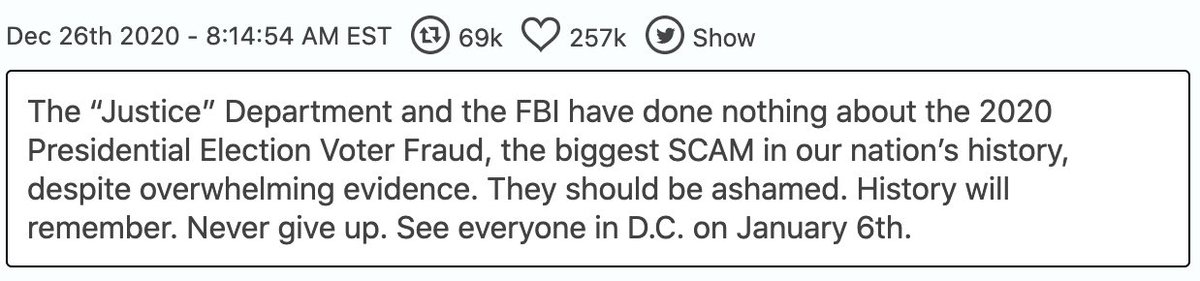
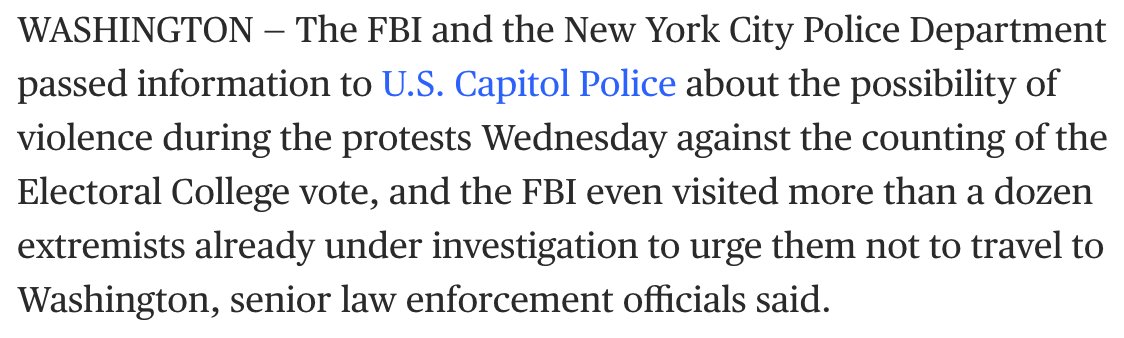
1/1: Trump tweets the time of his protest. Then he retweets “The calvary is coming” on Jan. 6!” Sounds like a war? About this time, the FBI begins visiting right wing extremists to tell them not to go--does the FBI tell the president? https://t.co/3OxnB2AHdr
12/12: The earlier DC protest over the electoral college vote during clearly inspired Jan 6th. On Dec 12th, he tweeted: “Wow! Thousands of people forming in Washington (D.C.) for Stop the Steal. Didn’t know about this, but I’ll be seeing them! #MAGA.”
Jumping in for @DCist/@wamu885 this evening. The scene rn coming up 17th Street from BLM Plaza. pic.twitter.com/Fn9aukjEPW
— Matt Blitz (@WhyBlitz) December 12, 2020
12/19: Trump announces the Jan. 6th event by tweeting, “Big protest in D.C. on January 6th. Be there, will be wild!” Immediately, insurrectionists begin to discuss the “Wild Protest.” Just 2 days later, this UK political analyst predicts the violence
On January 6, armed Trumpist militias will be rallying in DC, at Trump's orders. It's highly likely that they'll try to storm the Capitol after it certifies Joe Biden's win. I don't think this has sunk in yet.
— Arieh Kovler (@ariehkovler) December 21, 2020
12/26-27: Trump announces his participation on Twitter. On Dec. 29, the FBI sends out a nationwide bulletin warning legislatures about attacks https://t.co/Lgl4yk5aO1
1/1: Trump tweets the time of his protest. Then he retweets “The calvary is coming” on Jan. 6!” Sounds like a war? About this time, the FBI begins visiting right wing extremists to tell them not to go--does the FBI tell the president? https://t.co/3OxnB2AHdr


You May Also Like

I just finished Eric Adler's The Battle of the Classics, and wanted to say something about Joel Christiansen's review linked below. I am not sure what motivates the review (I speculate a bit below), but it gives a very misleading impression of the book. 1/x
The meat of the criticism is that the history Adler gives is insufficiently critical. Adler describes a few figures who had a great influence on how the modern US university was formed. It's certainly critical: it focuses on the social Darwinism of these figures. 2/x
Other insinuations and suggestions in the review seem wildly off the mark, distorted, or inappropriate-- for example, that the book is clickbaity (it is scholarly) or conservative (hardly) or connected to the events at the Capitol (give me a break). 3/x
The core question: in what sense is classics inherently racist? Classics is old. On Adler's account, it begins in ancient Rome and is revived in the Renaissance. Slavery (Christiansen's primary concern) is also very old. Let's say classics is an education for slaveowners. 4/x
It's worth remembering that literacy itself is elite throughout most of this history. Literacy is, then, also the education of slaveowners. We can honor oral and musical traditions without denying that literacy is, generally, good. 5/x
As someone\u2019s who\u2019s read the book, this review strikes me as tremendously unfair. It mostly faults Adler for not writing the book the reviewer wishes he had! https://t.co/pqpt5Ziivj
— Teresa M. Bejan (@tmbejan) January 12, 2021
The meat of the criticism is that the history Adler gives is insufficiently critical. Adler describes a few figures who had a great influence on how the modern US university was formed. It's certainly critical: it focuses on the social Darwinism of these figures. 2/x
Other insinuations and suggestions in the review seem wildly off the mark, distorted, or inappropriate-- for example, that the book is clickbaity (it is scholarly) or conservative (hardly) or connected to the events at the Capitol (give me a break). 3/x
The core question: in what sense is classics inherently racist? Classics is old. On Adler's account, it begins in ancient Rome and is revived in the Renaissance. Slavery (Christiansen's primary concern) is also very old. Let's say classics is an education for slaveowners. 4/x
It's worth remembering that literacy itself is elite throughout most of this history. Literacy is, then, also the education of slaveowners. We can honor oral and musical traditions without denying that literacy is, generally, good. 5/x