1) Washington is staring at the potential of a government shutdown Monday night. This is grim. Congress has approved four temporary spending bills since the end of the government’s fiscal year in September to prevent a shutdown.
The latest the current Congressional session can end is 11:59:59 am on January 3.
In other words, Congress needed to get the President the bill by December 23 to avoid a pocket veto. That’s the “ten-day/Sundays excluded” window.
But Congress adjourning within that “ten day/Sundays excluded” window effectively neuters the possibility of an override attempt.
It’s unclear if the President’s proposed changes to the bill could pass. And, don’t forget that Congress has some responsibility in all of this, too.
More from Chad Pergram
More from Government


How does a government put a legislation on 'hold'? Is there any constitutional mechanism for the executive to 'pause' a validly passed legislation? Genuine Koshan.
So a committee of 'wise men/women' selected by the SC will stand in judgement over the law passed by
Here is the thing - a law can be stayed based on usual methods, it can be held unconstitutional based on violation of the Constitution. There is no shortcut to this based on the say so of even a large number of people, merely because they are loud.
Tomorrow can all the income tax payers also gather up at whichever maidan and ask for repealing the income tax law? It hurts us and we can protest quite loudly.
How can a law be stayed or over-turned based on the nuisance value of the protestors? It is anarchy to allow that.
CJI: our intention is to see if we can bring about an amicable resolution to the problem. That is why we asked you why don't you put the #FarmBills on hold. You want time for negotiation. If there is some sense of responsibility showing that you will not implement the laws
— Bar & Bench (@barandbench) January 11, 2021
So a committee of 'wise men/women' selected by the SC will stand in judgement over the law passed by
CJI: .....then we can form a committee with ICAR members to look into this. Till then you can continue to put the law on hold. Why will you insist on continuing the law anyhow
— Bar & Bench (@barandbench) January 11, 2021
Here is the thing - a law can be stayed based on usual methods, it can be held unconstitutional based on violation of the Constitution. There is no shortcut to this based on the say so of even a large number of people, merely because they are loud.
AG Venugopal: none of the petitions point to any provision of three farm acts stating that it is unconstitutional
— Bar & Bench (@barandbench) January 11, 2021
CJI: we are not declaring it unconstitutional
AG: laws cannot be stayed. This is drastic
Tomorrow can all the income tax payers also gather up at whichever maidan and ask for repealing the income tax law? It hurts us and we can protest quite loudly.
How can a law be stayed or over-turned based on the nuisance value of the protestors? It is anarchy to allow that.

Which metric is a better predictor of the severity of the fall surge in US states?
1) Margin of Democrat victory in Nov 2020 election
or
2) % infected through Sep 1, 2020
Can you guess which plot is which?
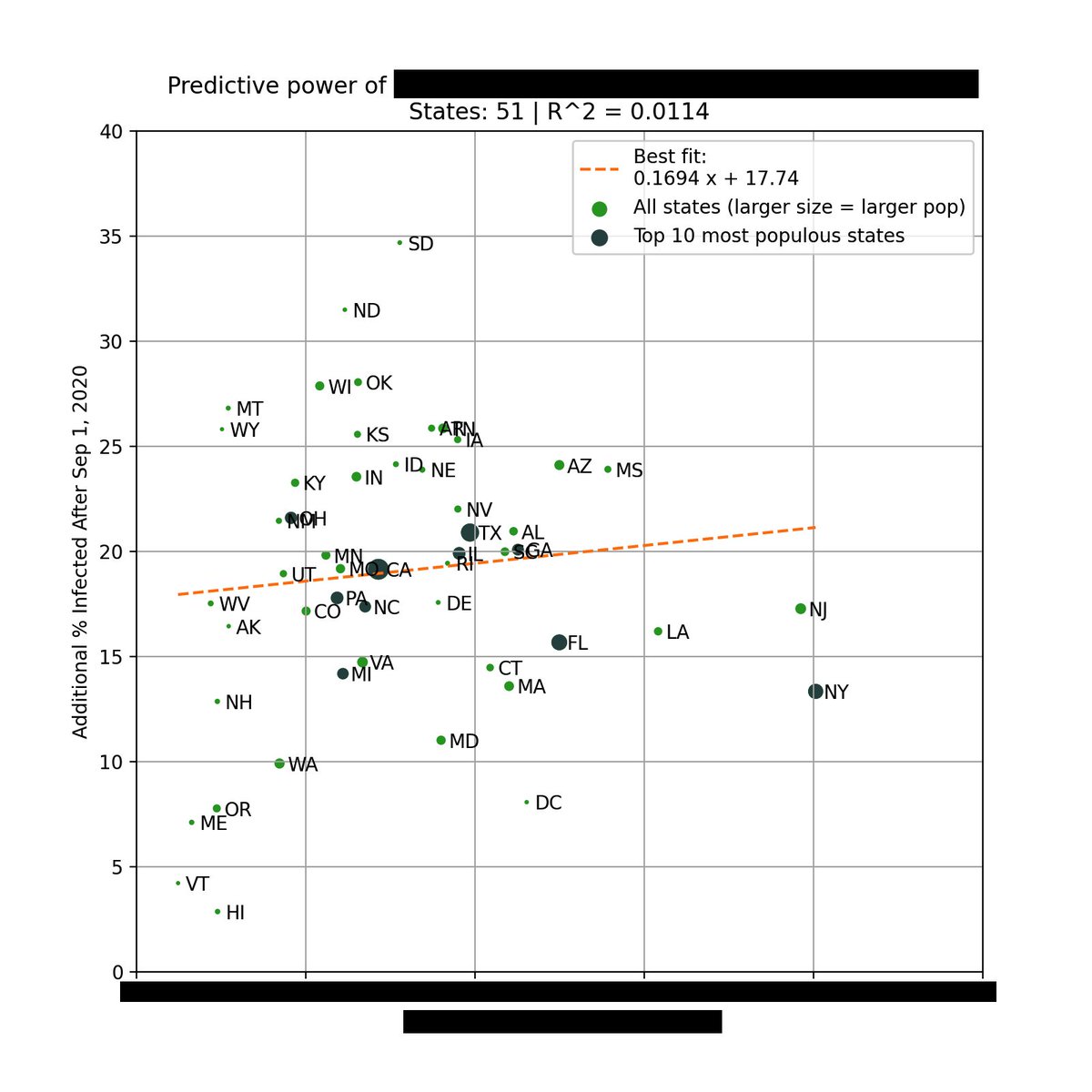
The left plot is based on the % infected through Sep 1, 2020. You can see that there is very little correlation with the % infected since Sep 1.
However, there is a *strong* correlation when using the margin of Biden's victory (right).
Infections % from https://t.co/WcXlfxv3Ah.

This is the strongest single variable I've seen in being able to explain the severity of this most recent wave in each state.
Not past infections / existing immunity, population density, racial makeup, latitude / weather / humidity, etc.
But political lean.
One can argue that states that lean Democrat are more likely to implement restrictions/mandates.
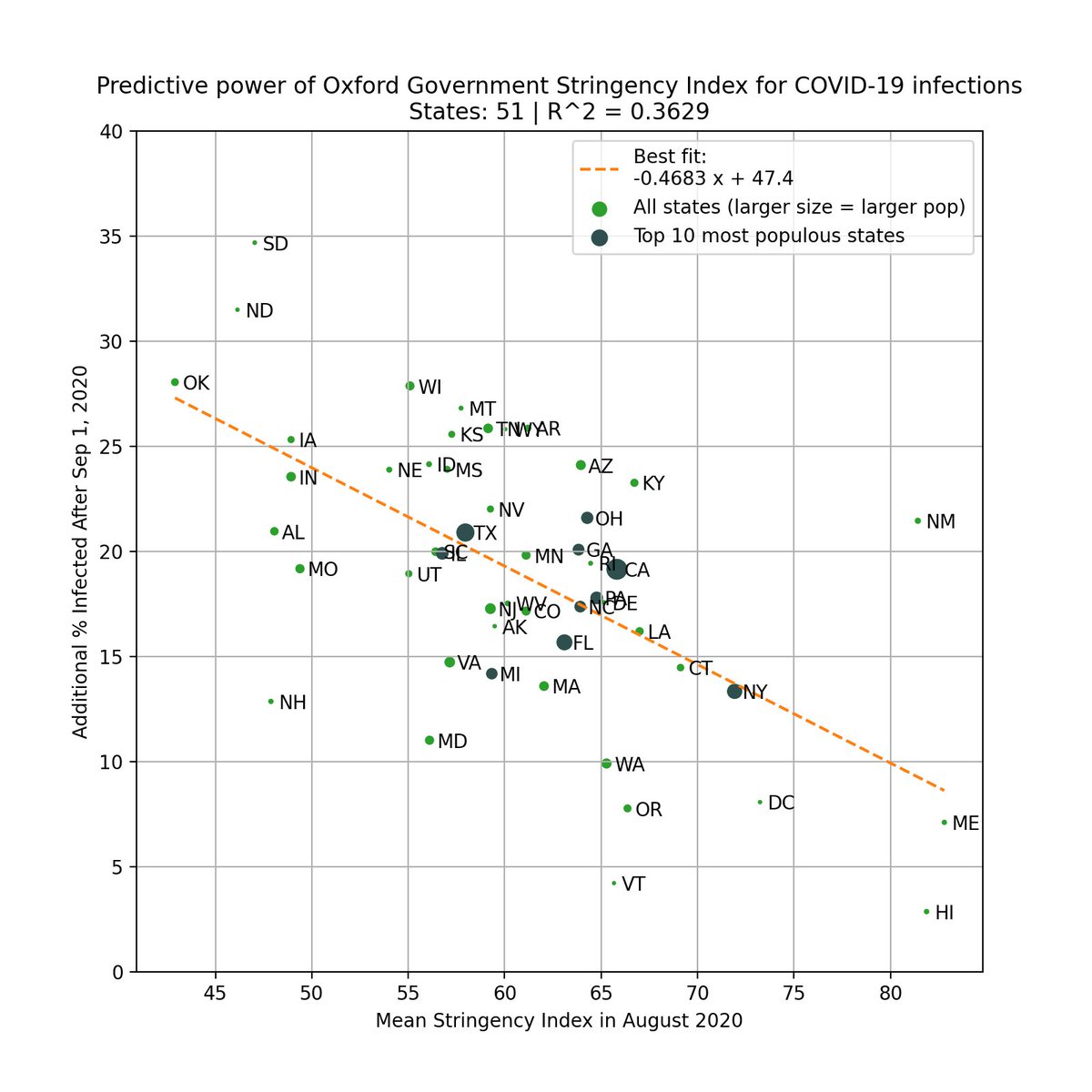
This is valid, so we test this by using the Government Stringency Index made by @UniofOxford.
We also see a correlation, but it's weaker (R^2=0.36 vs 0.50).
https://t.co/BxBBKwW6ta
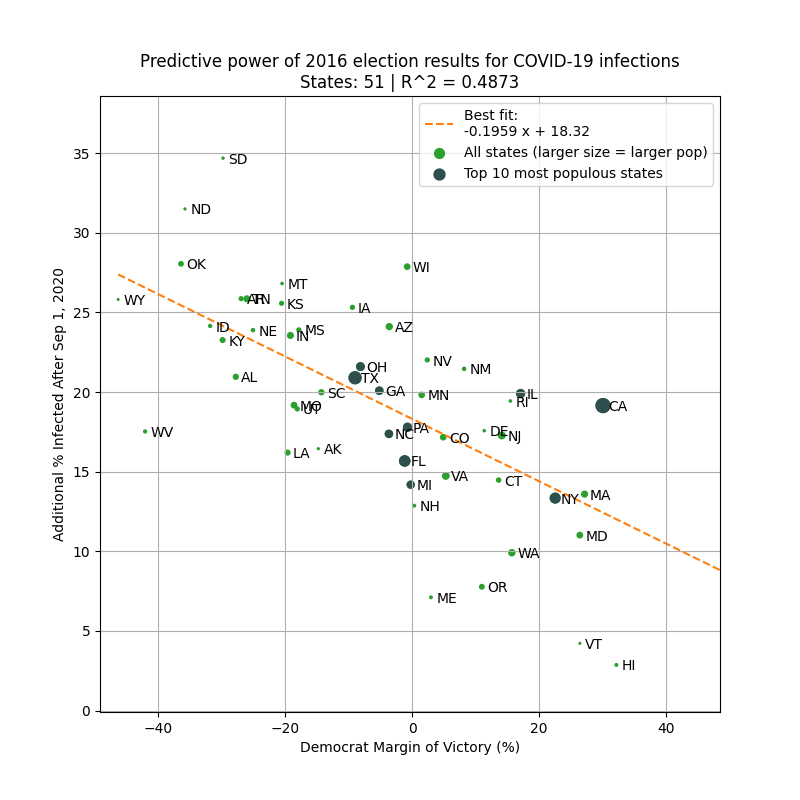
To avoid look-ahead bias/confounding variables, here is the same analysis but using 2016 margin of victory as the predictor. Similar results.
This basically says that 2016 election results is a better predictor of the severity of the fall wave than intervention levels in 2020!
1) Margin of Democrat victory in Nov 2020 election
or
2) % infected through Sep 1, 2020
Can you guess which plot is which?
The left plot is based on the % infected through Sep 1, 2020. You can see that there is very little correlation with the % infected since Sep 1.
However, there is a *strong* correlation when using the margin of Biden's victory (right).
Infections % from https://t.co/WcXlfxv3Ah.
This is the strongest single variable I've seen in being able to explain the severity of this most recent wave in each state.
Not past infections / existing immunity, population density, racial makeup, latitude / weather / humidity, etc.
But political lean.
One can argue that states that lean Democrat are more likely to implement restrictions/mandates.
This is valid, so we test this by using the Government Stringency Index made by @UniofOxford.
We also see a correlation, but it's weaker (R^2=0.36 vs 0.50).
https://t.co/BxBBKwW6ta
To avoid look-ahead bias/confounding variables, here is the same analysis but using 2016 margin of victory as the predictor. Similar results.
This basically says that 2016 election results is a better predictor of the severity of the fall wave than intervention levels in 2020!