
This is alternatively called the "fox, goose, and bag of beans" or "wolf, goat, and cabbage" puzzle.
So there's a class of puzzles called "river crossing puzzles" which involve having to cross a river on a boat/bridge containing some set of individuals/items with restrictions on which ones can be on the boat/left on each shore, right?
This is alternatively called the "fox, goose, and bag of beans" or "wolf, goat, and cabbage" puzzle.
and similarly, the goose/goat will eat the beans/cabbage if left alone
1. take the goat/goose over
2. return empty
3. take the wolf/fox over
4. return with the goat/goose
5. take the cabbage/beans over
6. return empty
7. take the goat/goose over
So it allows for endless creativity.
* wolf, sheep, cabbage
* fox, chicken, grain
* fox, goose, corn
* panther, pig, porridge
every storyteller can mix it up as they like
In "Gone Maggie Gone", Homer has to cross a river with Maggie, Santa's Little Helper, and Rat Poison That Looks Like Candy.
Come up with a big list of items you might need to boat across a river.
Either just the 3 item, 1 storage, empties allowed version, or expand it to more items by allowing more storage and varying empties.
Like you might have a puzzle where you're a farmer who has
1. a bag of beans
2. a cabbage
3. a panther
and needs to cross the river
beans aren't going to eat cabbage, cabbage isn't going to eat beans, and panthers are carnivores who aren't going to care about beans & cabbages
So, like, you could define [predator] as a tag, and it applies to wolves, foxes, and panthers.
Then you define other items (goats, chickens, geese) as [prey animals]
you can't leave a [predator] and a [prey animal] on the same shore unattended.
Lion is a [predator].
Now you automatically get functionality for the lion, without having to define how lions feel around chickens, geese, and goats.
but I just found a mistake in wikipedia. Sigh.
The six items are:
3 cannibals
3 missionaries
it's instead "cannot be outnumbered".
So cannibals will eat missionaries if at any point there's more cannibals than missionaries on a given shore.
You have three married couples, and no wife can be left alone with another husband unless her husband is also present
well, you can see that both the "Missionaries & Cannibals" and "Jealous Husbands" puzzles are not the same, mechanically, as the Fox/Goose/Beans-style A>B>C puzzle, right?
Makes sense, that game is an adventure game of puzzle minigames, of course they'd use it!
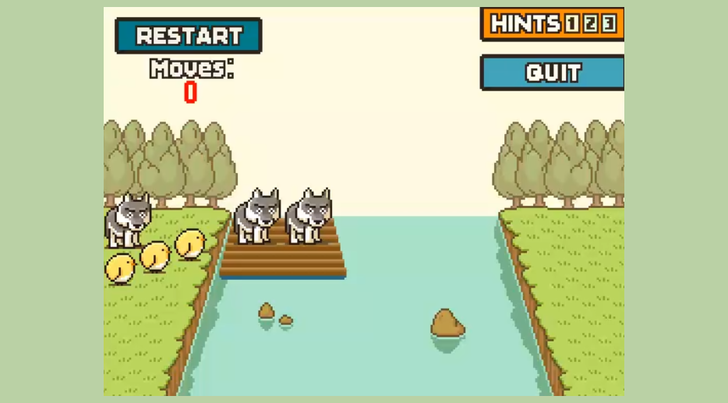
What kind is this one? ehhh...
The dog can't be left with only one cat, and you have to have more chicks than cats.
The raft holds two animals
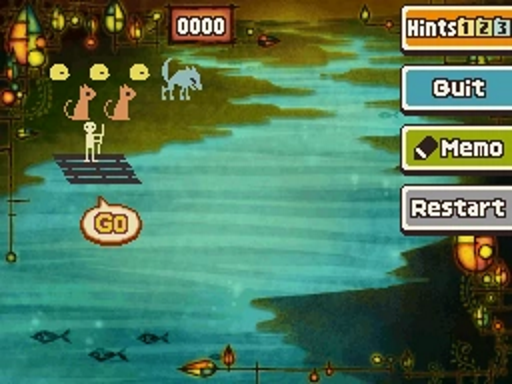
There IS another river crossing puzzle (#93) in Curious Village.
It's an A>B>C puzzle, using a Wolf, Sheep, & Cabbage.
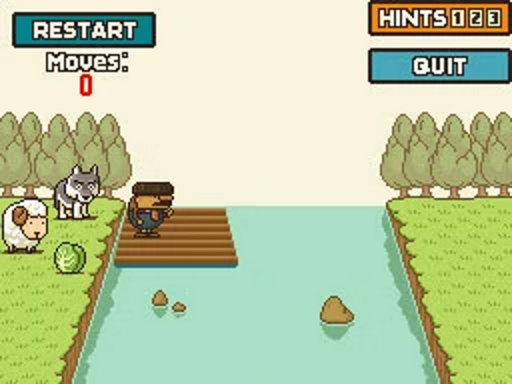
A>B>C, Missionaries & Cannibals, and Jealous Husbands.
You have four people who need to cross a bridge over a dangerous river. It's dark and if they don't have a torch, they'll fall off and drown.
The torch will burn out in 15 minutes.
They can cross it in 1 minute, 2 minutes, 5 minutes, and 8 minutes.
If two people cross together, they have to move at the speed of the slower person.
So how do you get all 4 people across?
And you can cosmetically change it up while leaving it mechanically identical.
Those versions are 1200 years old, this one is known to be at least... 39 years old.
* A,B cross, taking 2 minutes
* A returns, 1 minute
* C,D cross, taking 8 minutes
* B returns, taking 2 minutes
* A,B cross, taking 2 minutes
2+1+8+2+2: 15 minutes
and also you have to alternate trips, because the torch has to move.
More from foone













You May Also Like












Oh my Goodness!!!
I might have a panic attack due to excitement!!
Read this thread to the end...I just had an epiphany and my mind is blown. Actually, more than blown. More like OBLITERATED! This is the thing! This is the thing that will blow the entire thing out of the water!
Has this man been concealing his true identity?
Is this man a supposed 'dead' Seal Team Six soldier?
Witness protection to be kept safe until the right moment when all will be revealed?!
Who ELSE is alive that may have faked their death/gone into witness protection?

Were "golden tickets" inside the envelopes??

Are these "golden tickets" going to lead to their ultimate undoing?
Review crumbs on the board re: 'gold'.

#SEALTeam6 Trump re-tweeted this.

I might have a panic attack due to excitement!!
Read this thread to the end...I just had an epiphany and my mind is blown. Actually, more than blown. More like OBLITERATED! This is the thing! This is the thing that will blow the entire thing out of the water!
Tik Tok pic.twitter.com/8X3oMxvncP
— Scotty Mar10 (@Allenma15086871) December 29, 2020
Has this man been concealing his true identity?
Is this man a supposed 'dead' Seal Team Six soldier?
Witness protection to be kept safe until the right moment when all will be revealed?!
Who ELSE is alive that may have faked their death/gone into witness protection?
Were "golden tickets" inside the envelopes??
Are these "golden tickets" going to lead to their ultimate undoing?
Review crumbs on the board re: 'gold'.
#SEALTeam6 Trump re-tweeted this.

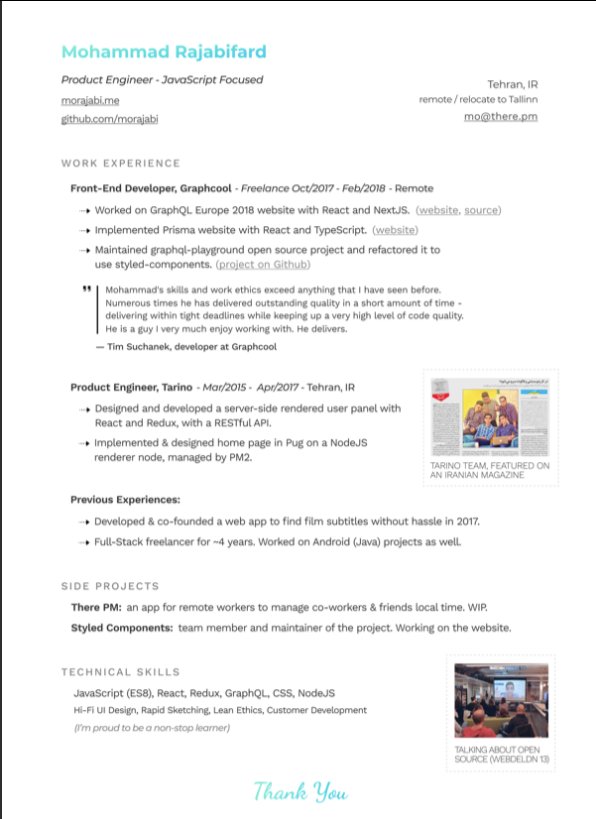
👨💻 Last resume I sent to a startup one year ago, sharing with you to get ideas:
- Forget what you don't have, make your strength bold
- Pick one work experience and explain what you did in detail w/ bullet points
- Write it towards the role you apply
- Give social proof
/thread
"But I got no work experience..."
Make a open source lib, make a small side project for yourself, do freelance work, ask friends to work with them, no friends? Find friends on Github, and Twitter.
Bonus points:
- Show you care about the company: I used the company's brand font and gradient for in the resume for my name and "Thank You" note.
- Don't list 15 things and libraries you worked with, pick the most related ones to the role you're applying.
-🙅♂️"copy cover letter"
"I got no firends, no work"
One practical way is to reach out to conferences and offer to make their website for free. But make sure to do it good. You'll get:
- a project for portfolio
- new friends
- work experience
- learnt new stuff
- new thing for Twitter bio
If you don't even have the skills yet, why not try your chance for @LambdaSchool? No? @freeCodeCamp. Still not? Pick something from here and learn https://t.co/7NPS1zbLTi
You'll feel very overwhelmed, no escape, just acknowledge it and keep pushing.
- Forget what you don't have, make your strength bold
- Pick one work experience and explain what you did in detail w/ bullet points
- Write it towards the role you apply
- Give social proof
/thread
"But I got no work experience..."
Make a open source lib, make a small side project for yourself, do freelance work, ask friends to work with them, no friends? Find friends on Github, and Twitter.
Bonus points:
- Show you care about the company: I used the company's brand font and gradient for in the resume for my name and "Thank You" note.
- Don't list 15 things and libraries you worked with, pick the most related ones to the role you're applying.
-🙅♂️"copy cover letter"
"I got no firends, no work"
One practical way is to reach out to conferences and offer to make their website for free. But make sure to do it good. You'll get:
- a project for portfolio
- new friends
- work experience
- learnt new stuff
- new thing for Twitter bio
If you don't even have the skills yet, why not try your chance for @LambdaSchool? No? @freeCodeCamp. Still not? Pick something from here and learn https://t.co/7NPS1zbLTi
You'll feel very overwhelmed, no escape, just acknowledge it and keep pushing.