The common understanding of propaganda is that it is intended to brainwash the masses. Supposedly, people get exposed to the same message repeatedly and over time come to believe in whatever nonsense authoritarians want them to believe /1

And yet authoritarians often broadcast silly, unpersuasive propaganda.

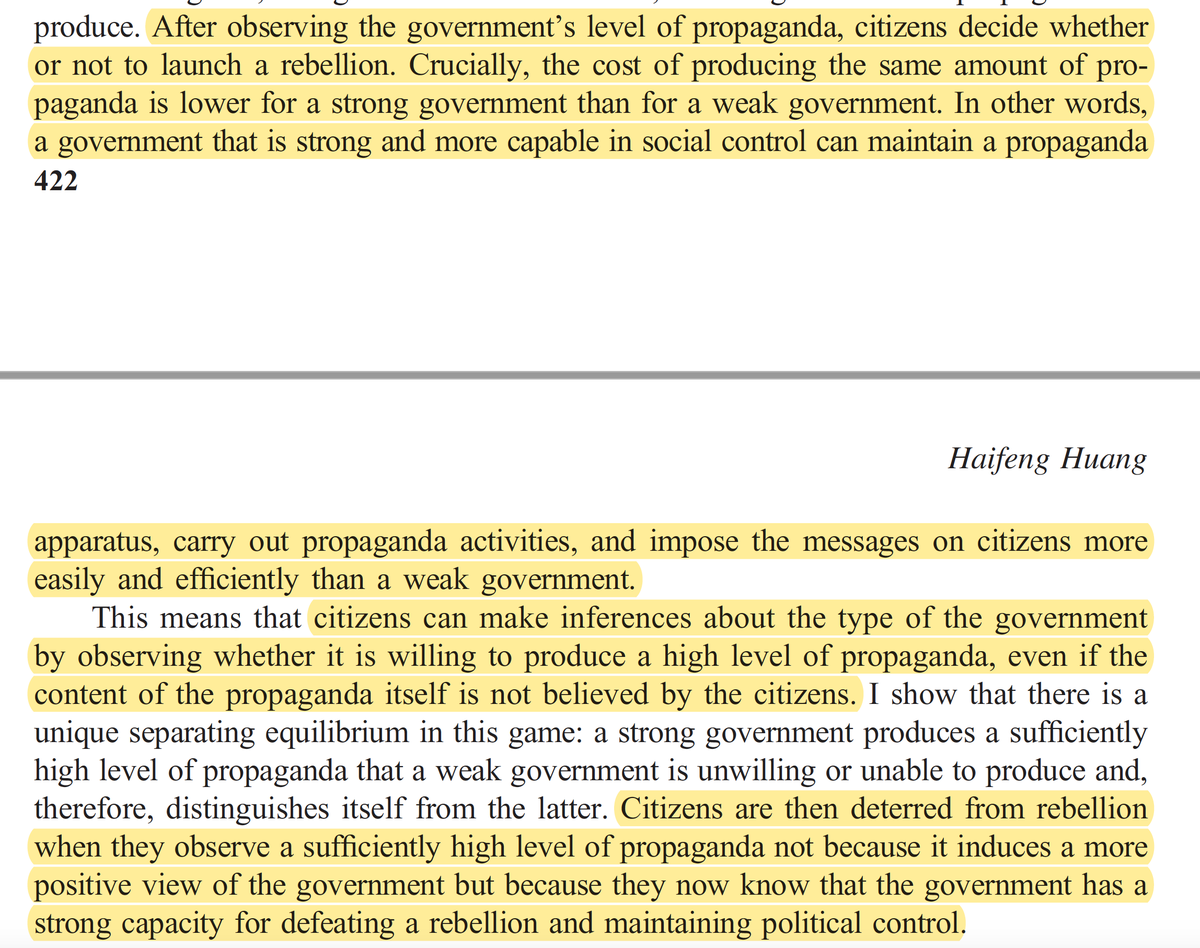
Political scientist Haifeng Huang writes that the purpose of propaganda is not to brainwash people, but to instill fear in them /2 https://t.co/KDnqnccVaQ
When people are bombarded with propaganda everywhere they look, they are reminded of the strength of the regime.

The vast amount of resources authoritarians spend to display their message in every corner of the public square is a costly demonstration of their power /3
In fact, the overt silliness of authoritarian propaganda is part of the point. Propaganda is designed to be silly so that people can instantly recognize it when they see it https://t.co/mZmY8ZvHeB
Propaganda is intended to instill fear in people, not brainwash them.

The message is: You might not believe in pro-regime values or attitudes. But we will make sure you are too frightened to do anything about it.
China’s primetime news program, Xinwen Lianbo, is stilted, archaic, and is “a constant target of mockery among ordinary citizens.”

Yet the Chinese government airs it every night at 7pm sharp. To remind citizens of the strength and reach of the communist party
The willingness of authoritarians to undertake costly endeavors to broadcast unpersuasive messages is a credible signal of just how powerful it is
Political ads work similarly. They almost never change anyone’s mind. The function of political ads, though, isn’t to persuade. It’s to “burn money” in a public way

They are costly signals of the political campaign’s willingness to expend resources. A demonstration of commitment
Prof. Huang found that Chinese citizens who were more knowledgeable about propaganda messages were not more satisfied w/the government. They weren't brainwashed

But they were less willing to express dissent and more likely to say the government was strong https://t.co/XAHwlHGl1h
The message from authoritarians is "Yes, we know this message is tiresome and obviously false. But we show this to you to tell you that helpless to do anything about it."
People are more likely to rebel against a regime when they sense that it is vulnerable. By broadcasting a consistent message repeatedly, the state broadcasts its power
A weak organization can’t produce such messages. They can’t expend the resources. A strong organization can play the same program every night on all networks. They can broadcast the same message on every website and advertisement and television series.
As Huang puts it, “citizens can make inferences about the type of government by observing whether it is willing to produce a high level of propaganda, even if the propaganda itself is not believed by citizens.” https://t.co/ZXzgT9TpGC
These official messages dictate the terms of acceptable public discourse and drive alternative ideas underground

They habituate citizens into acting “as if” they believe in the official doctrine, if for no other reason than that they do not publicly question it
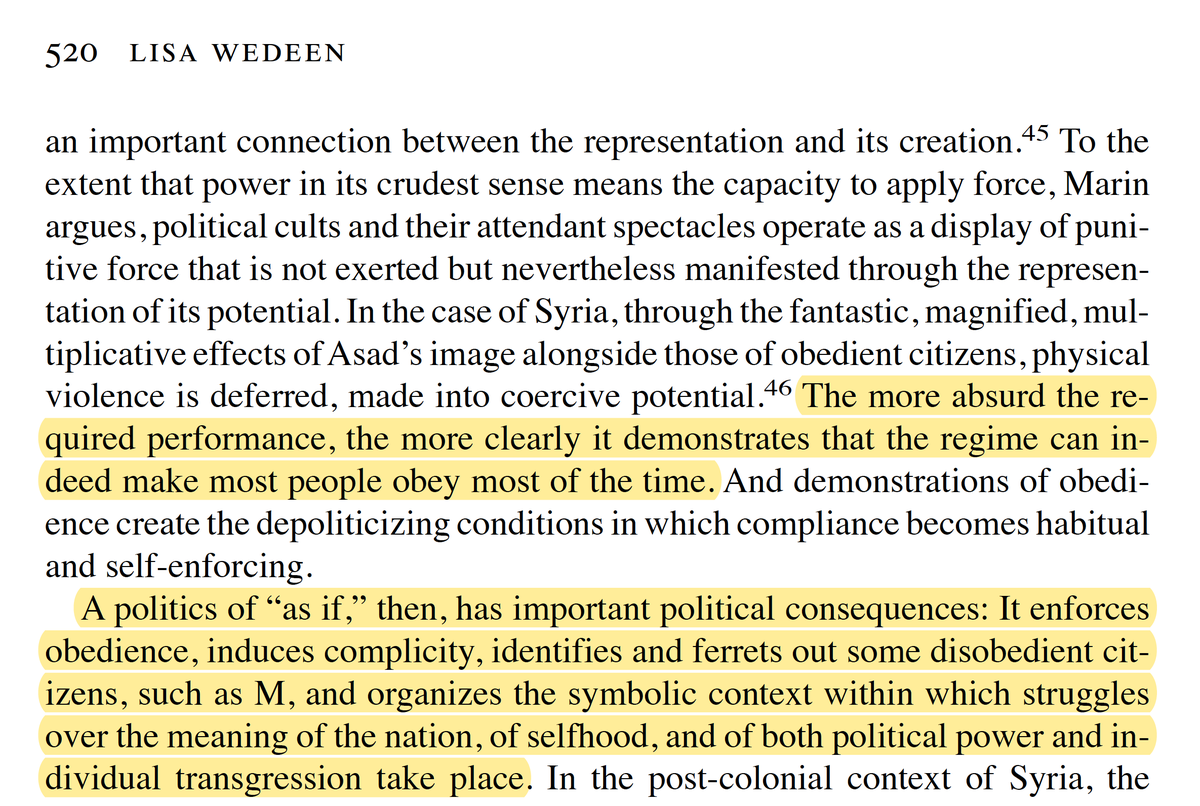
The political scientist Lisa Weeden has written why authoritarian regimes coerce their citizens to engage in preposterous rituals. "the greater the absurdity of the required performance, the more clearly it demonstrates that the regime can make most people obey most of the time.”
If a regime can make the people around you partake in absurdities, you are less likely to challenge that regime. You will be more likely to obey it.
Of course, this doesn’t mean regimes are not interested in indoctrination. They would prefer if people really did hold pro-regime attitudes and values
But the purpose of propaganda is not limited just to instilling desired beliefs.

Often, demonstrating the regime’s strength, capacity, and resources to intimidate people is a more important goal.

More from For later read

Humans inherently like the act of solidarity. We are social beings. We like to huddle up and be together.
They used this against us.
They convinced us that it was an act of solidarity to flatten the curve, to wear a mask for others, to take the vaccines for others,


and to reach #covidzero for others. They convinced us that this was for the greater good of society.
In reality, this couldn't be further away from the truth. They have divided us and broken the core structure of our society. They have dehumanized us with their masks.

They set us against each other into clans on opposite sides of a spectrum. They have turned us into aggressive beings fighting for our survival. Some of us fear harm from the virus, others fear harm from the vaccine, and yet others fear harm from the attack on our civilization.

We are all on a flight or fight mode. We are all operating under the influence of fear. We must collect ourselves and reflect on what has happened over the last year.
How is this for the greater good of society?

They used a tactical warfare strategy against us.
'Divide and conquer'.
We fell for it.
Now we must become aware of it and fight back.
We must reunite. We must find true solidarity to save our world. To free ourselves. To regain our autonomy.

You May Also Like

A THREAD ON @SarangSood

Decoded his way of analysis/logics for everyone to easily understand.

Have covered:
1. Analysis of volatility, how to foresee/signs.
2. Workbook
3. When to sell options
4. Diff category of days
5. How movement of option prices tell us what will happen

1. Keeps following volatility super closely.

Makes 7-8 different strategies to give him a sense of what's going on.

Whichever gives highest profit he trades in.


2. Theta falls when market moves.
Falls where market is headed towards not on our original position.


3. If you're an options seller then sell only when volatility is dropping, there is a high probability of you making the right trade and getting profit as a result

He believes in a market operator, if market mover sells volatility Sarang Sir joins him.


4. Theta decay vs Fall in vega

Sell when Vega is falling rather than for theta decay. You won't be trapped and higher probability of making profit.
क्या आप जानते हैं कि क्या है, पितृ पक्ष में कौवे को खाना देने के पीछे का वैज्ञानिक कारण!

श्राद्ध पक्ष में कौओं का बड़ा ही महत्व है। कहते है कौआ यम का प्रतीक है, यदि आपके हाथों दिया गया भोजन ग्रहण कर ले, तो ऐसा माना जाता है कि पितरों की कृपा आपके ऊपर है और वे आपसे ख़ुश है।


कुछ लोग कहते हैं की व्यक्ति मरकर सबसे पहले कौवे के रूप में जन्म लेता है और उसे खाना खिलाने से वह भोजन पितरों को मिलता है

शायद हम सबने अपने घर के किसी बड़े बुज़ुर्ग, किसी पंडित या ज्योतिषाचार्य से ये सुना होगा। वे अनगिनत किस्से सुनाएंगे, कहेंगे बड़े बुज़ुर्ग कह गए इसीलिए ऐसा करना

शायद ही हमें कोई इसके पीछे का वैज्ञानिक कारण बता सके।

हमारे ऋषि मुनि और पौराणिक काल में रहने वाले लोग मुर्ख नहीं थे! कभी सोचियेगा कौवों को पितृ पक्ष में खिलाई खीर हमारे पूर्वजों तक कैसे पहुंचेगी?

हमारे ऋषि मुनि विद्वान थे, वे जो बात करते या कहते थे उसके पीछे कोई न कोई वैज्ञानिक कारण छुपा होता था।

एक बहुत रोचक तथ्य है पितृ पक्ष, भादो( भाद्रपद) प्रकृति और काक के बीच।

एक बात जो कह सकते कि हम सब ने स्वतः उग आये पीपल या बरगद का पेड़/ पौधा किसी न किसी दीवार, पुरानी

इमारत, पर्वत या अट्टालिकाओं पर ज़रूर देखा होगा। देखा है न?

ज़रा सोचिये पीपल या बरगद की बीज कैसे पहुंचे होंगे वहाँ तक? इनके बीज इतने हल्के भी नहीं होते के हवा उन्हें उड़ाके ले जा सके।
First thread of the year because I have time during MCO. As requested, a thread on the gods and spirits of Malay folk religion. Some are indigenous, some are of Indian origin, some have Islamic


Before I begin, it might be worth explaining the Malay conception of the spirit world. At its deepest level, Malay religious belief is animist. All living beings and even certain objects are said to have a soul. Natural phenomena are either controlled by or personified as spirits

Although these beings had to be respected, not all of them were powerful enough to be considered gods. Offerings would be made to the spirits that had greater influence on human life. Spells and incantations would invoke their


Two known examples of such elemental spirits that had god-like status are Raja Angin (king of the wind) and Mambang Tali Arus (spirit of river currents). There were undoubtedly many more which have been lost to time

Contact with ancient India brought the influence of Hinduism and Buddhism to SEA. What we now call Hinduism similarly developed in India out of native animism and the more formal Vedic tradition. This can be seen in the multitude of sacred animals and location-specific Hindu gods