
Reality: This is false. Most human rights groups are calling for targeted measures directed solely at the military of Myanmar and companies it owns and which give revenue directly to it.
With Myanmar, it seems that some are raising questions about the efficacy of sanctions and concerns about unintended consequences. It’s time for a “Myth and Realities” guide. THREAD. #WhatsHappeningInMyanmar

Reality: This is false. Most human rights groups are calling for targeted measures directed solely at the military of Myanmar and companies it owns and which give revenue directly to it.
Reality: There are all kinds of ways to prevent unintended consequences on the broader Myanmar economy.
Reality: Sanctions are not just about assets. Sanctions imposed by the US Treasury, UK, the EU, and other jurisdictions, have extremely broad international consequences.


Reality: Myanmar economy is fundamentally different than it was under previous junta rule. Myanmar’s economic situation is not the same as it was during previous periods of junta rule.

https://t.co/CaTPrasbsu
#WhatsHappeningInMyanmar
More from For later read


Hi @EdinburghUni @EHRC @EHRCChair @KishwerFalkner @RJHilsenrath @trussliz @GEOgovuk
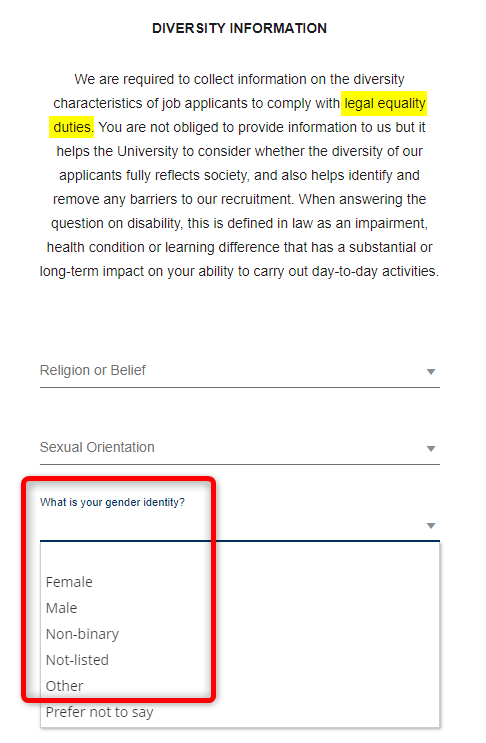
The DIVERSITY INFORMATION section in yr job application mentions 'legal equality duties'. You then ask "What is your gender identity?" with options
Female
Male
Non-binary
Not-listed
Other
1/13
'Gender identity' is not a protected characteristic under the Equality Act 2010 and is not defined in the Act.
https://t.co/qisFhCiV1u
2/13
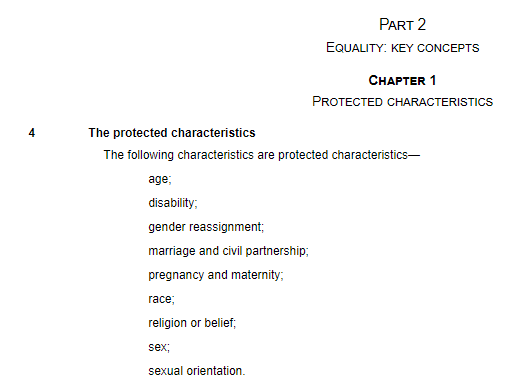
Sex is the protected characteristic and the only two possible options for sex are 'Female' and 'Male' as defined in the Act and consistent with biology - 'non-binary' and 'other' are not valid options.
https://t.co/CEJ0gkr6nF
'Gender identity' is not a synonym for sex.
3/13

You then ask "Does your gender identity match your sex registered at birth?"
4/13
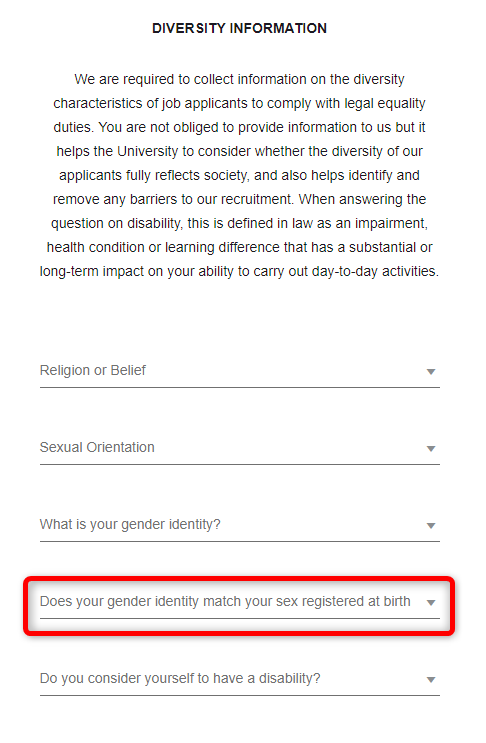
Again, 'gender identity' is not a protected characteristic under the Equality Act 2010 and is not defined in the Act.
https://t.co/qisFhCiV1u
5/13
The DIVERSITY INFORMATION section in yr job application mentions 'legal equality duties'. You then ask "What is your gender identity?" with options
Female
Male
Non-binary
Not-listed
Other
1/13
'Gender identity' is not a protected characteristic under the Equality Act 2010 and is not defined in the Act.
https://t.co/qisFhCiV1u
2/13
Sex is the protected characteristic and the only two possible options for sex are 'Female' and 'Male' as defined in the Act and consistent with biology - 'non-binary' and 'other' are not valid options.
https://t.co/CEJ0gkr6nF
'Gender identity' is not a synonym for sex.
3/13
You then ask "Does your gender identity match your sex registered at birth?"
4/13
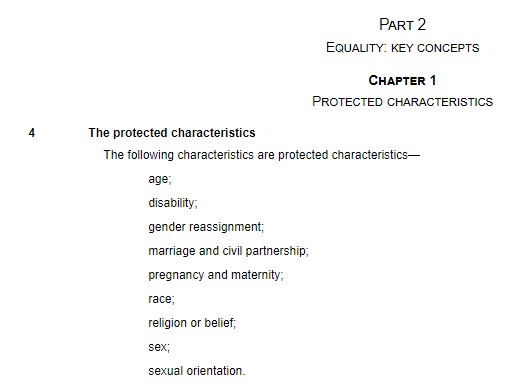
Again, 'gender identity' is not a protected characteristic under the Equality Act 2010 and is not defined in the Act.
https://t.co/qisFhCiV1u
5/13


You May Also Like








Trading view scanner process -
1 - open trading view in your browser and select stock scanner in left corner down side .
2 - touch the percentage% gain change ( and u can see higest gainer of today)
3. Then, start with 6% gainer to 20% gainer and look charts of everyone in daily Timeframe . (For fno selection u can choose 1% to 4% )
4. Then manually select the stocks which are going to give all time high BO or 52 high BO or already given.
5. U can also select those stocks which are going to give range breakout or already given range BO
6 . If in 15 min chart📊 any stock sustaing near BO zone or after BO then select it on your watchlist
7 . Now next day if any stock show momentum u can take trade in it with RM
This looks very easy & simple but,
U will amazed to see it's result if you follow proper risk management.
I did 4x my capital by trading in only momentum stocks.
I will keep sharing such learning thread 🧵 for you 🙏💞🙏
Keep learning / keep sharing 🙏
@AdityaTodmal
1 - open trading view in your browser and select stock scanner in left corner down side .
2 - touch the percentage% gain change ( and u can see higest gainer of today)
Making thread \U0001f9f5 on trading view scanner by which you can select intraday and btst stocks .
— Vikrant (@Trading0secrets) October 22, 2021
In just few hours (Without any watchlist)
Some manual efforts u have to put on it.
Soon going to share the process with u whenever it will be ready .
"How's the josh?"guys \U0001f57a\U0001f3b7\U0001f483
3. Then, start with 6% gainer to 20% gainer and look charts of everyone in daily Timeframe . (For fno selection u can choose 1% to 4% )
4. Then manually select the stocks which are going to give all time high BO or 52 high BO or already given.
5. U can also select those stocks which are going to give range breakout or already given range BO
6 . If in 15 min chart📊 any stock sustaing near BO zone or after BO then select it on your watchlist
7 . Now next day if any stock show momentum u can take trade in it with RM
This looks very easy & simple but,
U will amazed to see it's result if you follow proper risk management.
I did 4x my capital by trading in only momentum stocks.
I will keep sharing such learning thread 🧵 for you 🙏💞🙏
Keep learning / keep sharing 🙏
@AdityaTodmal

Took me 5 years to get the best Chartink scanners for Stock Market, but you’ll get it in 5 mminutes here ⏰
Do Share the above tweet 👆
These are going to be very simple yet effective pure price action based scanners, no fancy indicators nothing - hope you liked it.
https://t.co/JU0MJIbpRV
52 Week High
One of the classic scanners very you will get strong stocks to Bet on.
https://t.co/V69th0jwBr
Hourly Breakout
This scanner will give you short term bet breakouts like hourly or 2Hr breakout
Volume shocker
Volume spurt in a stock with massive X times
Do Share the above tweet 👆
These are going to be very simple yet effective pure price action based scanners, no fancy indicators nothing - hope you liked it.
https://t.co/JU0MJIbpRV
52 Week High
One of the classic scanners very you will get strong stocks to Bet on.
https://t.co/V69th0jwBr
Hourly Breakout
This scanner will give you short term bet breakouts like hourly or 2Hr breakout
Volume shocker
Volume spurt in a stock with massive X times


